

Fractional SEO Consultant vs Agency vs In-House: An Honest Comparison
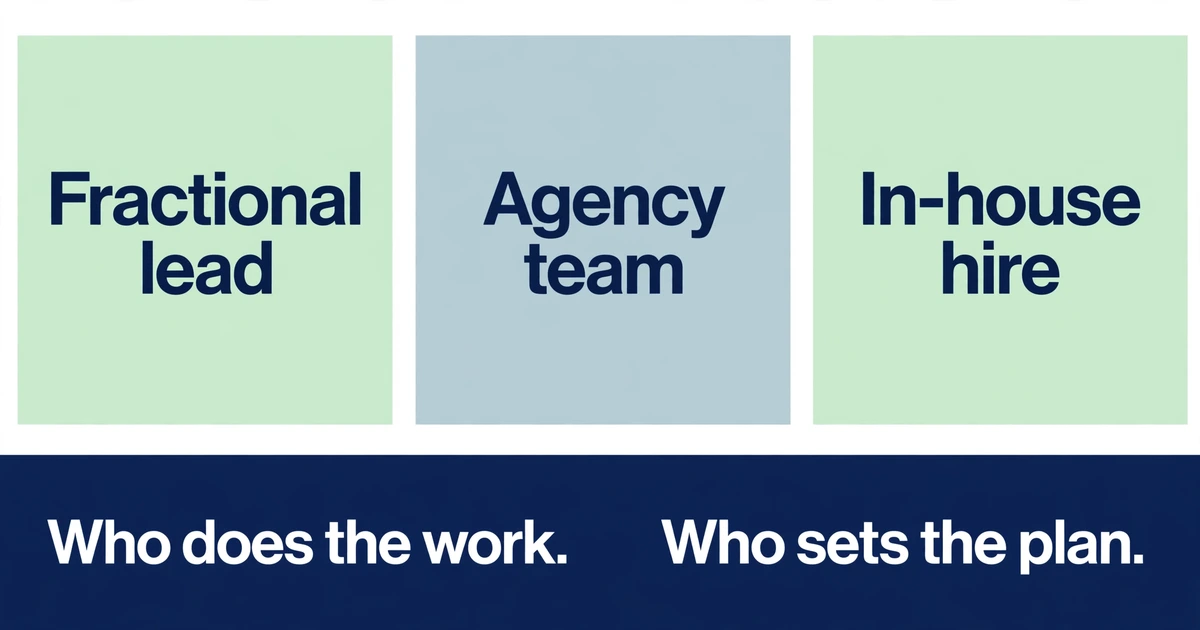
A fractional SEO consultant vs agency choice turns on who does the work, not on the headline fee alone. A fractional lead sets direction part time, an agency team produces work, and an in-house hire works inside the business. This guide compares all three models on work, cost, speed, reporting, contracts, and exit terms.
You need the full picture before you sign a retainer or hire a person.
Fractional SEO Consultant vs Agency: The Short Answer
When writers and developers are ready to ship work, but no senior person is setting the direction, a fractional lead fits.
When no team inside the business can produce the work at volume, an agency fits.
An in-house hire fits work that needs a person inside the business each day, with volume that lasts.
What a Fractional SEO Consultant Is
For a set share of each month, a company can bring in a senior SEO lead on a fractional basis. The lead stays with the company over several months. In that time, the lead chooses the direction of the SEO program and guides the staff who carry the work out.
Other names include fractional head of SEO and fractional SEO director. The person usually works part time, is legally a contractor, and serves more than one employer.
Some sources describe the lead as hands off for most writing, building, and outreach. Other sources say a fractional lead can apply edits directly, such as title tags and internal links. The split varies by person and contract, so get the work split in writing before you sign.
Imran Ali has spent 5+ years from 2021 managing his own-funded, in-house digital assets. He tests strategies with his own capital before applying them for clients.
What an SEO Agency Is
With an agency, the buyer pays for a team to carry out the work, and the retainer covers strategy too. That team usually brings together a strategist, writers, a technical specialist, and help with outreach.
In a B2B SaaS decision guide, the team named for an agency covers account management, link building, content, and technical SEO work.
In one practitioner’s account, a strong agency brings lessons learned across dozens of accounts and spare staff to cover gaps. The same account warns that the senior people who present the proposal may not stay on the account once the contract starts.
In the SE Ranking survey of 260 agencies, mostly small and local, 93 percent also sold other marketing services with SEO. Only 7 percent specialized solely in SEO, so check retainer coverage.
What an In-House SEO Hire Is
An in-house SEO hire is a full-time employee inside the business. In one hiring table, a full-time model means 40 hours a week for one employer.
After six months in the role, a practitioner says, the hire can shape sprint planning and earn trust. The gain claimed for that time is closer ties to engineering, deeper product knowledge, and insight into editorial work.
In one practitioner’s opinion, working for a single employer for years can leave judgment tied to one set of problems.
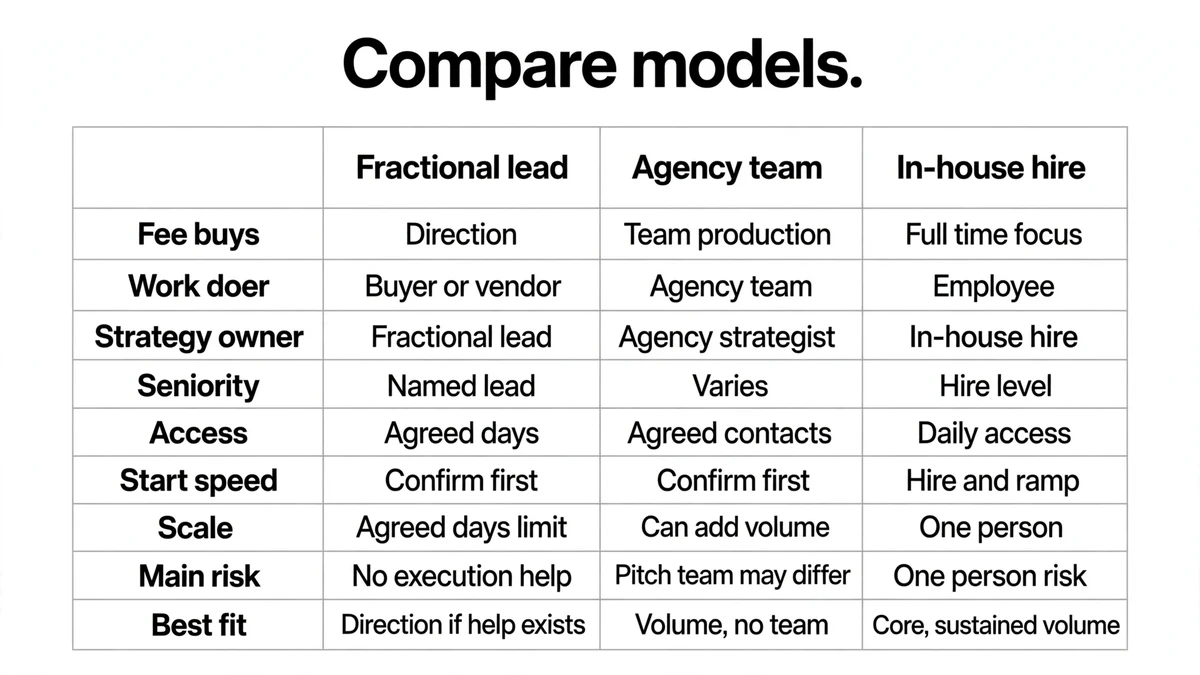
Side-by-Side Comparison: Fractional, Agency and In-House
Each cell in the table states one short summary for quick reading.
| Aspect | Fractional lead | Agency | In-house hire |
|---|---|---|---|
| Fee buys | Direction | Team production | Full time focus |
| Work doer | Buyer or vendor | Agency team | Employee |
| Strategy owner | Fractional lead | Agency strategist | In-house hire |
| Seniority | Named lead | Varies | Hire level |
| Access | Agreed days | Agreed contacts | Daily access |
| Start speed | Confirm first | Confirm first | Hire and ramp |
| Scale | Agreed days limit | Can add volume | One person |
| Main risk | No execution help | Pitch team may differ | One person risk |
| Best fit | Direction if help exists | Volume, no team | Core, sustained volume |
Who Actually Does the Work
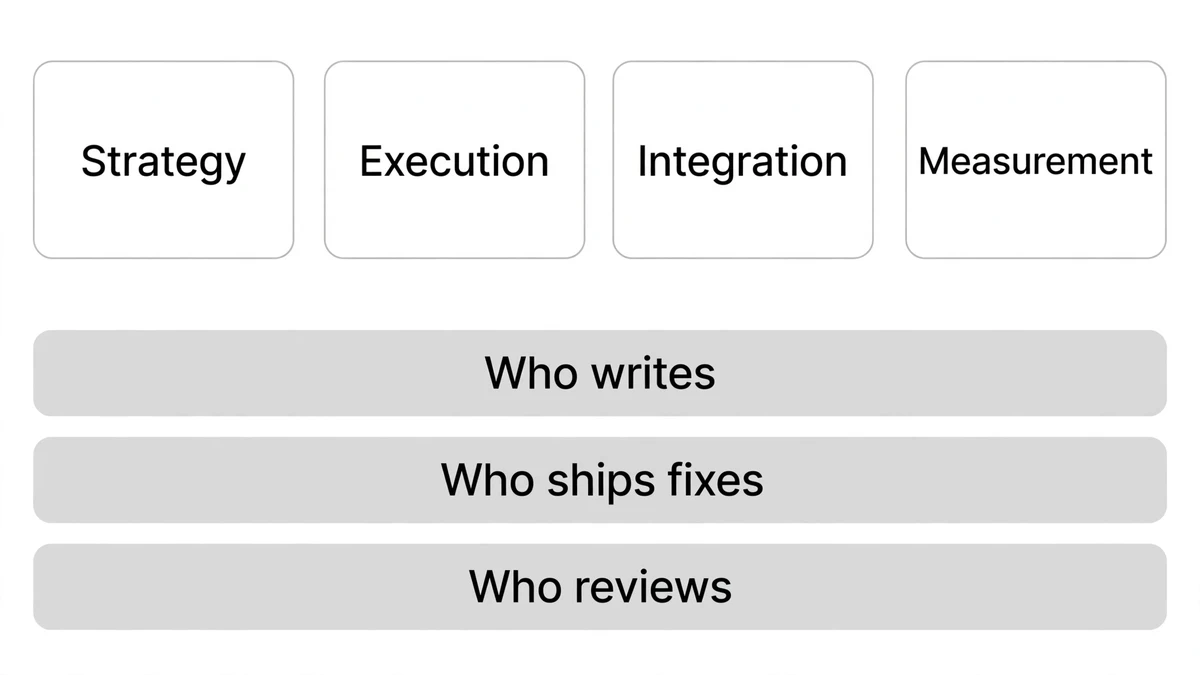
In one practitioner’s framing, SEO covers four kinds of work. They are setting direction, carrying work out, joining it up inside the business, and measuring results.
A fractional lead checks the site, ranks the priorities, keeps the plan current, and prepares briefs for writers.
Google lists content, technical advice, keyword research, training, and generative AI work as SEO services. Technical advice can cover hosting, redirects, error pages, and JavaScript use.
Facebook and Google Ads skills are fundamentals only, and ads work is not core SEO scope.
| Task | Fractional lead | Agency | In-house hire |
|---|---|---|---|
| Content | Briefs and reviews | Writers produce | Writes or briefs |
| Technical fixes | Tickets, checks | Specialist works | Employee works |
| Internal links | Directs structure | Team applies | Employee applies |
| Outreach | Directs outreach | Outreach team works | Employee or vendor |
Seniority and Access: Who You Really Get
Ask who sold the deal and who will do the work, since the two people can differ. No survey found measures how often the seller differs from the delivery team.
White-label delivery is sold openly, so ask if work is subcontracted. No source found gives the share of agencies that outsource work. Fractional time varies widely, from a few hours a month to half time in the offers found.
In his own account, one practitioner puts his load at three or four programs running together. On its own page, another provider caps the roster at six clients, with one client in each sector.
Ask how many other clients a lead serves and what cover exists during absence.
Ask every provider the same AI search questions, since no survey measures AI skill by model. Ask which buyer questions are tracked and how often the business appears in AI answers.
Ask what proof can be shown and whether advice follows Google official guidance on generative AI. Check the query fan-out guide for coverage of sub questions.
Cost Context in the Market
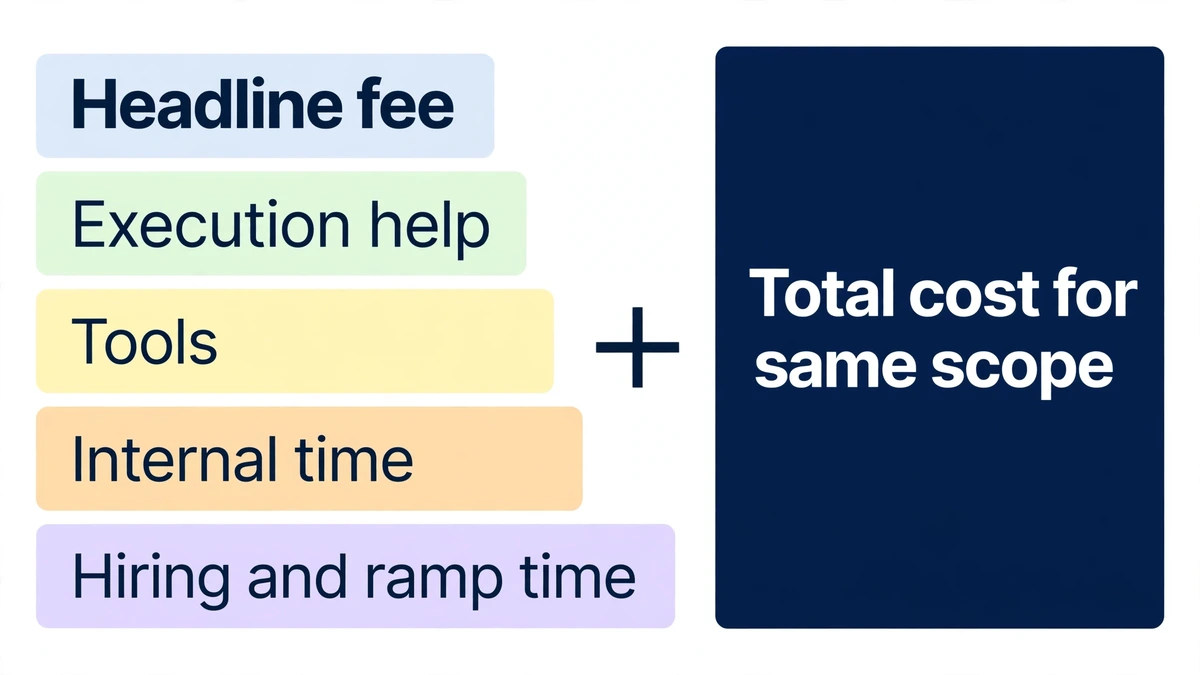
Compare total cost for a defined scope, not the headline fee alone. Surveys below and the SEO consultant cost guide and retainer pricing guide report provider charges, not your price.
Ahrefs polled 439 SEO providers and used the upper end of each price band. It reports average monthly retainers of 3,209 dollars for agencies and 3,250 dollars for consultancies. The survey date is not stated, and upper-end use pushes averages up.
SE Ranking surveyed 260 agencies, mostly small, with a sample that skews small. The survey was published 13 December 2024 and updated 23 February 2026. 64 percent charged below 1,000 dollars a month, with 30 percent below 500 dollars.
GoodFirms surveyed more than 300 agency professionals in April to May 2026, with 48.0 percent at 1,500 to 5,000 dollars a month.
The surveys ask different providers, so the figures differ: Ahrefs mixes global providers, while SE Ranking leans to small and local agencies. GoodFirms surveyed a broader mix of agency professionals in 2026. Judge a quote on scope, hours, region, and what is included, not on the headline fee alone.
No survey reports fractional leads separately, so published offers are individual prices only. LoudFace put most leadership-only offers between 1,999 and 9,999 dollars a month. That summary came from a small checked set read on 29 October 2026.
Baba SEO lists its own price from 7,500 euros a month, depending on scope and days per week. The engagement runs nine months, from 67,500 euros in total, for B2B SaaS scaleups.
For in-house cost, SE Ranking found in 2025 a global median salary of 51,680 dollars for SEO specialists. The survey had 279 responses, which is a modest sample.
For private industry workers in the United States, benefit costs were 29.9 percent of total compensation in December 2025 data. That share is an aggregate figure, not an SEO figure, and it excludes tools, recruiting fees, and management time.
Reported SHRM data put average recruiting cost at 5,475 dollars for nonexecutive roles. The median recruiting cost in the same survey was 1,200 dollars.
That figure covers recruiting costs only, not salary, benefits, or training, and it is not an SEO-specific cost. Parts come from different samples, so do not add them into one total.
Tool list prices reported in November 2026 were 129 dollars a month for Ahrefs Lite and 139 dollars for Semrush SEO.
GoodFirms lists link building at 500 to 3,000 dollars or more a month as a published typical extra, not a measured average. Ask whether it is included or extra in any quote.
Speed and Ramp Time
Google says some changes take a few hours and others take several months to show. Google also says to wait a few weeks to assess work effects.
Maile Ohye, a Google staff member, said this in a 2017 video. In most cases, SEOs need four months to a year to first implement improvements and then see potential benefit. Treat that remark as old spoken advice, not current written guidance and not a promise.
Baba SEO claims fractional work can produce work in week 1, with strategy by month 1. SEO GrowUp claims agency traction in 4 to 6 months for B2B SaaS only, also without a survey.
Reported SHRM data put median time to fill at 39 calendar days for nonexecutive roles in 2026. That measure ends at offer acceptance and excludes notice and ramp time.
Use shipped work and sound priorities to judge the early months, rather than rankings or pipeline alone. No one can guarantee a number one ranking on Google, in Google’s own warning.
Accountability and Reporting
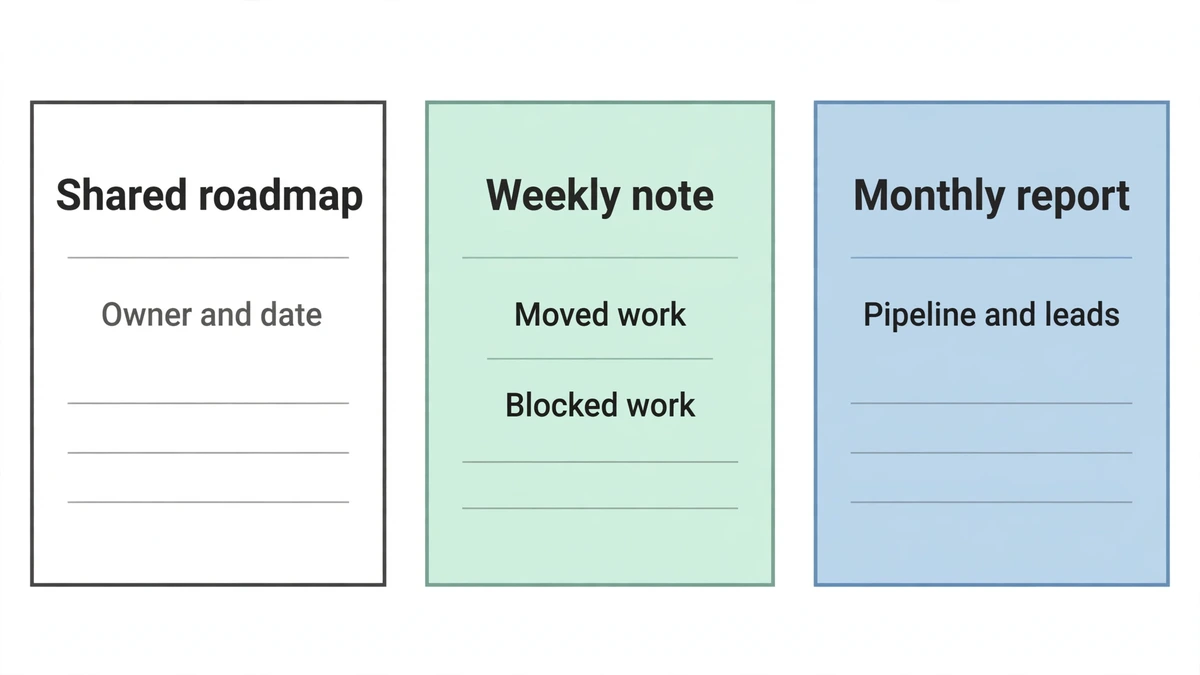
One guide recommends a short weekly note that names a single item that moved and a single item that is blocked. The same guide recommends one shared plan where every item carries a named owner and a date. The monthly report should connect work with results, rather than listing traffic alone.
Google asks providers to show past work and explain measurement. Google also asks about timeframe, communication, and whether all changes will be shared.
Scope and Limits: What Each Model Does Not Do
Providers state that a fractional lead, working alone, usually is not the source of work at volume. In those accounts, campaigns for links at scale and content at volume call for a larger team.
One practitioner argues that an outside agency has little sway over sprint planning, because it works apart from the business. In the same opinion, standard playbooks suit a complex business with a large catalog less well.
In that opinion, a single hire asked to cover everything ends up coordinating work, rather than forming a full function.
Contracts and Exit: What Happens When It Ends
This section is not legal advice, and terms vary by contract. Read the actual contract and take local legal advice where needed.
Search Console owners have full control, while full users can view all data and take some actions. A restricted user has simple view rights on most data.
Google advises read-only access for an audit, with no write access at that stage. Give the lead user access only, never owner access, and take that access away when the engagement ends.
The company name should hold the tools, and the company workspace should hold the documents.
Guides disagree on minimum terms, with one guide giving initial terms of three, six, or twelve months. Another favors terms of six to twelve months, and a third favors month-to-month terms after a short initial period.
Notice views differ, from 30 days to 60 days or 90 days in guides. Do not treat any length as the market norm, since no survey settles it.
Baba SEO designs its own nine-month engagement with exit points at month 3 and month 6. Knowledge can leave with a provider, so agree on handover documents and training in writing.
Combining Models: Fractional Lead Plus Agency or In-House Team
Paying for strategy twice is avoided with a single owner for the strategy. The lead decides the work and checks it, and the agency sends its reports to the lead and to the buyer.
For the scale stage, one practitioner describes support inside the business and a fractional advisor kept on. Agencies are brought in only for defined pieces of execution at that stage. For the enterprise stage, the same framework keeps that mix and adds specialists from agencies.
For B2B SaaS only, one provider puts a fractional lead in charge of an agency and freelancers who do the work. A fractional expert can also assess agency work and value, in one platform account. That use case does not prove combined models always work, so agree on the split first.
Decision Questions: A Checklist Before You Choose
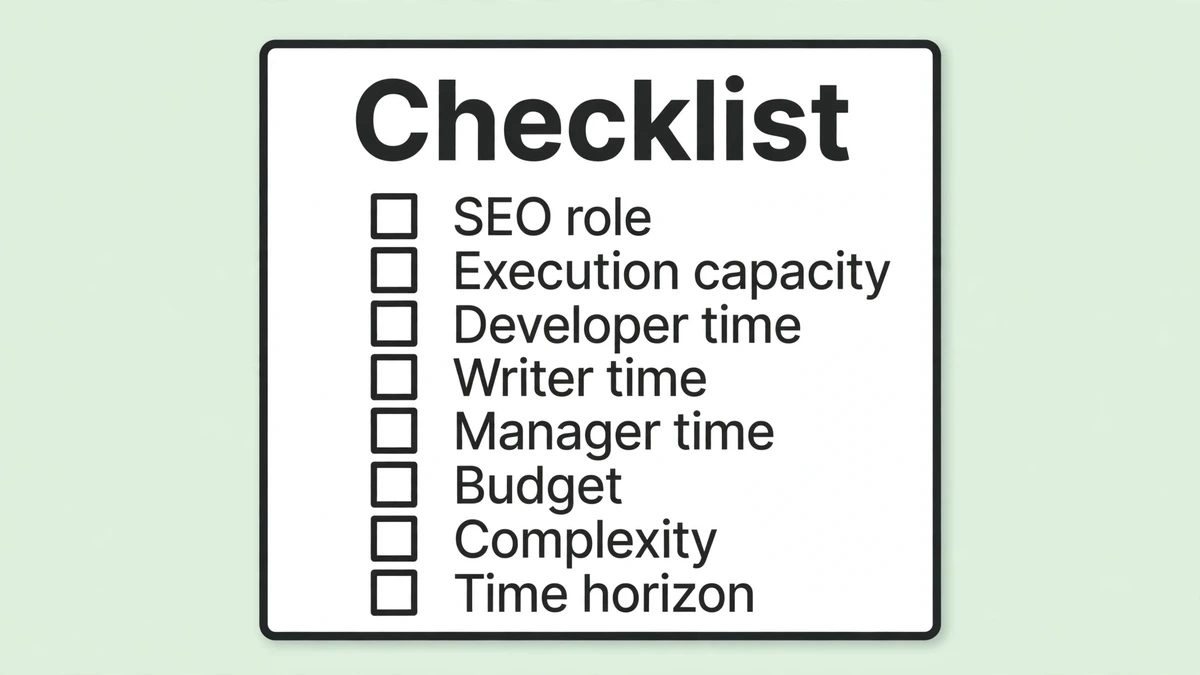
Answer these questions with your real team, time, and budget.
- SEO role: How central is search now, and in two years?
- Execution capacity: Who writes, ships fixes, and reviews work today?
- Developer time: How many developer hours can SEO use each week?
- Writer time: How many writer hours can SEO use each week?
- Management time: How much manager time can guide SEO each week?
- Sustained budget: Which monthly amount stays affordable for six to twelve months?
- Complexity: What makes the site hard, and what niche proof is on hand?
- Time horizon: How long can you wait for pipeline impact?
One SaaS guide uses thresholds that do not fit every buyer. Use the hiring questions on the how to hire guide to test each provider the same way.
Edge Cases and Honest Limits
With no internal team, a fractional lead alone can stall, since no one ships the plan.
With a very small budget, start with a paid audit on read-only access. Google says a small local business can do much work itself.
For one urgent project, such as a migration or recovery, use a defined project with a clear end. Use the Search Console compare method to check what changed before you act.
Google advises hiring early for a redesign, so the new site is built search-friendly.
Sites with many pages, several markets, or strict rules need proof from the same kind of work. Ask for content samples from the same vertical, and check who reviews facts.
When SEO is not yet proven, start small and judge shipped work before scaling spend.
When Each Model Wins
The fractional model works best with direction absent and execution capacity present. Its lead ranks priorities, checks work, and keeps the plan honest and current.
The agency model works best with volume to produce and no internal team to ship it. Its team produces work faster than a single person can.
The in-house model works best with SEO as a core revenue channel and work volume that lasts each month. In that case, daily integration and product knowledge count most.
The right model can change as the business grows, and switching models is normal. Review the choice at a set point, and move when execution, volume, or integration needs change.
FAQ
Is a fractional SEO consultant cheaper than an agency?
There is no simple yes or no, since the two fees pay for help of different kinds. Put the full cost side by side for the same scope, with execution, tools, and time counted in. Market ranges here are context only, not a quote for your project.
Can a fractional SEO consultant replace an agency completely?
Replacement is possible only where the business, or its freelancers, can carry the work out. Where writers and developer time are absent, the plan has no hands to carry it out. A lead paired with an agency can work, under one plan owner.
When should a business hire in-house instead of a fractional consultant or an agency?
Choose an in-house hire where SEO forms a core revenue channel and monthly volume lasts. The business also needs daily integration and funds for a senior hire plus support. Until then, a fractional lead or an agency can test the case.
Want help applying this to your site? Contact Imran Ali to book a free 30-minute meeting.