

How Many Articles Does a Topic Cluster Actually Need?
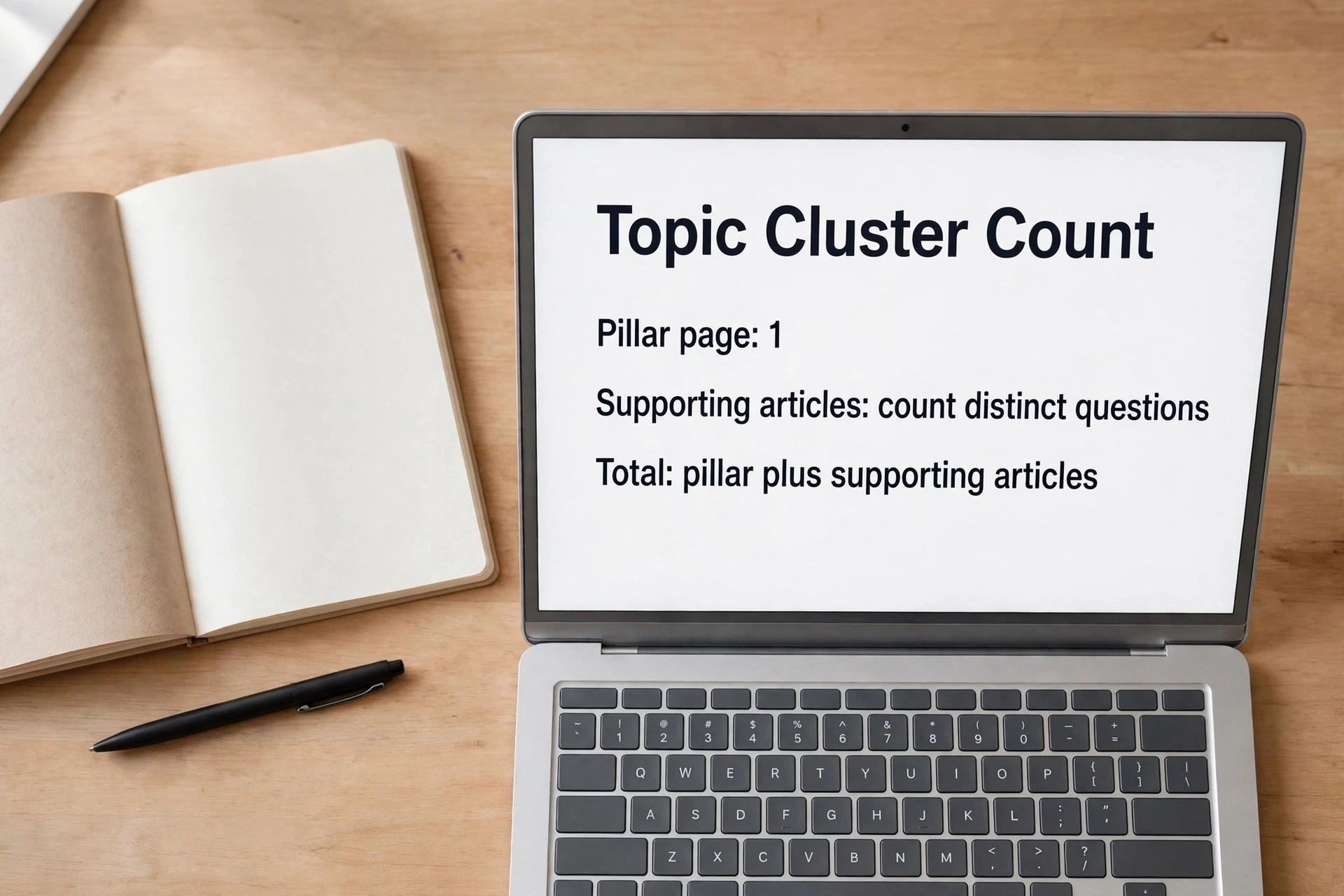
How many articles in a topic cluster you need depends on distinct questions, not on a fixed quota. A pillar page, the main overview page for one topic, is counted separately from supporting articles. Taismo, in September 2026, puts the starting set at 5 to 15 cluster articles beside one pillar page.
Rival guides disagree widely, and much of that disagreement comes from counting different things. This article gives the rule, the factors, and the count steps.
The direct answer: how many articles a topic cluster needs
Start with the counting rule, because rival totals count different things. Every total in this article means one pillar plus supporting articles.
A supporting article is one page that answers one distinct question in full. Two pages that answer the same question count as one page.
Google publishes no required page count and no authority score in the pages checked for this article. The numbers here come from rival ranges and distinct-question counts, not from Google. Taismo states plainly that there is no fixed number for a cluster.
| Source | Counting base | Planning range | What it means |
|---|---|---|---|
| Taismo, September 2026 | Pillar plus supporting | 5 to 15 | Start |
| WebPeak, November 2026 | Pillar plus supporting | 8 to 15 | Healthy start |
| TeamBench, February 2026 | Supporting only, pillar separate | 8 to 20, start 5 to 8 | Expand later |
| JMG Group, no date | Supporting only, pillar separate | 4 to 6 usually | Usual cover |
| Lyra, July 2026 | Supporting only, pillar separate | 15 to 30 | Large SaaS pipeline case |
Rival ranges differ in counting base, size, and topic.
Lyra covers a SaaS pipeline case with an automated publishing pipeline. Its page says a solo founder pipeline cannot feed more than a handful of clusters that deep.
Bulk SEO Article Generator gives 8 to 15 as its headline total. Low totals suit narrow topics, and high totals suit broad topics with large pipelines.
What counts in the number, and what does not
This rule applies to every total here, with no exceptions for examples. State your total the same way, so readers can compare without guessing.
WebPeak and Taismo describe the pillar page as answering the core question in brief and routing readers onward. Supporting articles answer one subquestion each in full and link to the pillar.
| Page type | Counts as | Example |
|---|---|---|
| Pillar page | Separate | Main overview |
| Supporting article | One article | One question |
| FAQ page | One if new | New question |
| Comparison page | One article | One choice |
| Commercial page | One article | Cost or choice |
| Category or tag page | Does not count | List only |
| Duplicate page | Does not count | Same question |
Some totals include the pillar, and some leave it out. Some mix FAQ and commercial pages in, and some leave them out.
Bulk SEO Article Generator mixes headline, support, and rule-of-thumb totals with no single rule. It states it was drafted with AI and not yet reviewed.
The factors that change the number
Six factors move the count, as judgment, not measurement.
Intent, as WebPeak groups it, means what the searcher wants, not the words they type. Same intent shares one page.
Two intents need two pages. Lyra and Taismo use one article per distinct intent.
| Factor | More articles when | Fewer articles when |
|---|---|---|
| Topic breadth | Many questions | One narrow set |
| Distinct intents | Many intents | Few intents |
| Rival depth | Deep rival cover | Clear gaps |
| Site size | Large site | Narrow start |
| Commercial depth | Cost questions exist | No cost questions |
| Pillar coverage | Core only brief | Core covered well |
A publishing quota does not change the count, and a rival total copied without a count does not either.
How to count your cluster, step by step
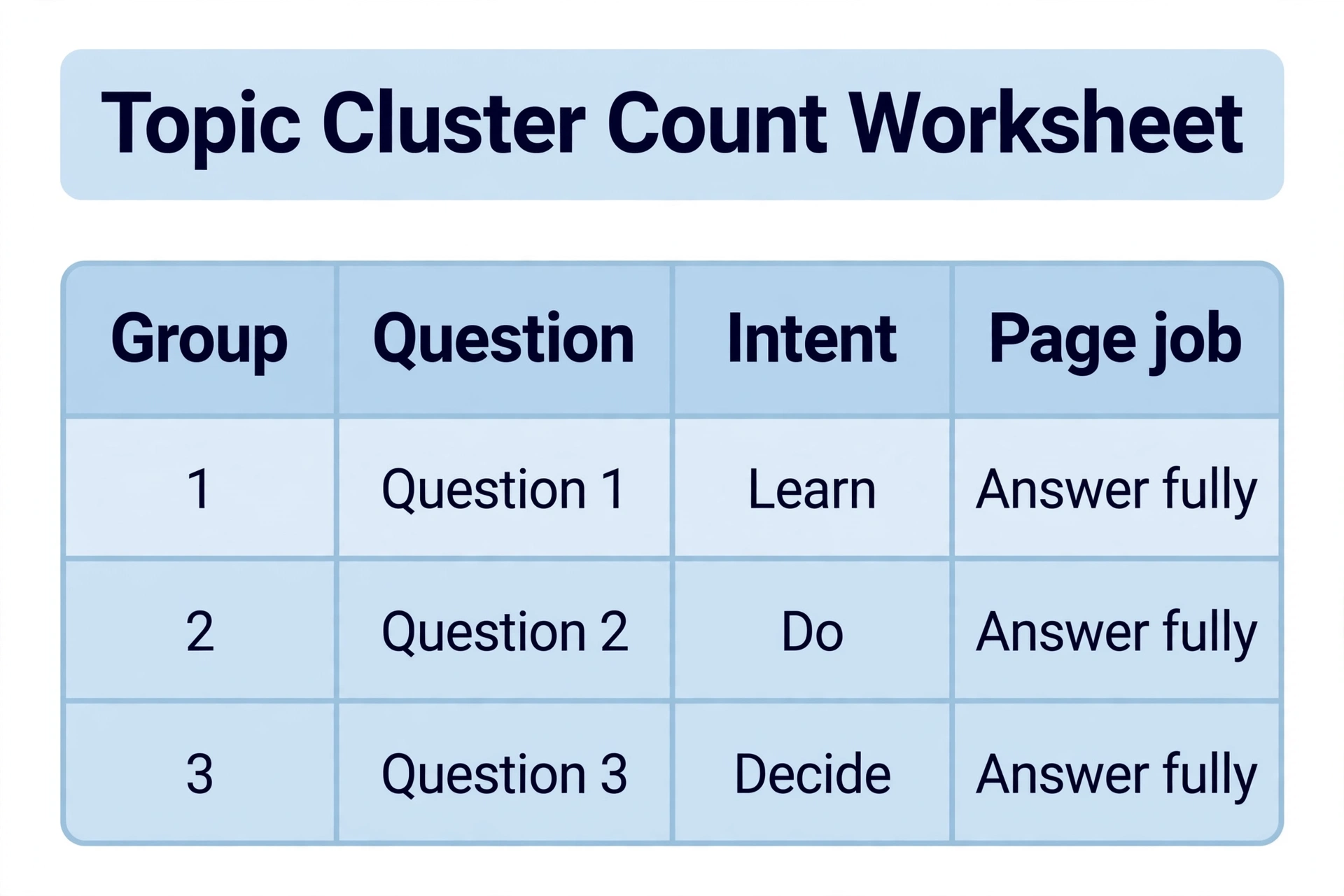
Use this method in a sheet, and allow about 15 minutes for one topic. Bulk SEO Article Generator describes a six-step process, restated here in fresh words for counting. See Topical Map Method for the full method for one topic.
- Gather questions first. Pull questions from search results, People Also Ask (related questions box), related searches, and from customers.
- Set the pillar title. Choose one plain title that names the whole topic.
- Sort by goal. Put questions that share a goal together, by the aim behind each search, not by wording.
- Cut sections that fit elsewhere. Drop a set that works better as a section inside another page.
- Count what remains. The groups left after the cut give the supporting total.
- Check overlap and record. Run the one-question test, join duplicates, and recount.
The one-question test asks whether two groups would answer one question in the same way. If yes, merge the groups, recount, and keep one owner page.
| Group | Question | Intent | Page job |
|---|---|---|---|
| 1 | Question 1 | Learn | Answer fully |
| 2 | Question 2 | Do | Answer fully |
| 3 | Question 3 | Decide | Answer fully |
The minimum viable cluster
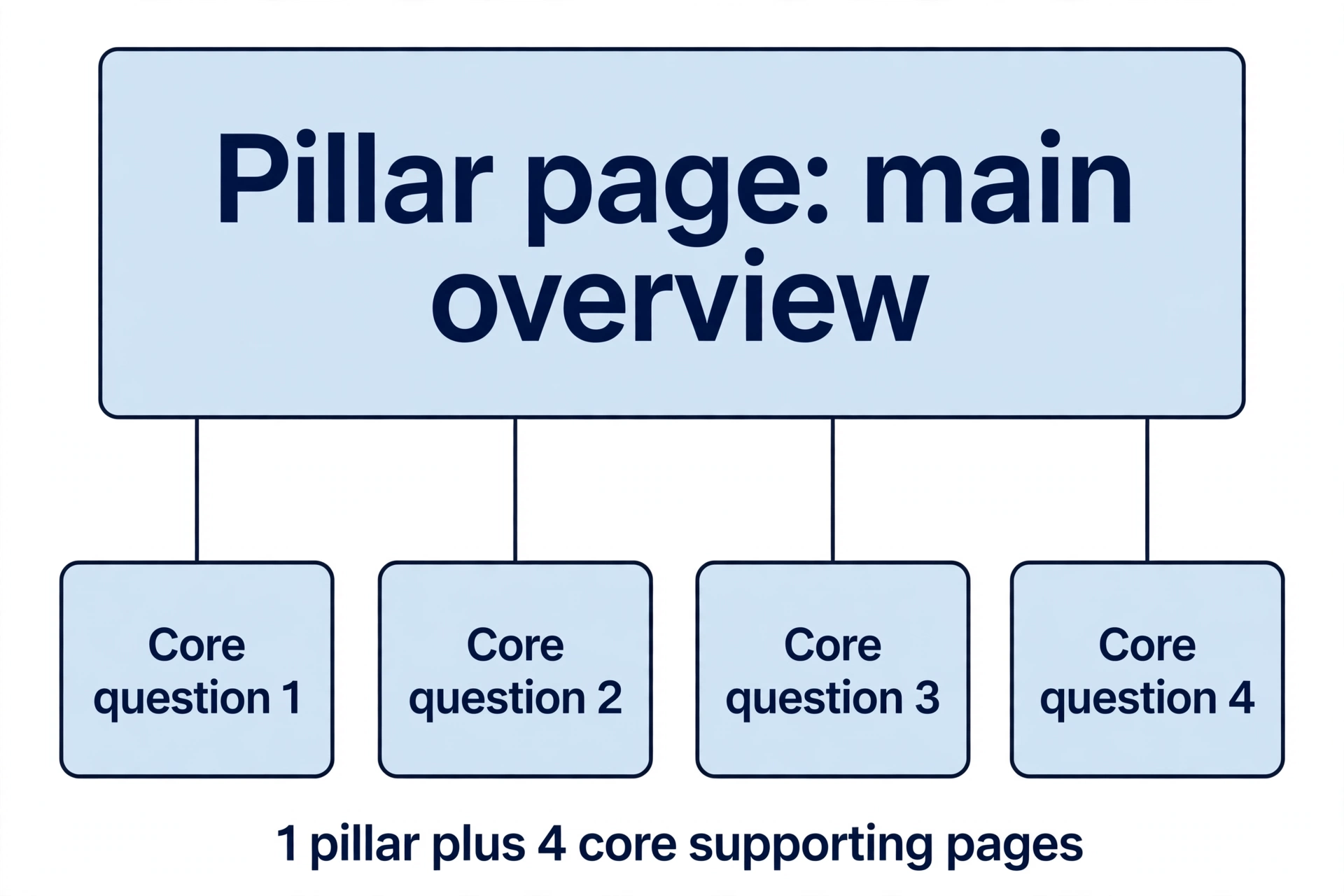
A minimum viable cluster is the smallest set that covers the core questions and gives the pillar real support. Viable means usable, and core means the questions that must be answered first.
Build one pillar page and core supporting articles, with links that tie the set together in both directions. Publish that set complete and linked, then judge expansion from evidence, not from the calendar.
- Below minimum: A pillar with one or two pages leaves core questions unanswered.
- Smaller set works: In a narrow topic, a pillar plus 3 or 4 supporting pages covers every question.
- Minimum not enough: In a topic with many intents, the minimum leaves major questions unanswered.
StriveLoom puts its minimum at one pillar plus four spoke posts, its term for supporting articles. Nahid Komol puts the range at 5 to 10 supporting articles. FinalPost AI calls 5 to 8 a good first cluster, and LaunchBuff backs building one complete cluster.
Worked examples: small, mid-sized, and large clusters
All three examples are illustrative, name no real business, and claim no result.
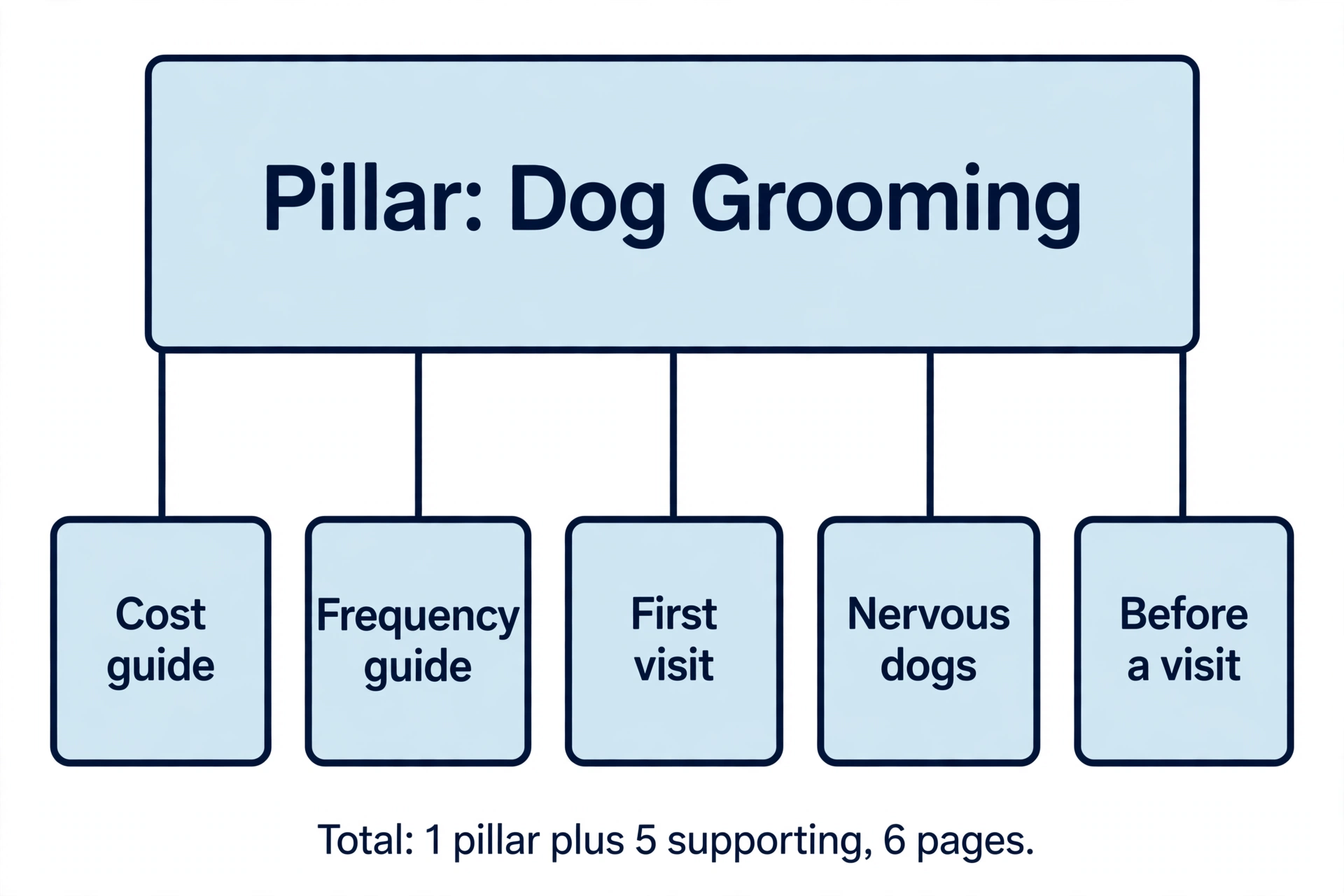
Example A: dog grooming (Illustrative)
The topic is dog grooming for one local service, with the pillar title Dog Grooming: Prices, Visits, and Choosing a Groomer.
| Page | Question | Intent |
|---|---|---|
| Cost guide | How much does grooming cost? | Cost check |
| Frequency guide | How often should a dog be groomed? | Care frequency |
| First visit | What happens on a first visit? | What to expect |
| Nervous dogs | Which groomer suits a nervous dog? | Choice |
| Before a visit | What should I do before a visit? | Preparation |
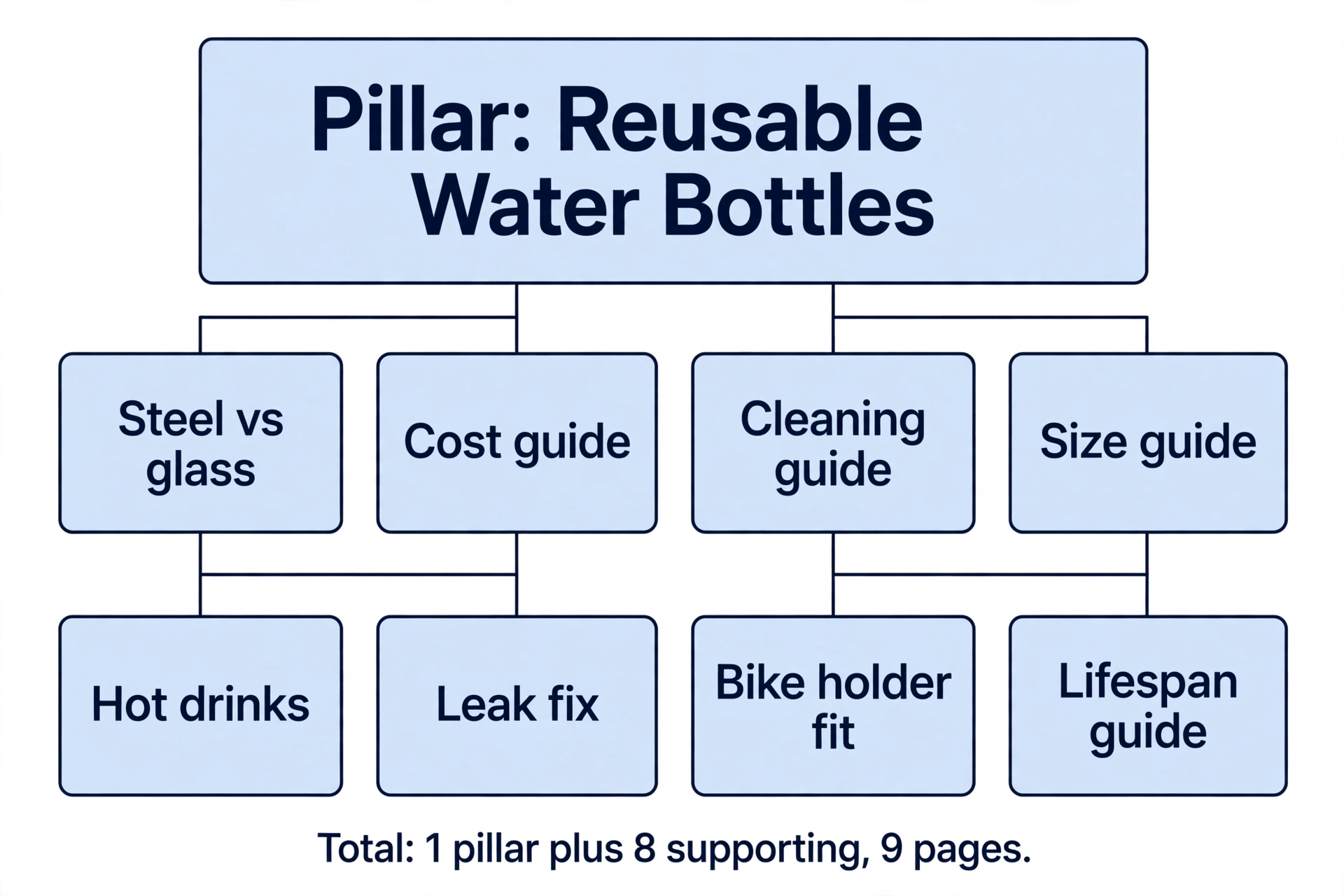
Example B: water bottles (Illustrative)
The topic is reusable water bottles for one small store. The pillar title is Reusable Water Bottles: How to Choose, Clean, and Use One.
| Page | Question | Intent |
|---|---|---|
| Steel vs glass | Steel or glass: which suits daily use? | Comparison |
| Cost guide | How much does a bottle cost? | Cost check |
| Cleaning guide | How do I clean a bottle? | Care |
| Size guide | What size should I carry? | Size choice |
| Hot drinks | Are bottles safe for hot drinks? | Safety |
| Leak fix | How do I stop leaks in a bag? | Problem fix |
| Bike holder fit | Which bottle fits a standard bike holder? | Fit |
| Lifespan guide | How long does a bottle last? | Durability |
Example C: vegetable gardening (Illustrative)
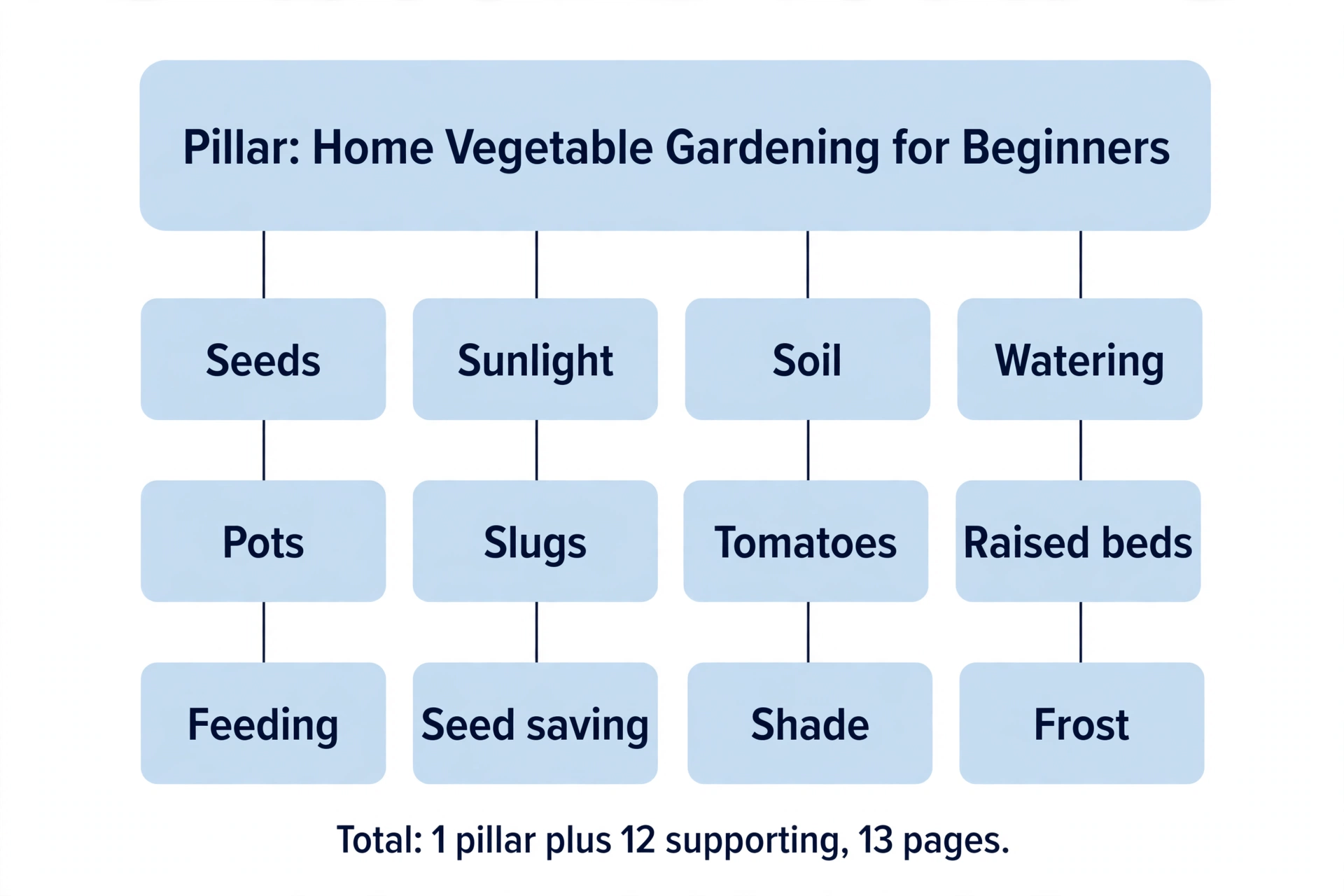
The topic is home vegetable gardening for beginners. The pillar title is Home Vegetable Gardening: Start, Grow, and Harvest.
| Page | Question | Intent |
|---|---|---|
| Seeds | When to start seeds indoors? | Timing |
| Sunlight | How much sun is needed? | Light needs |
| Soil | What soil for beginners? | Soil choice |
| Watering | How often to water? | Watering |
| Pots | Which vegetables for pots? | Container choice |
| Slugs | How to keep slugs off lettuce? | Pest problem |
| Tomatoes | When to pick tomatoes? | Harvest timing |
| Raised beds | How to plan a bed? | Bed planning |
| Feeding | What feed is needed? | Feeding |
| Seed saving | How to save seeds? | Seed saving |
| Shade | Which vegetables for shade? | Shade choice |
| Frost | How to stop frost damage? | Frost protection |
How to know when a cluster is complete
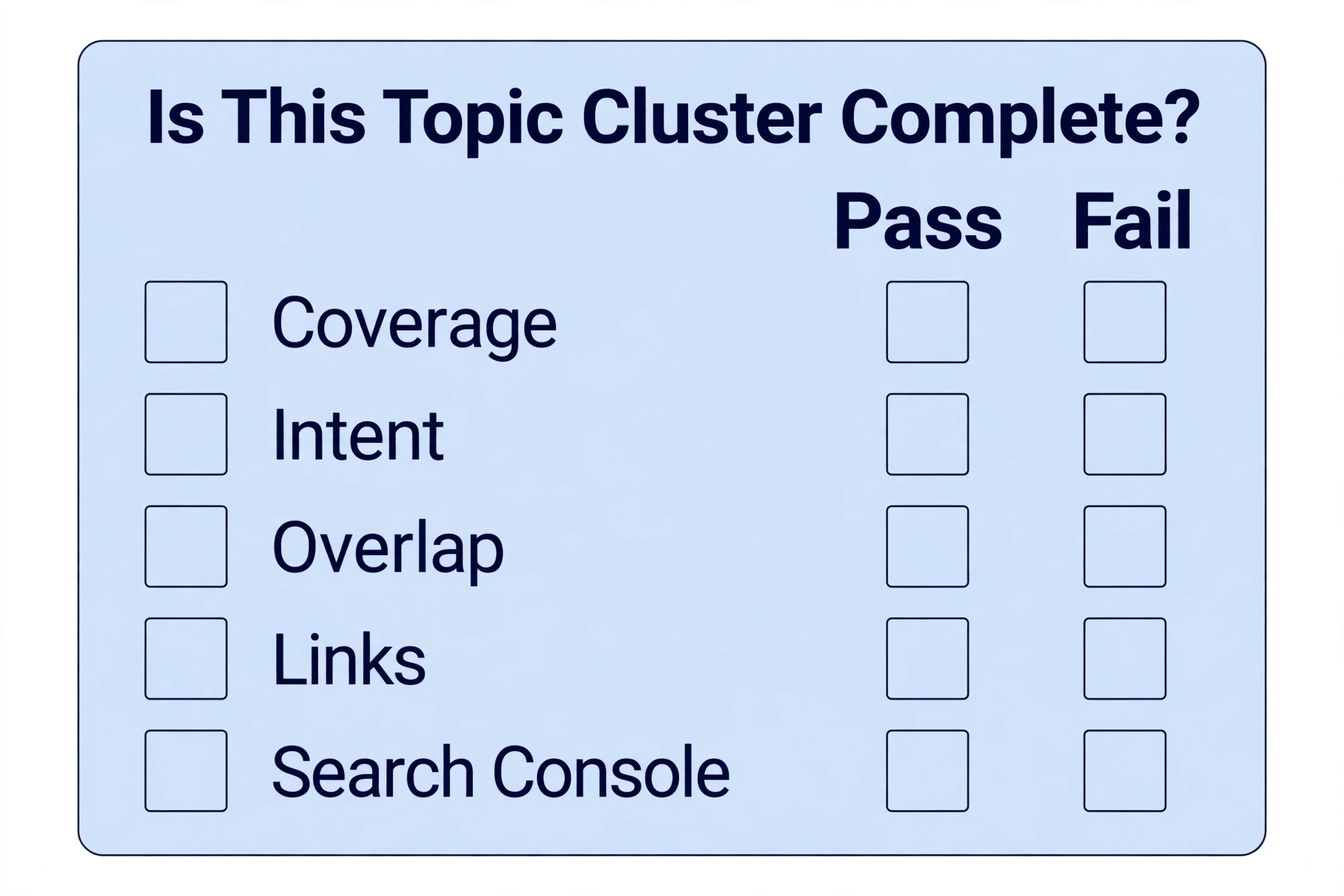
Run five checks, and treat each check as pass or fail. A small cluster can pass all five checks, and a large cluster can fail them.
| Check | How to run it | Pass looks like |
|---|---|---|
| Coverage | Compare list with live pages | Every question covered |
| Intent | Read one question per page | No shared answers |
| Overlap | Search site per question | One owner each |
| Links | Follow links both ways | Links both ways |
| Search Console | Read queries and pages | Impressions match |
Google Search Console Help lists clicks, impressions, CTR (clicks divided by impressions), and average position. Filter to one query, open the Pages tab, and read page impressions for that query.
Filter to one page, open the Queries tab, and read its queries. Compare two periods with Date and Compare, and read the Difference column.
Shared impressions alone do not prove harm, and two pages can share a query with different intents. Ahrefs gives a three-part test: same keywords, same intent, and harm. Google described topic authority for news only in May 2023, not for business blogs.
See Topical Authority for measurement, and Fan Out for citation checks.
When to stop, when to expand, and when to split
Three decisions follow the completeness test, and each decision needs its own signal, not a feeling. Use the table below to decide, then take the first step in the right-hand column.
| Signal | Decision | First step |
|---|---|---|
| Repeat intent | Stop | Fold into page |
| New questions shown | Expand | One page per intent |
| Two journeys | Split | Two smaller clusters |
When Search Console shows new questions, expand: add one page per new intent, update the pillar, and link both ways. A rival subtopic you miss is a second signal, and a new branch is a third signal.
The SEO Engine, in May 2026, says build eight posts first, then evaluate movement. It watches positions 8 to 20, and warns against going beyond 20 for non-distinct intents.
Complete the cluster you started before you open a second one, so attention and links stay with one topic. The SEO Engine, in May 2026, also says plan for two to four active clusters per domain at most. It builds each one to twelve posts before starting another.
Brilliance Growth states its stop rule plainly: stop when the buyer questions are covered.
Google warns, in its AI guide, against creating separate content for every possible variation of how people might search. Doing so mainly to manipulate rankings or generative AI responses in Google Search violates Google’s scaled content abuse spam policy.
Common mistakes that inflate or shrink a cluster
Each mistake below is a counting mistake, and each fix is a count decision, not a writing tip. Check your list against this section before you write, and fix the count first.
- Counting pages, not intents. Copying a rival total without a count means nothing.
- Splitting one answer. One answer split into thin pages leaves each page too weak.
- Padding with duplicates. Near duplicates compete and confuse the reader about the owner page.
- Starting many clusters. Many half-built clusters mean none gets finished, and one finished cluster works.
- Judging by count alone. A large total can miss core questions, and a small total can cover them.
- Stopping at a round total. A round total leaves core questions unanswered when the list is longer.
- Pillar holds too much. When the overview covers each detail in full, supporting pages lose a clear job of their own.
- Repeating FAQ pages. FAQ pages that repeat cluster pages add no new question and no value.
JMG Group calls overlap the main failure mode, where two pages weaken each other. Authentic Digital Solutions says fewer than six posts usually means too narrow a topic.
How cluster size connects to internal linking and site architecture
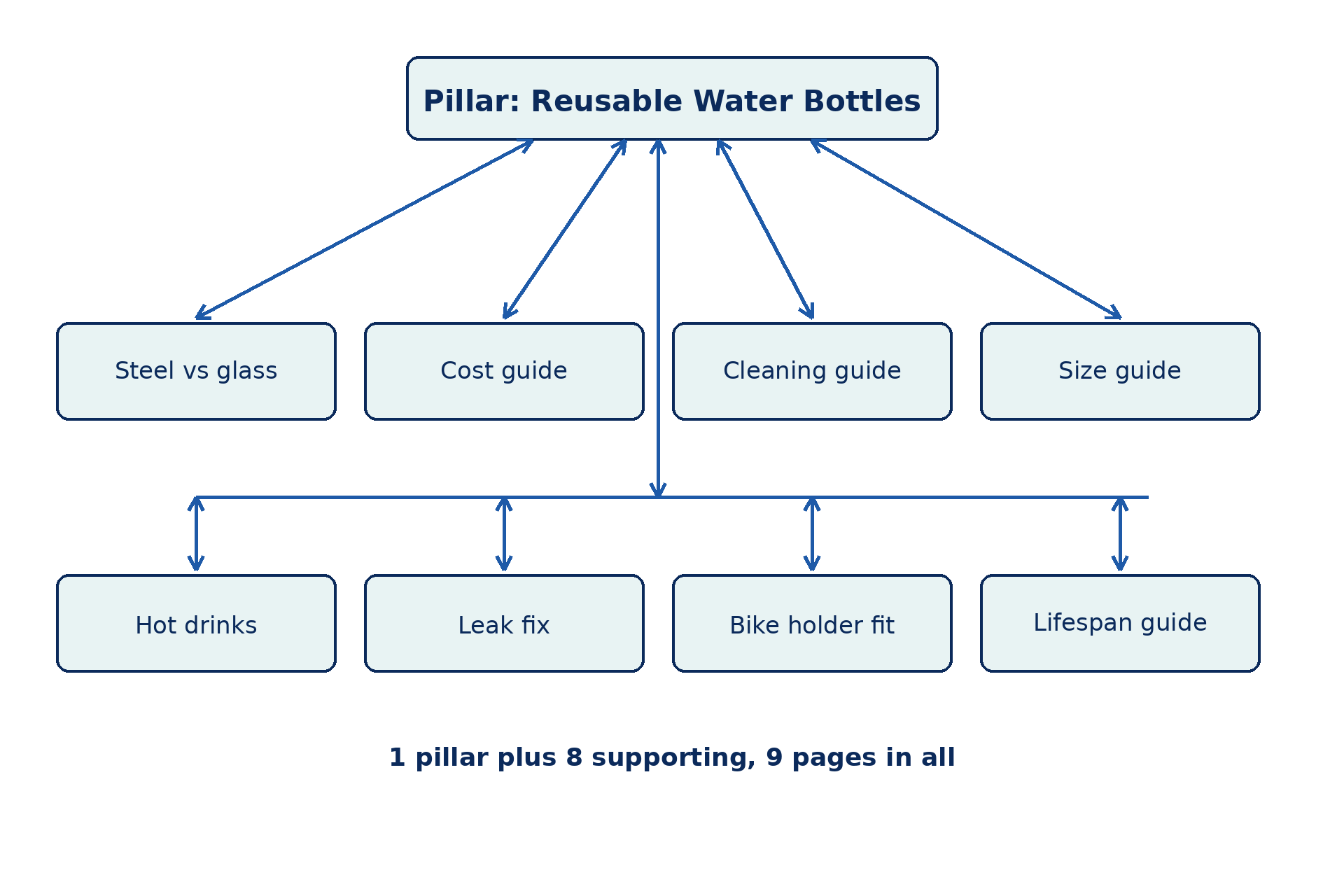
Google Search Central says every page you care about should have a link from another page. Good anchor text, the clickable words in a link, is descriptive, concise, and relevant.
HubSpot and WebPeak give the cluster pattern: every cluster page links to the pillar, and the pillar links back. Add sibling links, links between cluster pages, only where the reader would naturally go next. For the full pattern, see Pillar Pages, and for the linking strategy, see Linking Strategy.
As the count grows, the pillar stays an overview and routes readers onward. A subgroup may need a sub hub, an overview page inside the cluster.
New pages need links from older pages too, not only from the new page. Without that step, a new page can sit unlinked from its cluster.
FAQ
Does the pillar page count toward the total number of articles in a cluster?
No, not in this article, because totals here count supporting articles apart from the pillar page. Check any total from another source for whether it includes the pillar before you compare totals.
Can a topic cluster work with only 3 or 4 articles?
Yes, if those articles plus the pillar cover every distinct question in a very narrow topic. No, if core questions stay unanswered. The completeness test in H2 7 decides the case.
When should I add the next article instead of starting a new cluster?
Add the next article where evidence shows a new distinct intent inside the current topic. Start a new cluster where the current cluster is complete and the new topic needs its own pillar.
Want help applying this to your site? Contact Imran Ali to book a free 30-minute meeting.