

15 Questions to Ask Before Hiring an SEO Consultant (and the Answers That Matter)
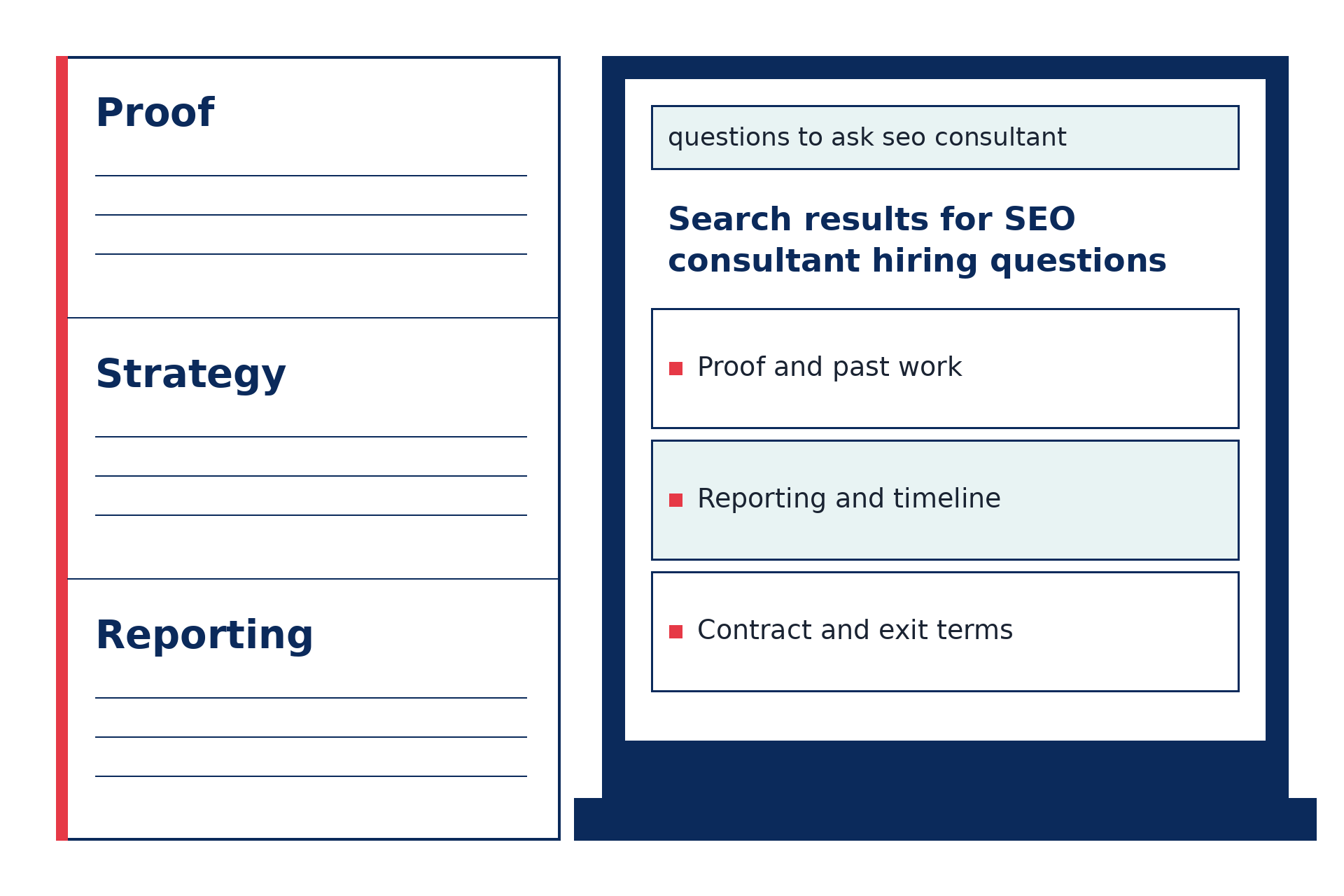
Use these questions to ask SEO consultant candidates before you hire one for your business. Each question shows what a good answer sounds like, what a weak answer sounds like, and one follow-up question. Together they test proof, method, reporting, people, and exit terms in plain terms.
A first sales call rarely separates one provider from the next. What separates them is how each answer names the work, the check, and the report.
How to Use These 15 Questions on Every Call
Screen names down to three to five before any call starts. Keep one fixed question sequence for all calls, and write down the exact words used, not your general impression.
Ask for one concrete example for each answer you receive. A fixed package in the first minutes shows a sales script, not a diagnosis.
A good consultant asks about your business before prescribing keywords or pages. That interest must show before any keyword list or page plan appears.
- Business model: The consultant asks how the business makes money and what a lead or sale is worth.
- Customers and sales: The consultant asks who buys, how customers find the business today, and how the sale closes.
- Competitors: The consultant asks who the main competitors are in search results.
- Resources: The consultant asks what internal time, developer time, and content help are available.
- Current performance: The consultant asks what search brings in today and what has been tried before.
- What makes it unique: The consultant asks what makes the business unique in its market.
A consultant who prescribes keywords before asking these questions is a warning sign, so walk away.
If you have not chosen a hiring model yet, read this link before the calls: comparison of fractional, agency, and in-house models. Then use the same 15 questions below for every provider you shortlist.
Proof and Strategy: Can They Show Work and Set Priorities
The first two questions test evidence and judgment before method detail. Proof comes before promises, and priorities come before any tactic.
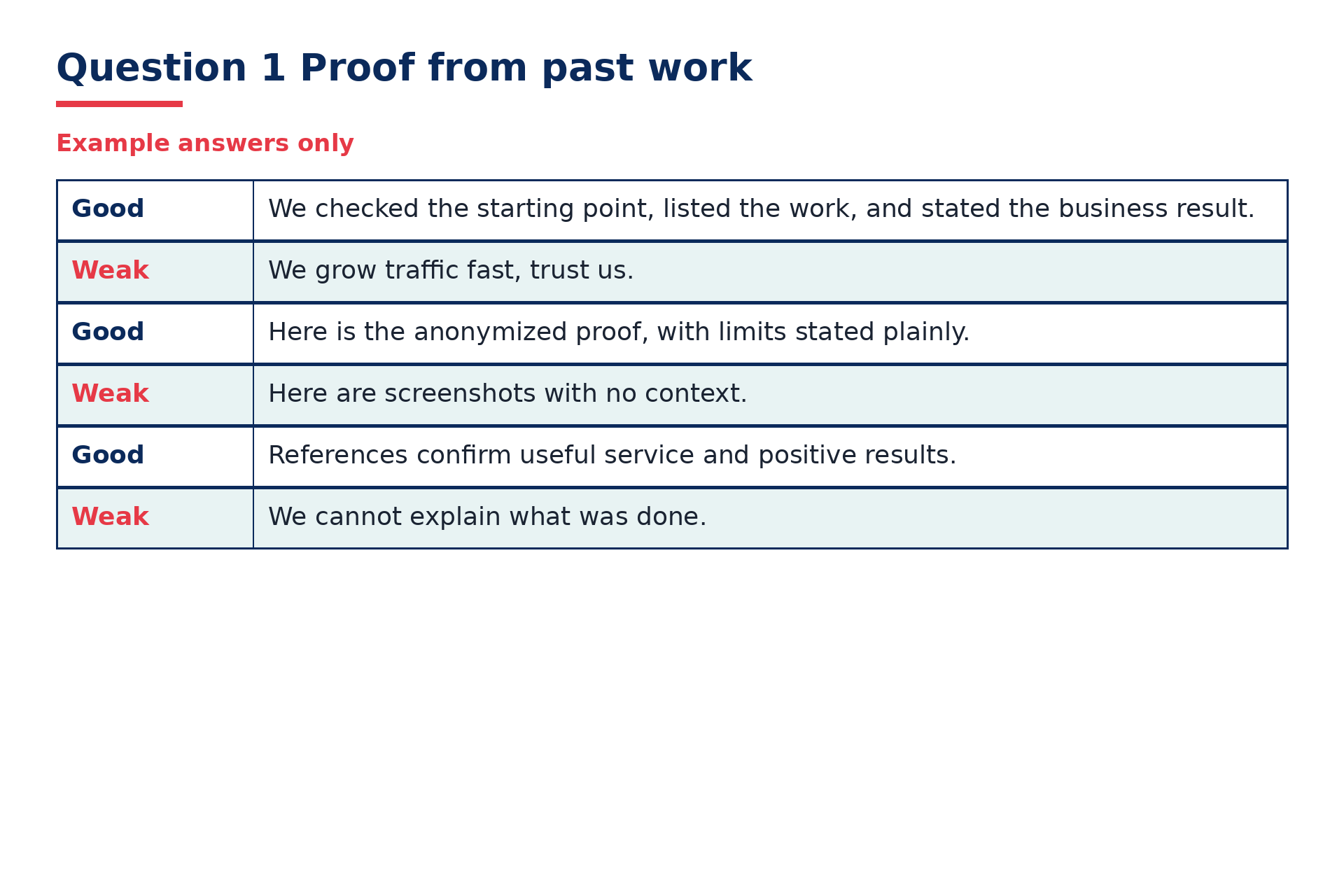
Question 1: From past work like mine, what evidence can you share that I can check?
Good answer: Checkable evidence comes first, without any demand for confidential names. The outcome is stated first, with how long the work took. What was done and where it started follow, with limits stated and proof anonymized.
It offers anonymized references or case notes the reader can check, without demanding client names or confidential data.
Weak answer: Screenshots of traffic appear with no context, and the work behind them stays unexplained. Vague claims replace detail, or the consultant refuses to explain the work.
Follow-up: Ask: What else changed at the same time, such as a product launch, a sale, or an ad campaign? Listen for the other change and the check used to separate its effect.
Question 2: How will you decide what to prioritize for my business, and what will you deliberately leave for later?
Good answer: Effort and confidence are weighed first, then fit with this business and the opportunity seen in the data. Dependencies decide what must wait, even when a task looks attractive on its own. The reply gives a short first list and clear reasons for holding the rest back.
Each priority is checked against Google Search Essentials, so technical needs, spam rules, and best practices shape the order.
Weak answer: A long tool warning list arrives with no order or reasons. The same package goes to every business, whatever the site, market, or goal.
Follow-up: Ask: Which fix would be first on this site, which fix would wait, and why? Expect one first fix, one delayed fix, and the reason for each choice.
Technical Work, Content, and AI Search: What Will Change on Your Site
The next three questions decide what actually changes on your site. Each change needs a reason, a check, and a named owner.
Question 3: What check proves a technical fix worked after launch, and what makes an issue worth fixing?
Good answer: Impact decides the order: crawl, indexation, rendering, speed, or conversions. Each fix gets a concrete check after launch, and a canonical tag must point to the right URL. A redirect must land on the right page as well.
It names who implements each fix, who checks it after launch, and what happens if the fix breaks something. The checker signs off only after the live check passes.
Weak answer: Warnings are counted, and every warning is treated as equal. Fixes arrive without a check step or a named owner. Changes go live before the client hears why they were made.
Follow-up: Ask: Who implements this fix, who checks it after launch, and what happens if it breaks something? Listen for one implementer, one checker, and one clear rollback step.

Question 4: Which pages deserve to be built, and how do topics earn a place in the plan?
Good answer: A topic earns its place when keyword, intent, page type, and commercial value align. The verdict for each topic is build, update, merge, or skip.
Length must serve the reader, not a quota set in advance. The build decision rests on intent and value, not on word count.
Weak answer: Search volume alone drives the choice, and a large keyword spreadsheet follows. A monthly article quota is promised, with no stated purpose for each page.
Follow-up: Ask: Which page does this content support, and what should the reader do next on that page? Expect the supporting page named, plus one clear next action for the reader.
Question 5: How do you make pages useful for AI answers and AI Overviews, and how are citations measured?
Google states no additional technical requirements to appear in AI Overviews or AI Mode. A page must be indexed and eligible for a snippet.
Good answer: As a working method, passages answer first, with sources beside the claims. The entity behind the business stays clear in the wording.
Key content is text, structured data matches visible words, and business details stay current. Crawl access, internal links, page experience, images, and videos are checked.
As a working method, key buyer questions are tracked, and checks record cited, mentioned, or absent. Search Console reports AI features in the Performance report Web search type, with no separate citation count stated.
Weak answer: A guaranteed ranking in ChatGPT or in AI answers is promised. A secret trick or placement is claimed, with no named source.
Follow-up: Ask: Which questions are tracked, how often, and what counts as progress if clicks fall but citations rise? Expect named questions, stated cadence, and a spelled-out progress test.
Reporting, Links, and Timeline: How Progress Will Be Proved
The next three questions test accountability, risk, and real progress over time. Reporting, links, and timelines each need evidence the reader can check.
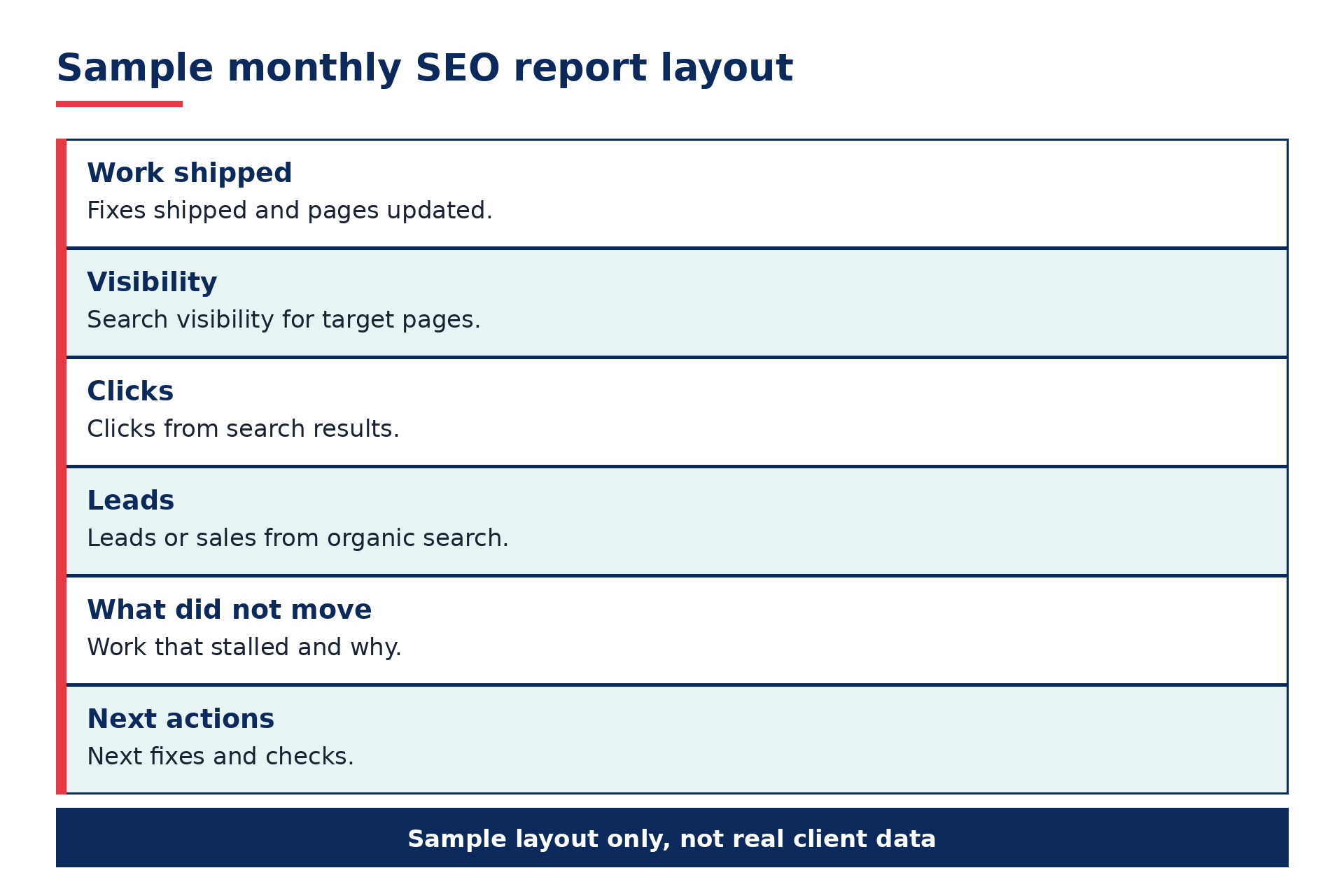
Question 6: How does a monthly report prove the work and tie it to leads or sales?
Good answer: Qualified outcomes lead the report, beside the work shipped and the work stalled. Visibility and clicks follow, with the reason each one moved or stalled.
It uses Search Console terms the reader can check: clicks, impressions, CTR, and average position. The report must use those terms in the same way, so each figure stays verifiable.
Weak answer: Rankings and impressions fill the report, and no link to leads or sales appears. A long automated export arrives with no explanation of the work.
Follow-up: Ask: Can I see a sample report with confidential details removed, and which numbers do you use to judge the work? The reply names the sample report and the numbers that will be used to judge the work.
Question 7: Which link tactics will you refuse, and what evidence proves a link is worth keeping?
Good answer: Relevance and a clear editorial standard decide whether a link earns its place. Links bought for ranking, schemes built to game results, and automated programs are refused.
Hidden links in widgets or footers are refused for the same reason. Excessive exchanges, directory links, and forum comments with optimized links fail the test.
A good answer states that paid links for advertising must carry rel nofollow or rel sponsored. A paid link without that qualification fails the quality test.
Weak answer: A fixed monthly link number is promised, with no quality test stated. Methods stay hidden as proprietary, and link sources stay secret. Link schemes and mass submissions are treated as useful work, against Google guidance.
Follow-up: Ask: Give one link example you would refuse, and explain why. Expect one real example refused, with one clear quality reason.
Question 8: What should happen in the first 30 and 90 days, and what is a realistic sign of progress in that time?
Good answer: A good answer starts with a baseline for visibility, clicks, and leads, then an audit with priorities. The implementation plan names owners, first actions, and the review date. Keyword and page mapping ties work to valuable services or products.
Access is reviewed for Search Console, analytics, and the CMS. Reporting setup connects organic visibility to inquiries, pipeline, or revenue indicators. Google guidance asks for realistic estimates of improvement and of the work involved, with no guarantee of first place.
Weak answer: A position is guaranteed by a set date, with no conditions stated. Meetings and paperwork fill the first weeks, and nothing ships.
Follow-up: Ask: What is live by day 30, and what is reviewed at day 90? Expect one live change and one review point for each date.
People, Contract, and Tools: Who Does the Work and What You Are Buying
The next four questions test accountability, scope, and safe access. People, contracts, and tools decide what the fee actually buys.
Question 9: How and how often will we communicate, and who explains changes before they go live?
Good answer: One named contact owns the conversation, with a clear cadence, meeting format, and written summary. A change log with reasons is shared before changes go live.
Each summary lists decisions, changes planned, and the next check date. Each change log entry names the page changed, the reason, and the check used.
Weak answer: No contact is named, and calls arrive with no set cadence. Changes go live unexplained, and no written record follows the work.
Follow-up: Ask: Who walks through the monthly report, and how are urgent issues raised between reports? The reply names the report owner and one clear route for urgent issues.
Question 10: Who actually delivers the work, who checks it, and what backup covers a departure?
Good answer: The people behind the day-to-day work are named, with their experience stated. Subcontracted parts are named too, with the checker and the backup if a named person leaves.
Subcontracted work is checked against the same brief and the same evidence standard as in-house work. Delivery notes record who did each task, who checked it, and when it shipped.
Weak answer: Only a team is promised, with no names given for the work. Subcontracting is admitted, but no quality check or backup plan is named.
Follow-up: Ask: Can I speak to the person who will do the work, before I sign? Expect a short talk with the delivery person, not a sales call only.
Question 11: What does the fee buy, what costs extra, and how can the engagement end?
Good answer: Included work, excluded work, and charges for content, development, and tools are listed in writing. Ownership of content, accounts, and data is stated, alongside the term and notice period. Pricing is explained in general terms: hourly, project, retainer, or fractional.
Weak answer: A monthly fee is stated, and scope and extras stay unstated. It asks for a long lock-in period before diagnostic work. The contract leaves ownership of content, accounts, and data unclear.
Follow-up: Ask: What counts as a new project, and what happens to work already paid for if the engagement ends early? Expect a definition of new project work and a statement of what the client keeps.
For pricing models and price bands, read this link: guide to SEO consultant costs. For retainer scope at different levels, read this link: guide to SEO retainer pricing.
Question 12: Which tools do you use, are tool costs included in the fee, and what access do you need at each stage?
Good answer: Tools are named, with costs stated as included or excluded. Tools are explained, and recommendations are checked against official Google guidance.
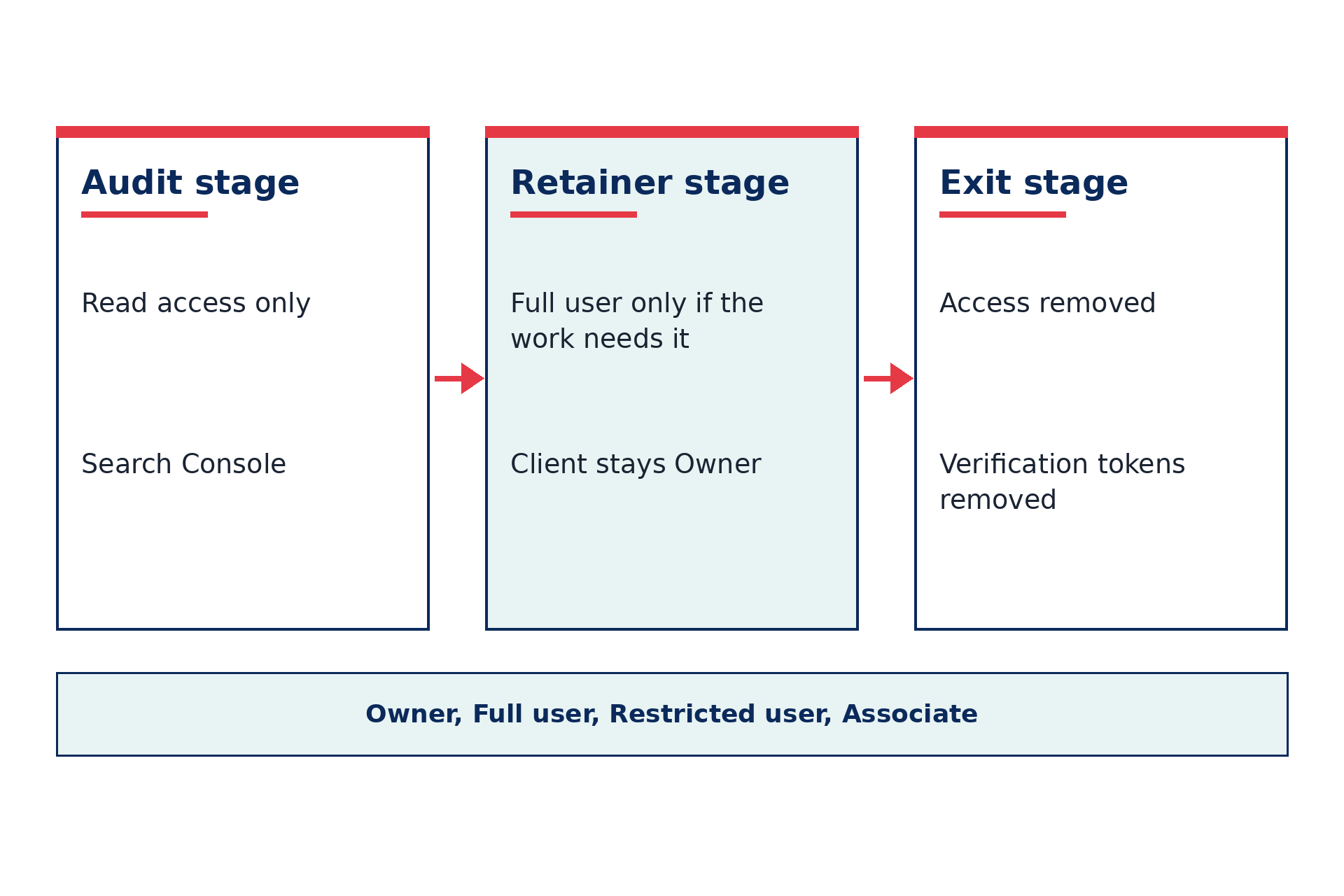
Access stays narrow at audit stage: read access to Search Console only, with no write access. The client stays Owner, among Owner, Full user, Restricted user, and Associate.
A Full user role at retainer stage applies only if the work needs it. Owner access is never a standing arrangement for a consultant.
Weak answer: Tool names stay hidden, with no check against official Google guidance. It asks for Owner access at audit stage or to create client accounts. Account ownership stays unexplained, or a tool claims approval by Google.
Follow-up: Ask: Who owns accounts and data, and when is access removed? Expect the account owner, the data owner, and the removal date named.
Your Role, Stalled Results, and Ending the Engagement
The last three questions test honesty about shared work, failure, and exit. Shared work needs named inputs, and an exit needs a clean handover.
Question 13: What do you need from me and my team each month, and what happens if we cannot supply it on time?
Good answer: Inputs, owners, approval steps, and deadlines are named up front. It states which work slows down or pauses if inputs are late, such as work needing developer time, content approval, or access. Each month names one input, its owner, and its deadline, such as content approval before publishing starts.
Weak answer: Nothing is asked of the client at all, and no input is named in advance. Blame follows later for inputs that were never named at the start.
Follow-up: Ask: On the client side, who signs off each kind of decision before work ships? Expect one named approver for each decision type, with no shared inbox left as the answer.
Question 14: If results stall or fall, how will you diagnose the cause, and what will you change?
Good answer: The work starts with measurement, moves to diagnosis, and ends with adjustment. Keywords and intent are checked first, then competition, technical issues, conversion, and missing client inputs, with the evidence stated at each step.
It states what will change, what will be measured next, and when the next review happens. For the diagnosis pattern after a drop, read this link: core update recovery process.
Weak answer: A new promise arrives before any diagnosis, and no evidence supports it. More volume follows, or blame lands on others without data.
Follow-up: Ask: Give one past example of a stall, anonymized if needed, and state what was changed as a result. Expect the stall cause named and the change that followed it.
Question 15: If we end the engagement, what do we keep, what handover do we receive, and when is access removed?
Good answer: Ownership of content, accounts, and data stays with the client. A written handover arrives, with documentation and training where agreed.
If a verified owner is removed, verification tokens must also be removed, or access can return. When the engagement ends, every login tied to it is closed, with no shared password left in use.
Weak answer: No handover is offered, and accounts stay under provider control. Access stays open after the end, and no removal date is ever stated.
Follow-up: Ask: What documents arrive on the last day, who removes access, and when does removal happen? Expect the last-day documents listed, plus the person and date for removal.
Score the Answers Side by Side Before You Decide
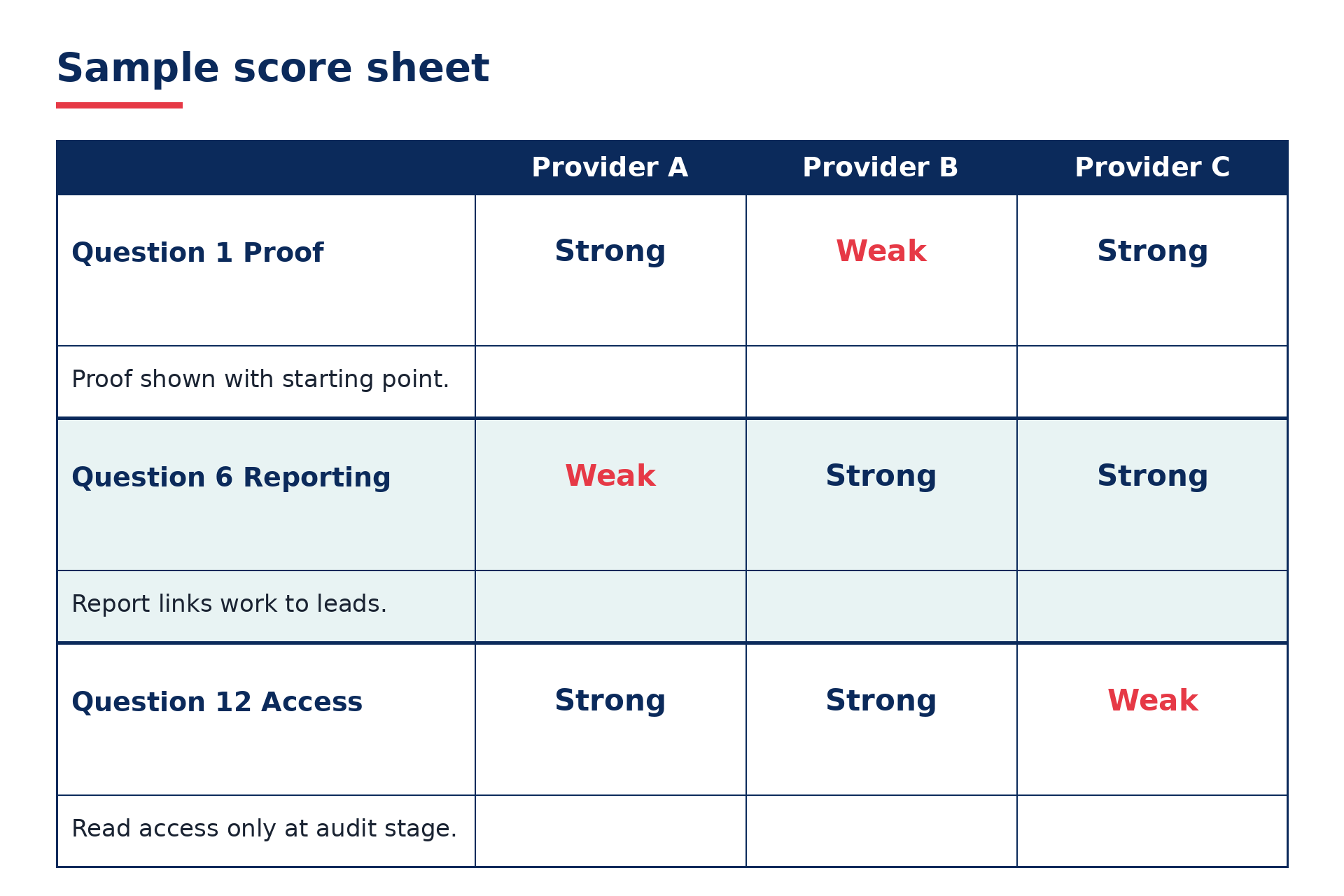
Score every provider on the same questions, with the same test. Score after each call, from your verbatim notes, not from memory of the pitch.
- Specificity: The answer names a concrete step or a named owner.
- Reasoning: The answer explains why the step matters for this business.
- Evidence: The answer offers proof, a sample, or a checkable record.
- Accountability: The answer states who does the work and what happens next.
Choose the provider whose answers stay specific when pressed on detail. A single red flag outweighs a strong score in other areas.
Google states: “No one can guarantee a #1 ranking on Google.” Treat any guaranteed first place as a clear stop signal.
Treat bought links as a stop signal, and be wary of firms that email out of the blue.
Start with a scoped diagnostic on read access before a monthly retainer. Readers who want scope and framework can read the link: Services and Pricing page.
| Question | Provider | Verbatim note | Strong or weak test | Follow-up needed |
|---|---|---|---|---|
| Q1: Proof | Provider name | Exact words on starting point, work, time, and result | Strong if all four are stated | Other changes named |
| Q2: Priorities | Provider name | Exact words on priorities, delays, and Search Essentials check | Strong if a short first list has reasons | First fix named |
| Q3: Technical | Provider name | Exact words on impact, check, implementer, and rollback | Strong if each fix has a named check | Checker named |
| Q4: Content | Provider name | Exact words on intent, value, and build decision | Strong if intent and value decide the build | Next action named |
| Q5: AI search | Provider name | Exact words on answer passages, sources, and citation check | Strong if citation checks are named and dated | Check cadence stated |
| Q6: Reporting | Provider name | Exact words on work, outcomes, and test numbers | Strong if outcomes link to leads or sales | Test numbers named |
| Q7: Links | Provider name | Exact words on refused tactics and quality test | Strong if refused tactics are named | Refused example named |
| Q8: Early plan | Provider name | Exact words on baseline, first fixes, and review | Strong if a baseline and first fixes are stated | Day 30, 90 review named |
| Q9: Communication | Provider name | Exact words on contact, cadence, and change log | Strong if one contact and a change log are named | Report owner named |
| Q10: Delivery | Provider name | Exact words on named people, checks, and backup | Strong if delivery people and backup are named | Delivery talk offered |
| Q11: Scope | Provider name | Exact words on scope, extras, term, and ownership | Strong if scope, term, and ownership are in writing | Project rule stated |
| Q12: Tools | Provider name | Exact words on tools, costs, and access stage | Strong if tools are named and access is staged | Account ownership named |
| Q13: Client role | Provider name | Exact words on inputs, owners, and deadlines | Strong if inputs, owners, and deadlines are named | Approvers named |
| Q14: Stall | Provider name | Exact words on evidence, diagnosis, and change | Strong if evidence precedes the change | Past example named |
| Q15: Exit | Provider name | Exact words on handover, ownership, and removal | Strong if handover and removal dates are stated | Last day documents listed |
This guide reflects 5+ years of broad SEO practice from 2021, tested first on own-funded in-house assets, with own capital at risk. WordPress and Shopify are the strongest platforms in that work, and Facebook and Google Ads are fundamentals only, not expert services.
FAQ
How many SEO consultants should I interview before hiring one?
A practical shortlist runs to three to five providers, from method, not from Google. Put the same questions to each one and score the answers side by side. Use the scorecard in this guide and keep verbatim notes for every call.
Should an SEO consultant guarantee first place on Google?
Google states: “No one can guarantee a #1 ranking on Google.” A trustworthy answer gives realistic estimates of improvement and of the work involved. It also states the conditions and risks that apply to the work.
What should I check in the contract before I sign?
Check handover, confidentiality, and subcontracting, then ownership, term and notice, and fees and extras. This guide is not legal advice, so read the actual contract before you sign it. Get local legal advice where the terms are unclear or the risk is high.
Want help applying this to your site? Contact Imran Ali to book a free 30-minute meeting.