

Pillar Pages and Topic Clusters: The Architecture That Still Works in 2026

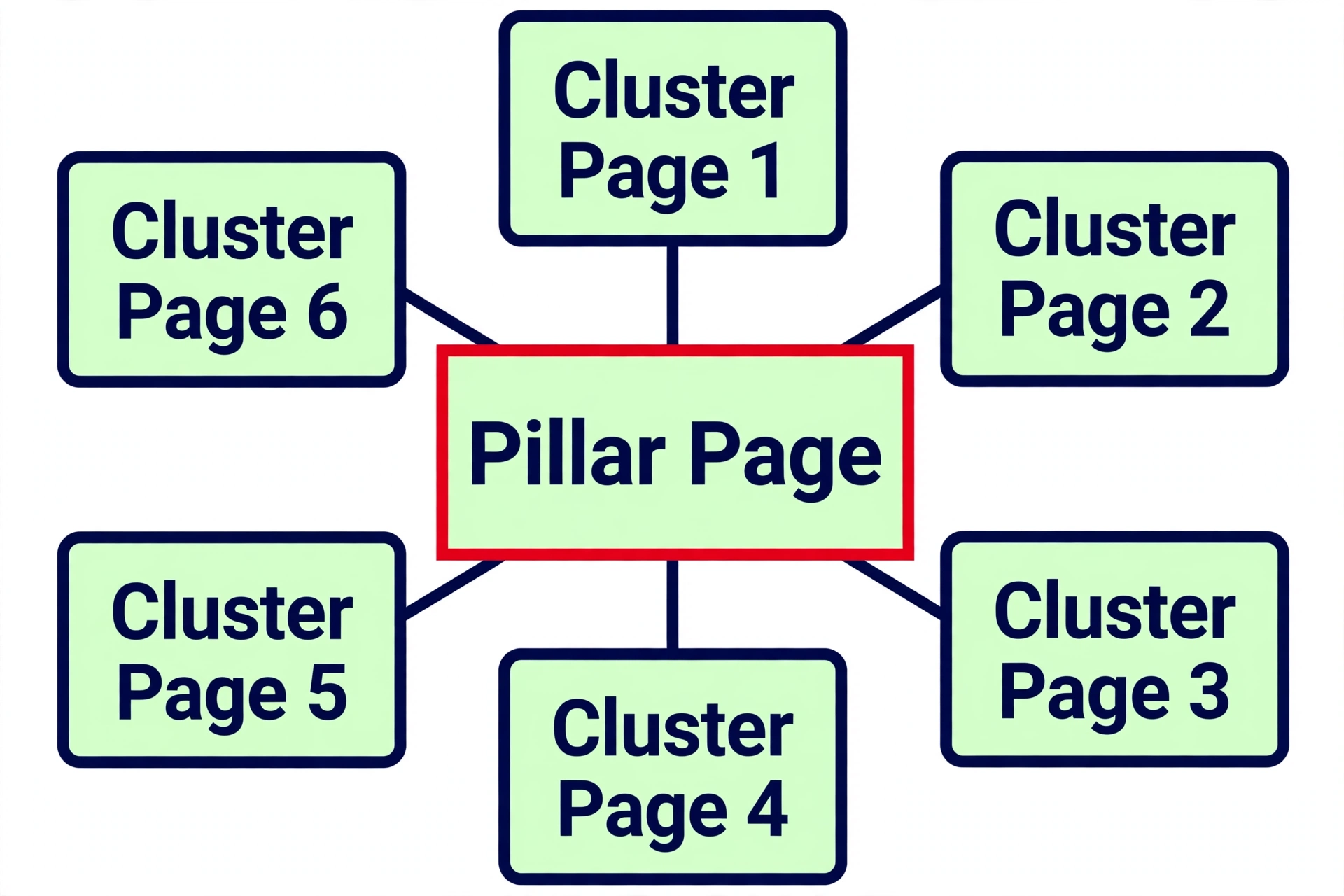
Pillar pages and topic clusters are one structure of pages built around a broad topic. One pillar page covers the broad topic at a high level and links to deeper pages. Each cluster page covers one subtopic in depth, linking back to the pillar.
The structure moves readers from a broad view to detail. This article shows the parts, the page types, the link pattern, and how to keep a cluster sound.
What Pillar Pages and Topic Clusters Are
A pillar page covers a main topic broadly and links to deeper pages. A cluster page covers one subtopic, and a topic cluster is the group.
HubSpot calls this shape the hub-and-spoke model: hub means the pillar page only, and spoke means one cluster page. HubSpot popularized this model in research from 2015 to 2017.
As a working distinction, a long blog post alone is not a pillar page without a cluster beneath it. A landing page sells a product or collects sign-ups, while a pillar page guides and routes.
- Pillar page job: Give the broad view, name subtopics, and route readers onward.
- Cluster page job: Answer one subtopic in full, and own that subtopic alone.
- Links job: Join pages so readers can move through them and crawlers, software that reads web pages, can do the same.
Why the Architecture Still Works in 2026
Search engines find most new pages through links from pages they have already crawled. Clear links show readers and search engines how pages relate.
One intent per page stops pages from competing for the same need, and keeps each page focused. One page cannot do several separate jobs well at the same time. Readers lose the thread, and each need gets part of an answer.
AI answers may use fan-out, issuing related searches across subtopics to build a response. A cluster with clear subtopic passages gives those answers material to cite. Google states no additional technical requirement beyond indexing and snippet eligibility.
Google does not define the terms pillar page and topic cluster in Search Central docs checked here. The model is a practitioner method, and no structure on its own guarantees a ranking or a citation.
The starter guide says no secret technique automatically ranks a site first. A working site should not be reorganized on organization advice alone.
This article stays with the shape of pages and the links between them. The wider case for topical authority is in Topical Authority in SEO: How to Build It.
Pillar Page Types and Shapes
Semrush names three common pillar types, with divisions not absolute. Some pages mix two types, so pick the shape that fits the question. As this article’s method, pick overview depth unless the pillar must also answer the main question itself.
| Type | Question | Shape | Pick when |
|---|---|---|---|
| Guide | What is this topic? | Broad overview | The topic splits into real subtopics. |
| What is | What does this term mean? | Definition and explanation | The meaning comes first. |
| How to | How do I do this task? | Steps in order | The reader needs a method. |
Read the question first, then pick the shape that answers it.
Keep the pillar at overview depth for every subtopic named. Full detail belongs on the cluster page for that subtopic. Google says length alone does not matter for ranking, and no fixed count applies.
Cluster Page Types
HubSpot matches each format to search intent: learn, compare, or act. The table follows the HubSpot list and adds Problem and fix as this article’s method.
| Type | Intent | Question | Depth test |
|---|---|---|---|
| How to guide | Act | How to do it | Full steps. |
| Checklist and template | Act | What to do or use | Items checked off. |
| Comparison | Compare | Which option fits | Shared points judged. |
| Definition and explainer | Learn | What does it mean | Clear reading. |
| FAQ | Learn | Asked most often | Each answer complete. |
| Case study and use case | Learn | How it works | One full case. |
| Problem and fix | Fix | Why wrong, how to fix | Cause and fix covered. |
Pick the type by intent, and use the depth test to judge whether the page owns its subtopic.
The same subtopic needs a separate page only when the intent differs. Pages that differ only in wording stay on one page.
How to Design the Architecture, One Intent per Page
Start with scope, and set a boundary one pillar page can cover. The topic must split into real subtopics, yet stay narrow.
A topical map sets the shape of the subject before pages are designed. For the full map method, read How to Build a Topical Map for Your Niche. With the map in hand, assign one intent per page before writing.
HubSpot frames its test for a large blog with 20 to 30 articles. Semrush observes 5 to 15 cluster pages, and neither range is a rule. Create one row first for each planned page, with intent, question, and owning page.
| Case | Test | Result |
|---|---|---|
| Split | Answer or format differs | Separate page. |
| Merge | Same answer, same way | One page. |
| Keep | Covered in a sentence | Stay on pillar. |
The table gives this article’s split test, merge test, and keep test.
Cannibalization is a practitioner term for pages that compete for the same intent. Google advises one URL per piece of content, with a canonical link naming the preferred URL.
The Internal Linking Pattern
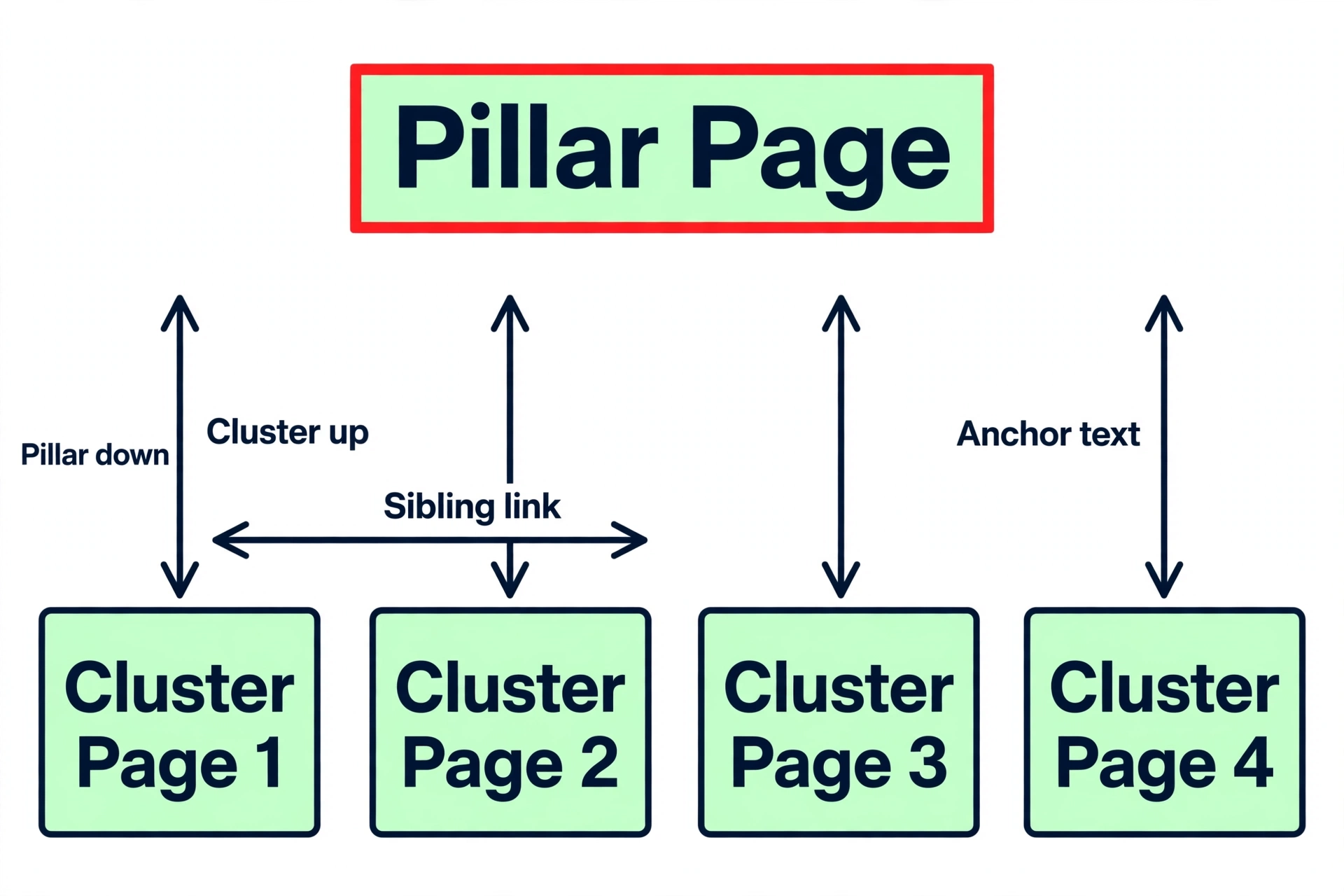
The pattern has three link moves, pillar down, cluster up, and sibling to sibling, plus one check for orphans. Each move serves the reader first, and structure follows reader needs. It is a practitioner method, built on Google link guidance.
- Pillar down: The pillar links to every important cluster page, ideally from the section that introduces that subtopic.
- Cluster up: Every cluster page links to the pillar, naming its subtopic.
- Sibling links: A page links to a sibling only where the reader would naturally go next.
- Orphan check: Every page needs one incoming link from inside the cluster.
Good anchor text, the visible link words, is descriptive, concise, and relevant to both pages. Write naturally; do not cram keywords into link text or chain links side by side.
A silo, in the strict sense, does not link outside its group. Semrush advises loosening strict silo rules and linking clusters where readers benefit.
Google can generally crawl a link only when it is an anchor with an href attribute. Where JavaScript inserts anchor text, check the rendered HTML in the URL Inspection Tool.
Building Order, New Clusters and Existing Sites
A new cluster can start from the pillar or the cluster pages. A lean pillar gives a hub at once, but its links stay thin until cluster pages arrive. Cluster pages built first bring depth, but readers have no hub until the pillar follows.
- Map first: Count live pages fitting the subject before planning new pages, and mark gaps and overlaps.
- Pillar first, one order: Publish a lean pillar first, naming each subtopic before its page is live.
- Clusters first, the other order: Build priority cluster pages first, so the pillar links only to live pages.
- Spokes by priority: Add cluster pages in priority order, linked from the pillar.
- Pillar updated: Revise the pillar after each new cluster page goes live.
- Overlaps: Combine pages that cover one question in the same way, and redirect the page that is removed.
- Fix orphans: Give each orphan page one link from inside its cluster.
- Expand last: Add new pages only after overlaps and orphans are fixed.
Wix sets cluster pages before the pillar in its 2023 guide. HubSpot puts the pillar early as a hub, and neither order ranks better. Reorganize an existing site only for gaps, overlaps, or orphans.
Worked Illustrative Example, One Pillar and Its Cluster
ILLUSTRATIVE EXAMPLE
This example is hypothetical, naming no real business and claiming no results. It shows page roles and links only, for copying the structure, not the facts.
The pillar is a high-level guide to home solar panels. It names subtopics and routes readers onward to cluster pages.
| Page | Intent | Links |
|---|---|---|
| Home Solar Guide | Learn | Down to all pages. |
| Solar Cost and Payback | Compare | Up to the pillar and to the finance page. |
| Panel Types Compared | Compare | Up to the pillar and to the roof page. |
| Roof Fit and Shading | Learn | Up to the pillar and to the types page. |
| Install Steps and Timeline | Act | Up to the pillar and to the maintenance page. |
| Maintenance and Problems | Fix | Up to the pillar and to the install page. |
| Finance Options | Learn | Up to the pillar and to the cost page. |
The table shows one pillar, six cluster pages, and their link pattern.
The finance page explains options generally, with no scheme or eligibility detail. No cost, payback, or efficiency figure appears in this example.
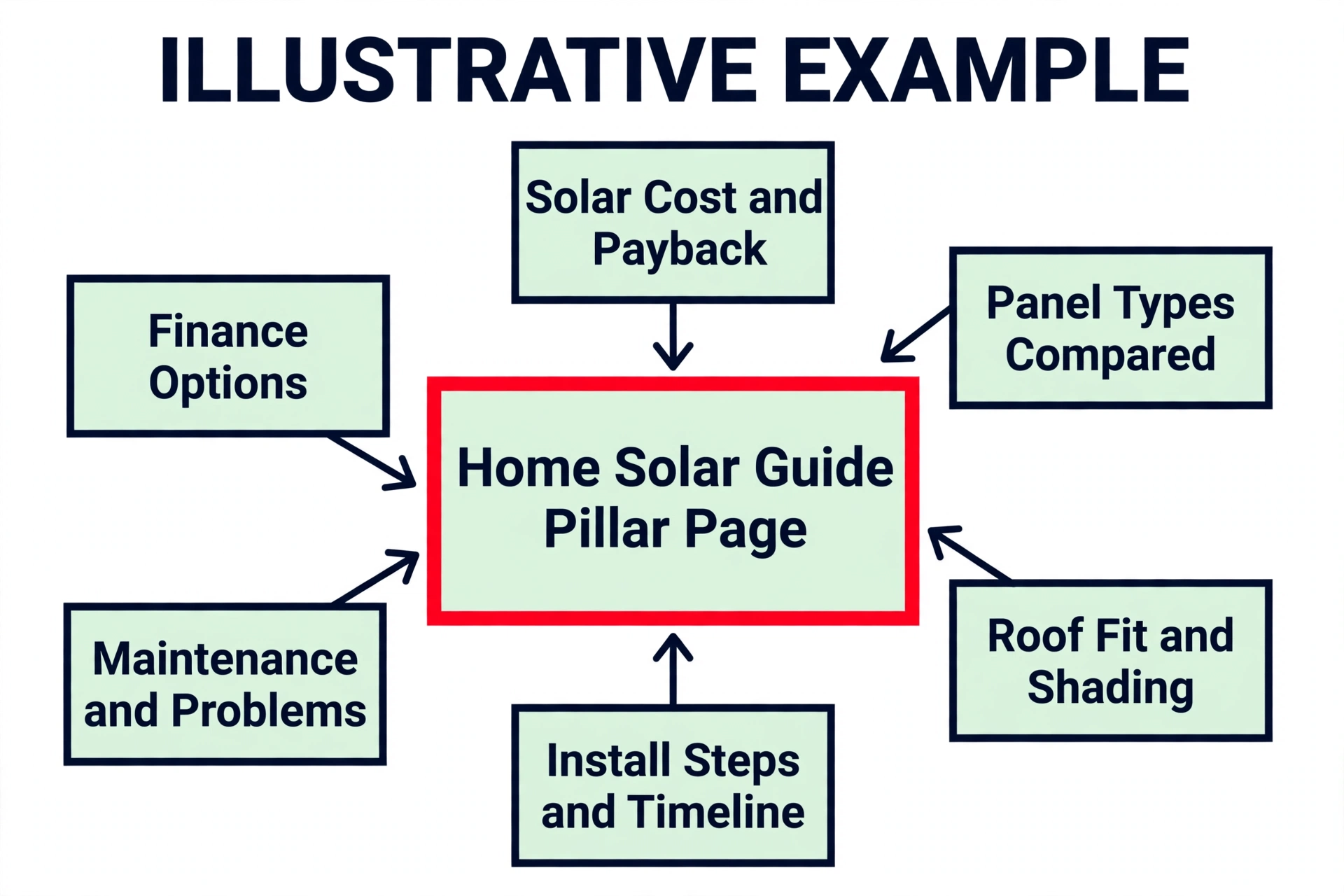
Buying questions sit in the cost and panel types pages, and problems sit in the maintenance page. The pillar routes readers to the cost page early, so they can judge affordability first. The finance page supports the cost question in general terms.
How to Maintain a Cluster
Maintenance is scheduled work, not a step that ends at first build. Without checks, facts age and subjects grow, and the cluster stops matching its subject.
| Page | Down link | Up link | Last check |
|---|---|---|---|
| Solar Cost and Payback | Yes | Yes | Not yet checked. |
| Panel Types Compared | Yes | Yes | Not yet checked. |
| Maintenance and Problems | Yes | Yes | Not yet checked. |
This tracker uses three example rows, and you should use one row for each page in the cluster.
HubSpot suggests a check at least twice a year for evergreen topics. For competitive, product-led, or fast-moving clusters, HubSpot suggests a quarterly check instead. Treat both as a cadence, not as a Google rule.
On each check, update dated material across the whole cluster. Shift useful material from outdated pages into the replacement page, and add pages for new subject parts.
A page that no longer belongs can be merged in, redirected, or removed. Record each decision, so the next check starts from it.
How to Measure Whether the Cluster Works
Judge all cluster pages together in one report, and look for a shared pattern. No single page result proves the architecture works, and no Google score sums up cluster authority. HubSpot lists cluster-level metrics, with no benchmark figure, adapted below as five checks.
| Check | Where | Weak signal |
|---|---|---|
| Coverage | Search Console | Pages not live. |
| Cluster health | Search Console | Pages move apart. |
| Reader path | Analytics | Few moves between pages. |
| Commercial result | Analytics | Few inquiries. |
| Citation presence | AI answers | No cluster cited. |
The table lists five checks, where to run them, and weak signals.
Google reports AI feature traffic in the Search Console Performance report for Web search. Use that report, and check citations in AI answers at the cluster level.
Citation checks need fan-out, as AI answers draw on sub-questions. For the full fan-out method, read Query Fan-Out: Why Covering Sub-Questions Gets You Cited by AI.
Mistakes That Break the Architecture
Each mistake below is an architecture failure, not a writing tip. Each fix below is a structure decision for the architecture.
- Template copy: Shape the cluster from the subject, not from a template.
- Pillar alone: Do not build a pillar with no cluster beneath it.
- Phrasing pages: Do not build a page per phrasing; build one page per intent.
- Thin bloat: Do not add thin pages that answer the same question.
- Walled silos: Do not wall a cluster off, and link where readers benefit.
- Orphan pages: Give every page one incoming link from inside its cluster.
- Links left to chance: Link for the reader’s next question, not for menu position, recency, or a tool suggestion.
- No upkeep: Review the cluster on a cycle, and do not treat the build as the end.
FAQ, Frequently Asked Questions
The answers below match the FAQPage block that follows, word for word. No rich result is promised for that block in search.
What is the difference between a pillar page and a topic cluster?
A pillar page is one broad page, while a topic cluster is the whole group. The pillar page stays at overview level for the whole topic. Each cluster page then covers one subtopic in full detail.
How many cluster pages does a pillar page need?
There is no fixed count; the subject decides size from distinct intents. HubSpot mentions 20 to 30 articles, and Semrush observes 5 to 15 pages. Neither range is a rule, so use the split test above and merge duplicates.
Should the pillar page or the cluster pages be written first?
Either order works, so pick the order that fits the site. A lean pillar first gives readers a hub at once, while priority cluster pages first give depth before the hub arrives. On an existing site, clear overlaps and orphans before adding new pages.
Want help applying this to your site? Contact Imran Ali to book a free 30-minute meeting.