

How to Measure AI Search Visibility Without Expensive Tools
How to measure AI search visibility: run a fixed set of buyer prompts each week in four systems. Ask 15 to 25 questions in AI Overviews, ChatGPT, Perplexity and Gemini, and record each result. Note whether each answer cites, mentions, recommends or ignores your site over four to six weeks.
This method needs no paid tool. It uses a fixed prompt set, manual checks and free Search Console data.

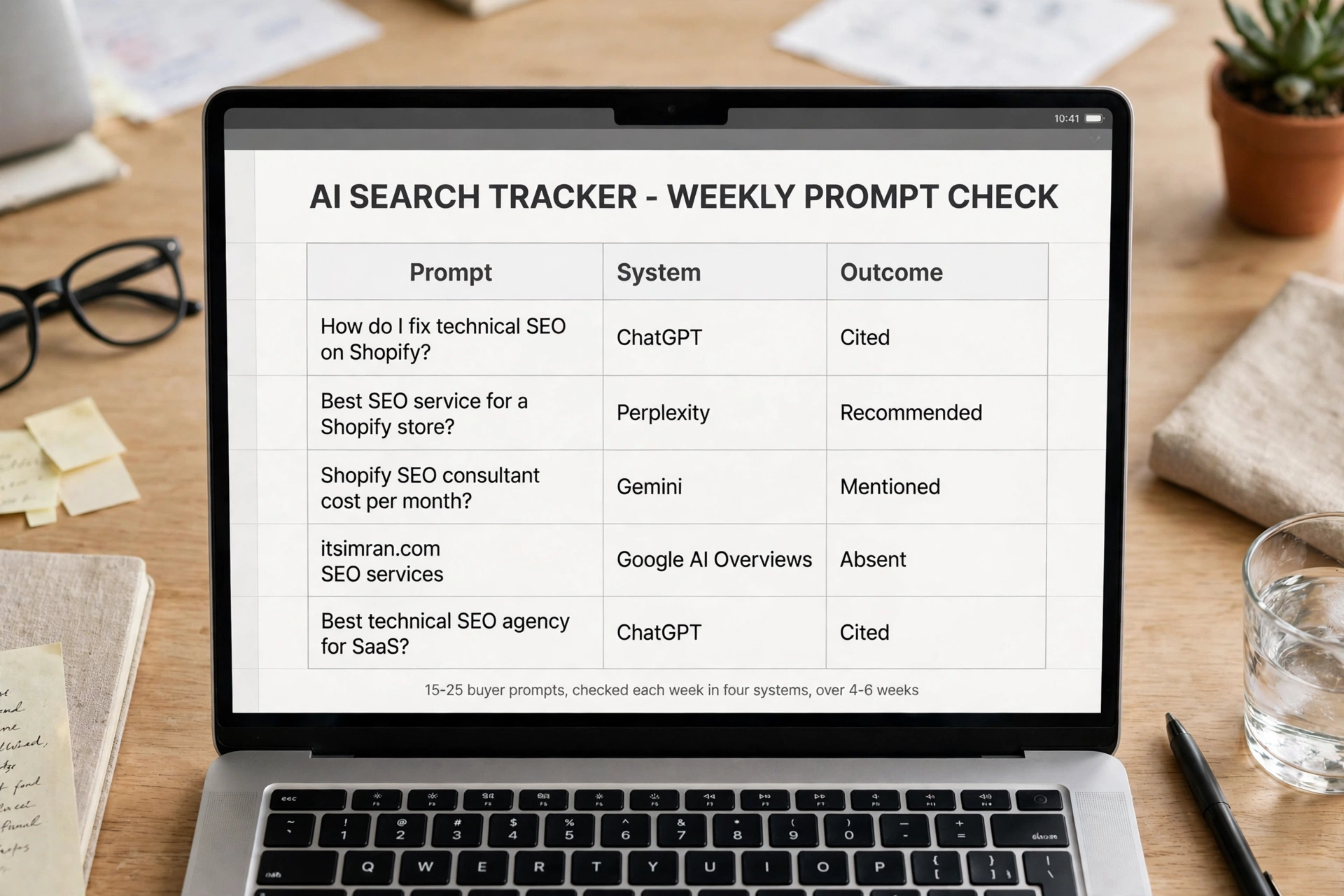
The tracker this method runs on: one row per buyer prompt, one outcome per row. Five buyer prompts are shown here; your own set will have 15 to 25.
Start with the right definition
AI search visibility has three meanings. Confusing them is why most measurement goes wrong.
A useful system tracks all three separately. A single blended score hides the real difference. The difference between a citation and a mere mention is the whole commercial story.
1. Citation visibility. An AI answer names your site or links to one of your pages as a source. This is the closest thing to a ranking in AI search.
It is the most valuable form of visibility. The reader can click through to your site.
2. Mention visibility. An AI answer names your brand or product in its text without linking to you. The reader then has no direct path to your site.
This still matters, because it is how shortlists are formed. It is weaker than a citation, and it is easy to overcount.
3. Recommendation visibility. The AI recommends you for the task, or puts you first in a comparison. This is the rarest and most valuable form for sales.
It is also the hardest to measure. It depends heavily on the exact question asked.
Step 1: Build a fixed prompt set
Everything else depends on asking the same questions the same way every time. If the questions change, the results cannot be compared.
Build a set of 15 to 25 prompts. Cover the questions your buyers actually ask AI assistants.
Split the set into four groups. Each group tests a different kind of visibility.
- Informational questions your content already answers. They test whether your pages are in the citation pool.
- Comparison questions. These are “X vs Y”, “best tool for”, and “alternatives to” questions. They test recommendation visibility, where buying decisions are made.
- Brand questions. These name your brand, your product, or your category with your brand in the frame. They test whether the systems know you exist at all.
- Local or niche questions, if your business has them. These are the specific, buyer-shaped questions a generic guide would never think to ask.
Write each prompt down exactly as you will type it. Do not improvise the wording each week.
The same question asked two different ways is two different tests. AI answers are sensitive to phrasing.
Keep the list in a spreadsheet, one row per prompt. Add columns for the system tested, the date, the outcome, and the page cited.
The outcome is one of four words: cited, mentioned, recommended, or absent. Add a short note on what the answer actually said.
Include a few prompts where you expect to be absent. If every prompt is one you already rank for, the test will flatter you.
The honest prompts are the ones where a competitor is the cited source. Those are the ones that show you where the work is.
Step 2: Run the prompts, by hand, in the systems that matter
Once a week, run the full set in the systems your buyers actually use. At minimum, use Google’s AI Overviews, ChatGPT, Perplexity, and Gemini.
Use a fresh session where you can. Log out, or start a new conversation. A system that knows your history will answer differently from a fresh one.
For each prompt, record the outcome in your four categories: cited, mentioned, recommended, or absent. Note the exact page cited, if any. It could be your homepage, a specific article, or a competitor’s page.
Also note the position in the answer. A citation in the first paragraph is not the same as a link buried in a list of eight sources.
This is deliberately slow work, and that is the point. A paid tool that runs a thousand prompts a day gives you volume.
Running twenty prompts carefully gives you understanding. You will notice things a dashboard hides.
You may be cited for the informational questions but never for the comparisons. A competitor may be cited for the exact question your best page answers.
The AI answer may quote your page’s wording without naming you at all. That is a mention a tool would miss and a human would catch.
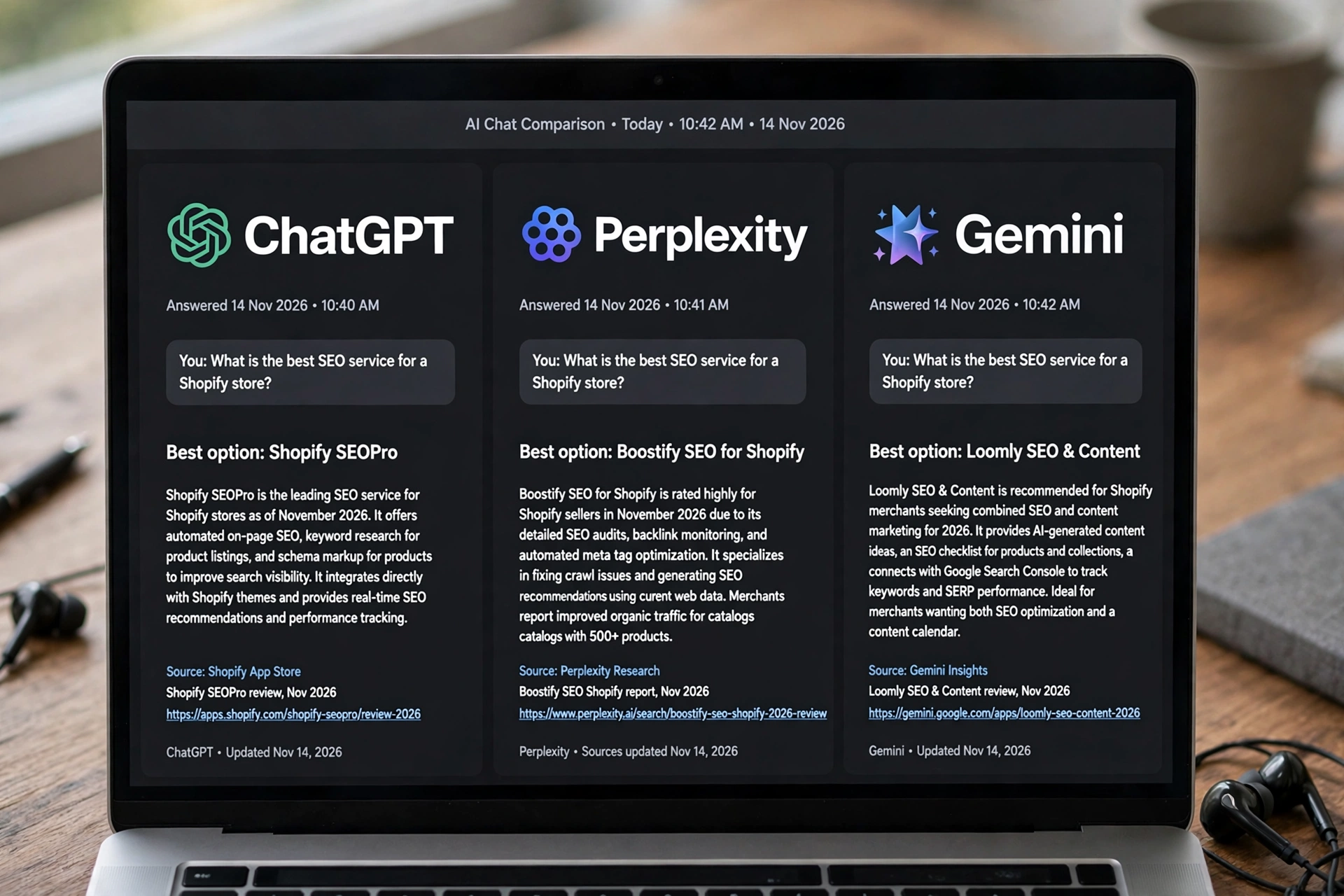
Why one system is never enough: the same buyer question gets different answers in each system. Each system draws on a different pool of pages, so the cited sources differ too. The answers shown are an example.
One more honest point, and it changes how you run the set. AI answers vary from run to run even when the prompt is identical.
SISTRIX measured 10,826 daily series across four models in October 2026. It found that most brands appear in fewer than one in five daily answers for a given prompt.
Citlyze ran 30 buyer prompts five times each in 2026. It found about one mentioned brand in three flickered in and out across identical runs.
So expand the prompt set instead of repeating the same few questions. SISTRIX found that asking more different buyer prompts gives a far more reliable read.
Adding prompts beats adding repeat runs. Treat a single week’s absence as noise.
Six weeks of absence is a finding. One week is not.
Do not run the set once and declare a result. Run it weekly, at the same time of day if you can.
Look at the trend over four to six weeks before drawing any conclusion. The trend is the measurement, and one week on its own proves very little.
Step 3: Use Search Console for what it can actually tell you
Google Search Console cannot show you AI Overview citations directly. But it now has a free Generative AI report for AI Overview and AI Mode appearances.
It can also show you the shape of the change around them. It is free, which is the whole point of this method.
Its job here is corroboration. The manual prompt checks tell you what the AI answers say.
Search Console tells you whether the traffic pattern is moving in the same direction. Compare the two, and trust the prompt checks for what the answers say.
First, open Search Console’s Search Generative AI performance report. Google announced it on 3 June 2026.
It rolled out to all websites worldwide on 31 August 2026. It shows how often your pages appeared in AI Overviews and AI Mode.
You can break the data down by page, country, device and date. It is impressions only, with no clicks and no triggering queries.
Use it for which pages appear. Use the prompt checks for what the answers say.
Second, watch the impressions against clicks pattern. Look for impressions holding while clicks fall.
If a query’s impressions stay steady and its clicks drop, the clicks may be going to an AI Overview. This only holds if the page has not lost its classic ranking.
This is the same check used to separate a traffic drop from clicks lost to an AI Overview. It is the closest thing Search Console has to an AI visibility signal.

The pattern to look for in Search Console: impressions steady, clicks falling, ranking unchanged. That gap is the AI Overview taking the clicks above the results.
Third, watch for new queries appearing. New question-shaped queries can also appear in Search Console.
AI systems surface pages for questions classic search rarely showed. Treat that as a lead to check against your prompt set, not as proof on its own. This matters most when the new queries match your prompt set.
Fourth, track brand and product queries separately from the rest. A rise in branded impressions alongside AI mentions is worth noting.
People who see you in an answer may then search for you by name. But the two series alone do not prove one caused the other.
What Search Console cannot do is tell you which AI system cited you, or what the answers said. Its new Generative AI report does show how often your pages appeared in AI Overviews and AI Mode.
It shows this by page and date, but only as impressions.
Its role is to confirm or challenge what your prompt checks found. When the two disagree, trust the prompt checks for what the answers say. Use Search Console to ask whether the traffic agrees.
Step 4: Keep a simple tracker, and read the trend, not the week
Your tracker needs only six columns. After four weeks, add one more: change since last month.
The table below is the exact shape to copy. The tracker image at the top of this article shows three of those columns filled in with real buyer prompts.
| Column | What to write |
|---|---|
| Prompt | The exact question, word for word |
| System | ChatGPT, Perplexity, Gemini, or AI Overviews |
| Date | The day you ran it |
| Outcome | Cited, mentioned, recommended, or absent |
| Page cited | Your page, or the competitor’s page |
| Notes | What the answer actually said |
Read it the way you would read any measurement. Look for patterns, not single results. Four patterns cover most of what you will see.
- Cited for informational, absent for comparison? Your content is in the pool, but your pages are not winning the buying questions. That points to comparison content, not more informational articles.
- Mentioned but never cited? The systems know your brand but do not trust a specific page enough to link to it. That points to the citation playbook: answer-first structure, quotable passages, and clear sourcing on the pages that should be cited.
- Cited in one system and absent in the others? Each system draws on a different pool. Perplexity and ChatGPT often cite different pages from Google’s AI Overviews, so a single system measurement is a single system story.
- Everything flat for a month? That is also a result. AI visibility moves slowly, and a flat month tells you the change did not move the needle.
Set a simple review rhythm. Spend one hour a week to run the set, and fifteen minutes a month to read the trend.
The measurement is only useful if it changes what you publish next. Let the pattern, not the single week, decide the next piece of content.
What the numbers will not tell you
Two honest limits, because they are the reason expensive tools oversell this. First, AI referral traffic is still small.
Two GA4 analyses published or updated in October 2026 put AI assistant referrals under 3% of organic volume. The figure covers the full year they measured.
One study, by Marie Haynes, looked at 100 sites. Another, by The SEO Works, looked at 95 sites.
That does not make visibility unimportant. Those visits convert at a higher rate than organic in both datasets.
But the two datasets disagree on the trend. So treat AI visibility as a leading indicator, not yet a traffic channel.
Measure it as an early signal of where search is going. Do not use it as a replacement for classic rankings and clicks.
Second, Ahrefs found position 1 click rate about 58% lower where an AI Overview appears.
Ahrefs measured this in February 2026, across 300,000 keywords. That is why the impressions versus clicks check in Search Console matters.
A page can hold its ranking and lose its clicks. It can still be doing its job if the AI answer above it is citing it. The click is no longer the only measure of being found.
The method, in brief
Fix a set of 15 to 25 prompts your buyers actually ask. Split them across informational, comparison, brand, and niche questions. Run them by hand, weekly, in Google’s AI Overviews, ChatGPT, Perplexity, and Gemini. Record cited, mentioned, recommended, or absent for each, and add more different buyer prompts rather than repeating the same few questions.
Check it against Search Console: impressions holding while clicks fall, new question queries appearing, and branded queries moving. Read the trend over four to six weeks, not the single week, and let the pattern decide what you publish next.
No expensive toolkit is required. The same questions, asked the same way, every week, are what is required.
FAQ
Can I measure AI search visibility for free?
Yes. Use a fixed prompt set, manual checks in four AI systems, and Google Search Console. All three are free, and together they give you a trend you can trust.
How long does it take to see a trend in AI search visibility?
Run your prompt set once a week for four to six weeks. One week on its own proves very little. A trend that holds for a month is a finding you can act on.
Why do AI answers change for the same prompt?
AI answers vary from run to run, even with identical wording. SISTRIX found most brands appear in fewer than one in five daily answers. So add more different prompts instead of repeating the same few questions.
Next step: Request a free written SEO audit of your site. It is a concise written report on your technical health, search visibility, and AI presence.
It gives a first read of whether AI answers are citing, mentioning, or ignoring your pages: Free SEO Audit. For the full engagement behind this measurement, the prompt set, the citation work, and the reporting, see the Services & Pricing page.