

Query Fan-Out: Why Covering Sub-Questions Gets You Cited by AI

Query fan out SEO covers the extra searches AI search runs behind one question. One typed question can trigger several linked searches, each pulling in pages for one answer with links. A page that answers those linked searches well stands a better chance of retrieval, with no promise of a citation.
This matters because a page can earn a citation by answering one sub-question well. This article explains the meaning, the evidence, the worked map, and how to check results.
What query fan-out is, in plain words
Google describes fan-out as a set of searches that run side by side. The model creates them from the words in the first question. Each one seeks extra detail and pulls in pages related to that question.
That wording comes from Google’s guide to generative AI features, last updated on 10 July 2026.
Google gives one example about fixing a lawn full of weeds. The fan-out queries might cover the best herbicides, chemical-free removal, and prevention.
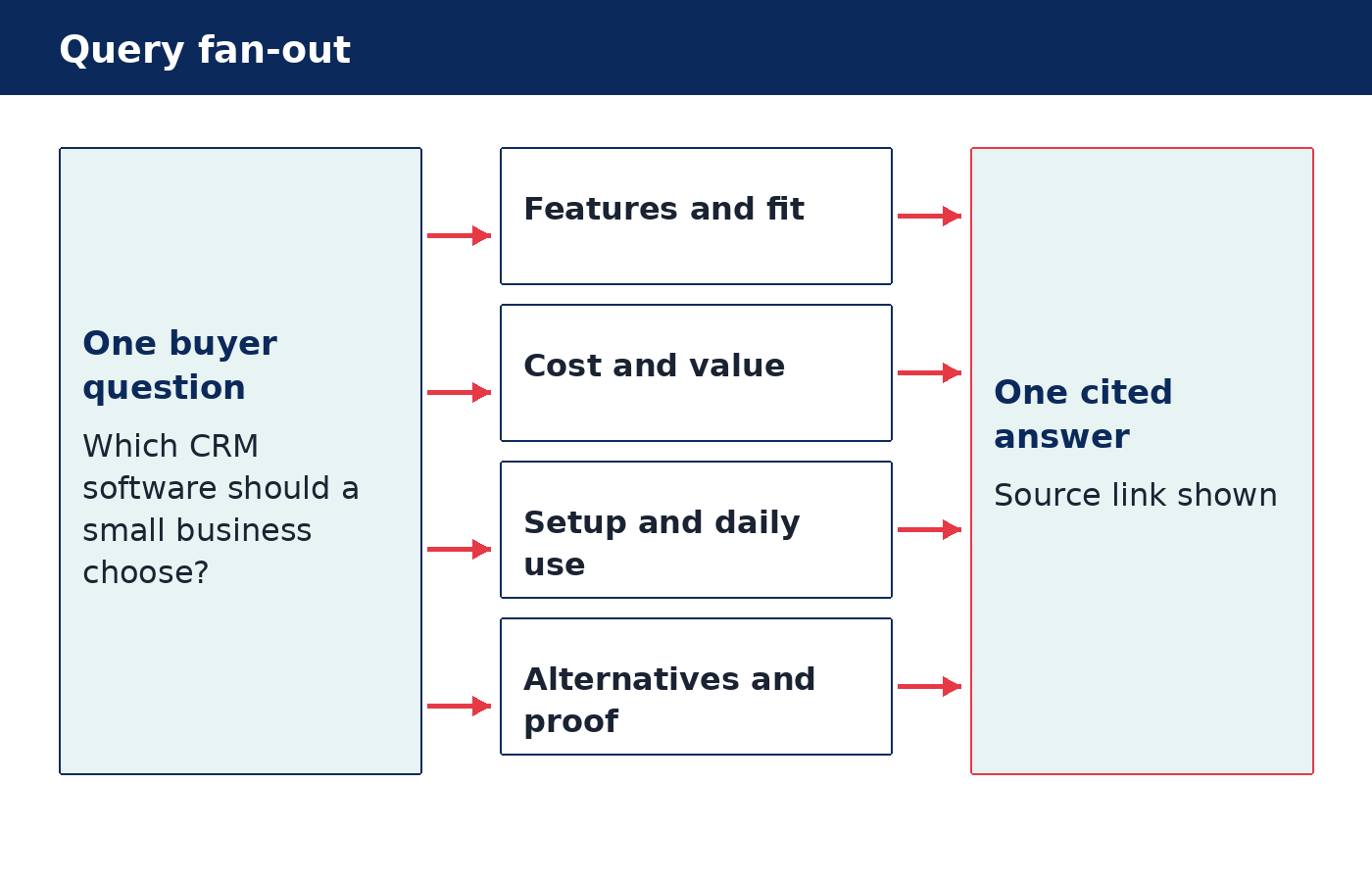
A buyer question works the same way. The example question is: Which CRM software should a small business choose?
The sub-questions behind that question fall into four themes. They cover features and fit, cost and value, setup and daily use, and alternatives and proof.
The SEO meaning here is the AI search meaning, not the older computing one.
Different AI systems do not all search in the same way or from the same index.
| Engine | How it searches, in plain words | Whose index it uses |
|---|---|---|
| Google AI Overviews and AI Mode | It splits a question into sub-queries and runs them together | The Google index |
| ChatGPT search | Sometimes it rewrites a query into targeted queries for search partners | Search partners |
| Perplexity | It runs its own crawler and index | Its own crawler and index |
The Perplexity row claims nothing about retrieval scoring.
For the wider topical authority picture, read Topical Authority SEO.
How query fan-out works, step by step
The mechanism has five steps for one user question. Steps 1 to 3 are documented, and steps 4 and 5 are inferred.
- Understand the question and its intent.
- Generate related sub-queries that cover angles the user never typed.
- Run the sub-queries at the same time against an index.
- Select passages from the pages returned. This step is inferred.
- Build one answer with links to supporting pages. This step is inferred.
They can cover cost, risk, and proof, even when the user never typed those words.
Google does not publish a fixed count for an ordinary answer. An Ahrefs guide states AI Mode typically makes 5 to 11 searches for a shopping-style example, with no sample stated.
Deep Search is a heavier research mode, announced in May 2025, that can issue hundreds of searches. Google said it would reach Labs in the coming months.
To be eligible, a page must be indexed and eligible for a snippet, and it must meet Search technical requirements. The site must also be included in Search generative AI features in Search Console. Meeting that bar does not promise a citation.
How query fan-out differs from classic search and from keyword clustering
Classic search, keyword clustering, and query fan-out are three different jobs.
| Job | Input | Output | What decides it |
|---|---|---|---|
| Classic search | One typed query | One ranked list of pages | The words typed and page rank signals |
| Keyword clustering | A list of known keywords | Groups of keywords by shared intent | Measured terms from keyword data |
| Query fan-out | One user question | Many sub-queries, run together | Inferred need behind the question |
A keyword list alone misses many sub-questions, since many have no measured volume. In the SEER vendor study of Gemini 3, global search volume was zero for 95 percent of the fan-out queries. The study used 501 prompts in November 2025 with grounding forced on.
Topic clusters help planning, but they do not predict exact sub-queries. Plan themes with clusters, not exact lists.
For the full topical map build, read How to Create a Topical Map.
What the studies say, and what they do not prove
Three studies matter most, and each used a different method. AirOps used a different engine from the other two.
For its 2025 vendor study on Google AI Overviews, Surfer took the top 10 pages for 10,000 keywords. Gemini generated 33,000 fan-out queries, and 173,902 URLs were checked.
Surfer compared pages with main-query rank plus fan-out rank with pages with main-query rank alone. The first group showed a 161 percent higher citation likelihood.
That figure is a relative lift. Surfer states the link is correlation, not cause.
Of cited pages that ranked, 51.2 percent ranked for the main query plus at least one fan-out query. Fan-out queries alone accounted for 29.2 percent, and the main query alone for the last 19.6 percent.
Citation likelihood rose with the number of fan-out queries ranked for. The Spearman correlation was 0.77.
AirOps ran a vendor study on ChatGPT only: 16,851 queries, each run 3 times, covering 353,799 pages.
Only the landing page summary was checked, and its figures are rounded.
At position 10, about 14 percent of pages were cited, against about 58 percent at position 0. Pages covering 26 to 50 percent of sub-queries were cited more often than pages covering all of them.
Laurelin ran its test on Google AI Overviews under a pre-registered design. The sample covered 235 keyword-and-country pairs. The test fold held 158 queries, 1,190 pages, and 670 cited pages.
Better rank and longer pages were linked to citation. Once rank and length were known, share answered, heading similarity, and sub-query rank added nothing to out-of-sample prediction.
The pass bar for coverage was plus 0.02. The observed change was minus 0.003. Guessed clusters averaged 16.1 per keyword, while observed fan-out averaged only 2.35 clusters.
In short, Surfer and AirOps point to focused coverage on their engines, while Laurelin found no added prediction for AI Overviews. That result does not prove coverage never helps one page. There is no guarantee, no universal count, and no cover everything rule.
Counts differ because methods differ, so plan for themes, not for one exact list.
| Engine or model | Average as reported | Measurer | Method and sample |
|---|---|---|---|
| Gemini 3 API | 10.7 fan-out queries per prompt | SEER | Grounding forced on, 501 prompts, November 2025 |
| ChatGPT | 2.1 fan-out queries per prompt | Peec | Vendor tracking, 1 to 21 April 2026, 5 million fan-outs across three engines |
| Perplexity | 1.4 fan-out queries per prompt | Peec | Vendor tracking, same Peec set, 1 to 21 April 2026 |
| Grok | 6.8 fan-out queries per prompt | Peec | Vendor tracking, same Peec set, 1 to 21 April 2026 |
Why covering sub-questions can help citation
More retrieval surfaces are the first reason, since a page that answers a sub-question can be pulled in for it. Surfer data shows this link as association only, not as proof of cause.
Passage match is the second reason, since a clearly headed section can match one sub-query cleanly. The AirOps landing page suggests heading match mattered for ChatGPT. By contrast, Laurelin found no added out-of-sample prediction for AI Overviews.
Cluster signal is the third reason: a site that answers follow-ups can look like a source.
None of this guarantees a citation on a given query.
How to map fan-out sub-questions for one topic
Follow five steps in order, for one buyer question, in buyer words.
- Write the full buyer question, not a short keyword.
- List the sub-questions an expert must answer, covering comparisons, costs, risks, alternatives, steps, and proof. Use sales and support questions, People Also Ask, autocomplete, and cited sources as inputs only, not as a Google log.
- Group the list into four or five themes by intent, not by wording.
- Map each theme to one owner: a page, a section, or a new page.
- Prioritize themes that decide a purchase or remove a blocker.
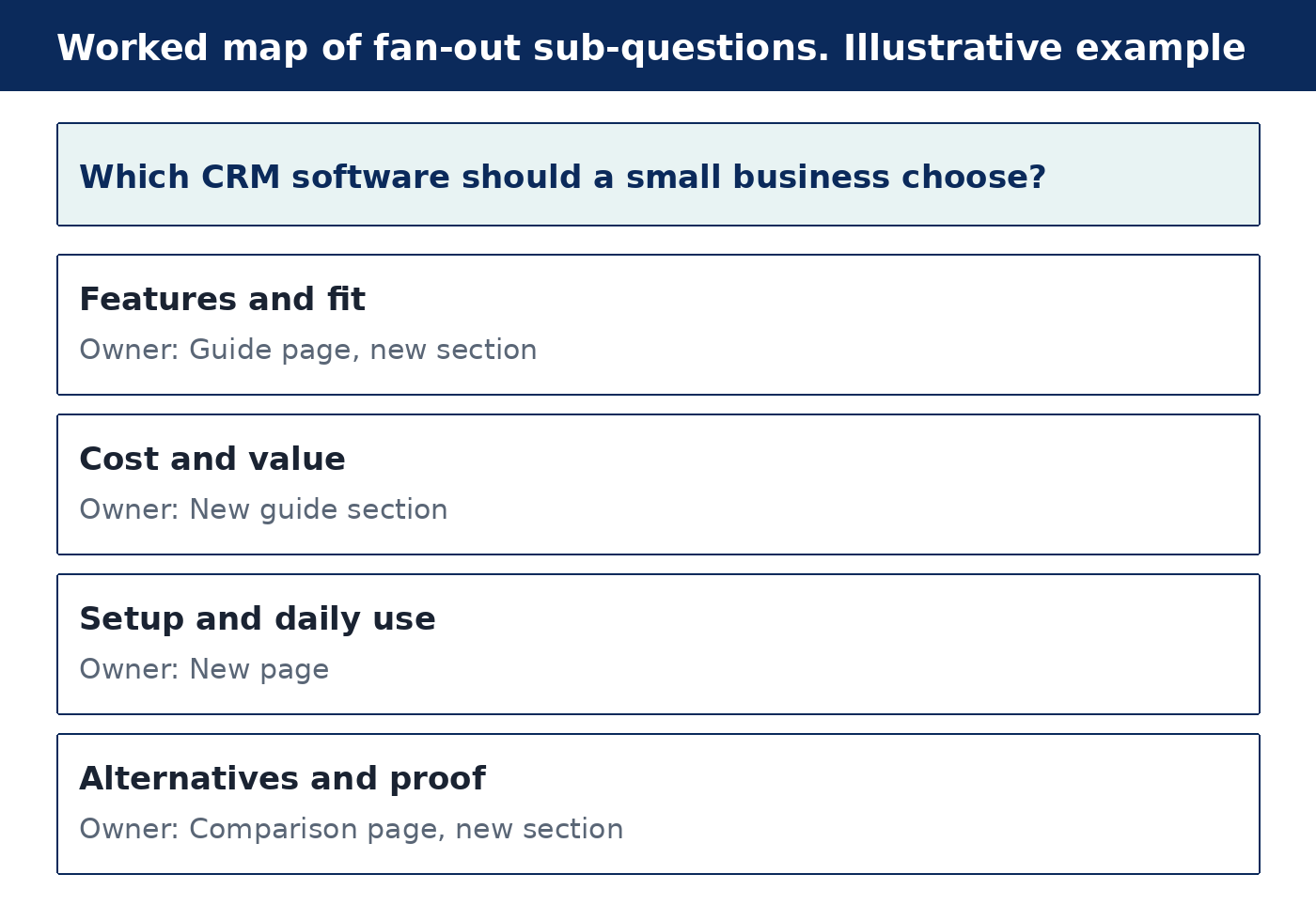
The worked example below is labeled ILLUSTRATIVE. The sub-questions are illustrative groups, not a log of what Google ran, with no volumes stated.
| Theme | Example sub-questions | Owner | Reason |
|---|---|---|---|
| Features and fit | What features does a small business need? How does it track deals? | Guide page, new section | The guide already owns the topic |
| Cost and value | What does it cost? What value does each plan add? | New guide section | Cost needs context, not a lone page |
| Setup and daily use | How long does setup take? What daily tasks does the team run? | New page | Setup is a distinct buyer task |
| Alternatives and proof | Which alternatives suit a small team? What proof supports each choice? | Comparison page, new section | Comparison already owns alternatives |
A theme with no owner needs a short decision. A theme with two owners needs one owner picked.
Add one section where it can serve. Never build competing pages.
How to write a section so it can be retrieved
Use this checklist for each section.
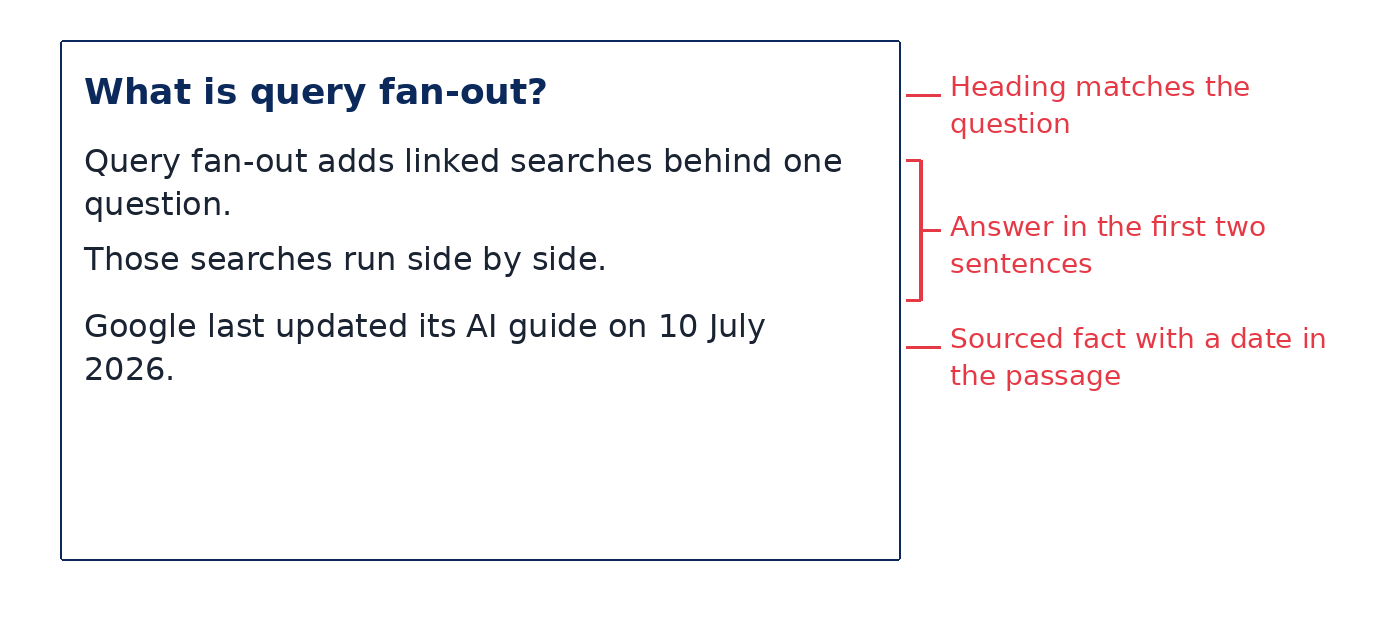
- Heading matches the question. Write the heading in the words of the sub-question.
- Answer first. Give the direct answer in the first two sentences.
- One point per passage. Keep each passage to a single point.
- Facts with source. Put the source and date in the passage itself.
- Plain words. Explain jargon in the same sentence.
- Link to owner. Link to the owner page where more depth is needed.
Facts must live in readable page text, not only in an image or behind a script. Google says no special markup is needed for generative AI search.
Freshness needs a real check date, not a changed date alone.
The first 100 words accounted for 38 percent of AI Overview citations in a Surfer vendor analysis of over 100,000 citation placements. The data was collected on 2 June 2026.
For the full citation playbook, read How to Appear in AI Overviews.
When a sub-question needs its own page, and when it does not
Use the decision table below for each sub-question.
| Sub-question type | Section or page | Test | Example |
|---|---|---|---|
| One angle of a topic | Section | Can one section answer it fully? | Cost and value |
| A distinct buyer task | New page | Does the buyer need a full task guide? | Setup and daily use |
| A wording variation | Section | Is it the same intent in new words? | A rephrased features question |
| A new subject | New page | Would buyers ask for it on its own? | A full setup guide |
Google advises against a new piece of content for each way a person might phrase a search. Pieces built mainly to steer rankings or AI answers fall under its scaled content abuse spam policy. More pages alone do not make a site better.
Use the reader test: If AI search vanished tomorrow, would buyers still ask for this page on its own? If not, build a section instead.
Instability also favors themes. In a Surfer test, only about 27 percent of fan-out queries repeated across runs.
How to check whether fan-out coverage is working
Run this check using only sources that are already available, with no paid tool required.
- Pick five to ten buyer questions from the worked map.
- Ask each question in the same AI system several times on different days, and record cited pages and themes covered.
- Check the Search Console Generative AI report by page, country, date, and device, for impressions only.
- Compare cited pages with the worked map owners, and list gaps by theme.
- Fix one gap at a time, then repeat the check after a hold period.
Google does not publish its sub-queries for a given answer; that is inference, not a Google quotation. Treat any tool list as a planning estimate, not as a log.
| Buyer question | Cited page | Theme | Gap |
|---|---|---|---|
| Which CRM software should a small business choose? | Owner page | Features and fit | None found |
| What does CRM software cost? | No owner page cited | Cost and value | Clearer answer needed |
| How long does setup take? | Owner page | Setup and daily use | None found |
For the full weekly method, read How to Measure AI Search Visibility.
Limits and mistakes to avoid
Do not build a page per phrasing, since phrasing variations share one intent and one section can serve them. Do not stuff every sub-question into one page, since one page cannot answer every angle well. Do not chase a sub-query list from one run, since sub-queries change run to run.
Do not present a vendor count as a Google count, since vendor studies measure their own samples and methods. Do not promise a citation, since no study here proves cause.
Do not treat a citation as a click. A citation is a link shown in an answer, and a click is a visit.
In the Pew study, 1 percent of visits to pages with a summary included a click on a link inside it. The panel covered 900 United States adults and 68,879 Google searches in March 2025.
Do not assume one engine result transfers to another, since engines search different indexes. Do not hide facts only in images or scripts.
Cover themes well, measure by repeat runs, and accept that citation is earned query by query.
Frequently asked questions
What is query fan-out in SEO?
Query fan-out is the extra-search step behind one AI search question. A page that answers the linked searches well has a better chance of retrieval, with no promise of a citation.
How many sub-queries does AI search run for one question?
No single count fits every engine, so work from themes instead of one fixed list. A SEER study of Gemini 3 with grounding forced on found an average of 10.7 fan-out queries per prompt. A Peec vendor study found averages of 2.1 for ChatGPT, 1.4 for Perplexity, and 6.8 for Grok.
Should I create a page for every fan-out query?
No, build a page only for a distinct buyer task or a real buyer need. Google advises against pieces built mainly to steer rankings or AI answers. A page per phrasing is the pattern to avoid.
Want help applying this to your site? Contact Imran Ali to book a free 30-minute meeting.