

GEO vs SEO vs AEO: What Is Actually Different in 2026?
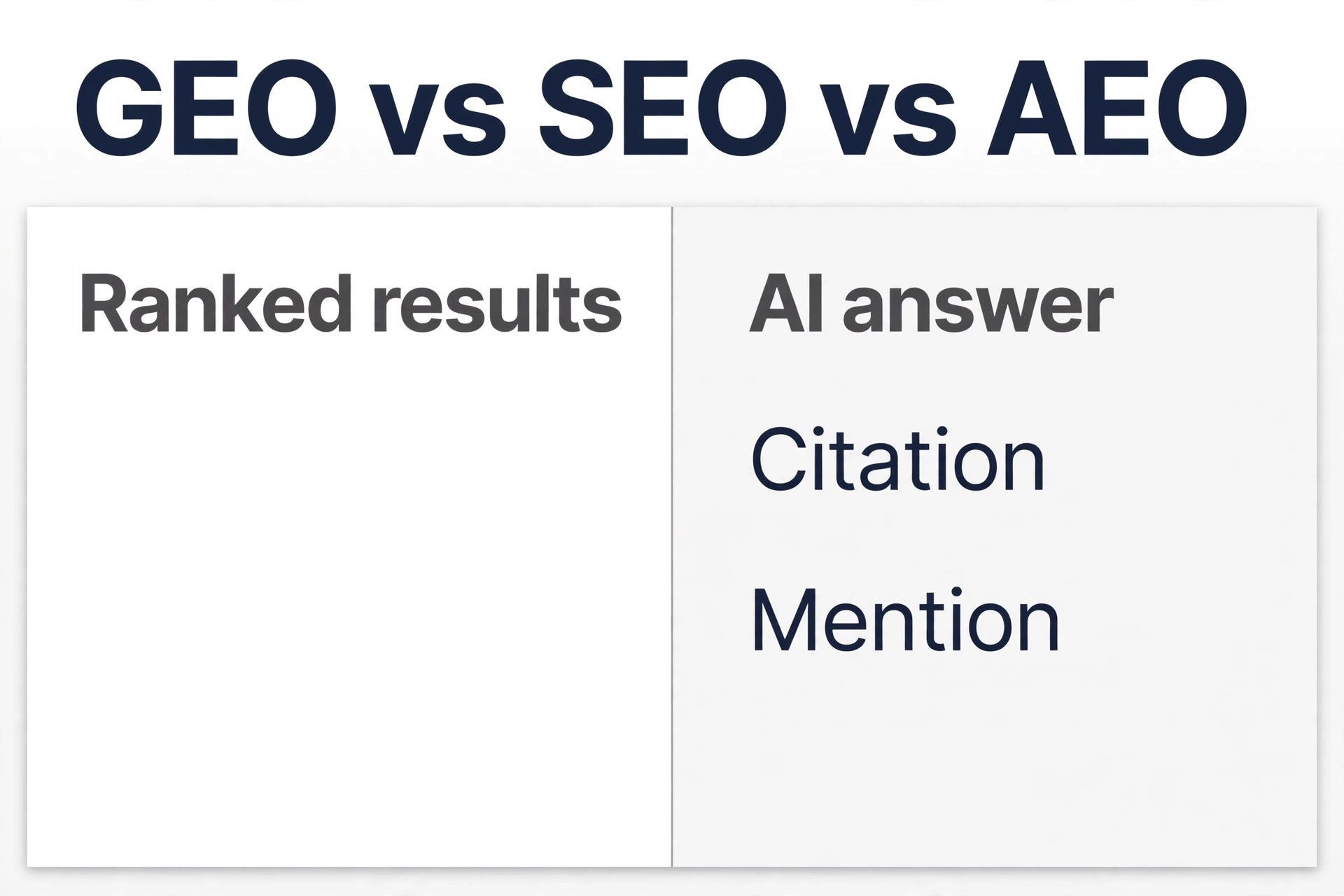
The question behind geo vs seo is how Generative Engine Optimization differs from Search Engine Optimization. SEO earns a ranked link that a searcher can judge and click. GEO earns a citation, mention, or recommendation inside an answer that an AI system writes.
The confusion costs time when work is judged by the wrong scoreboard. This article defines each term in plain words, shows what stays the same, and gives a lean way to measure each one.
What SEO means in plain words
The goal, and where the result shows
SEO means Search Engine Optimization. It is the work of making pages crawlable, indexable, relevant, and trustworthy for a search engine. The result shows as a ranked link on a Google or Bing results page.
The searcher reads the title and short text, then decides whether to click.
How a search engine works, in three steps
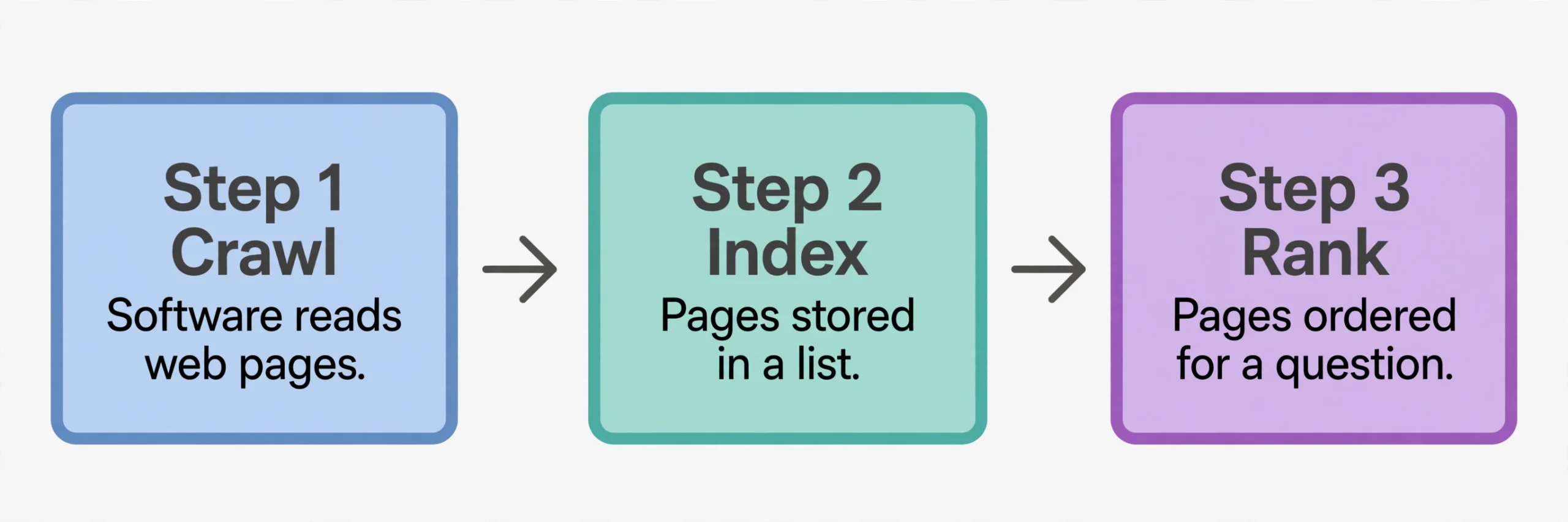
A crawler is software that reads web pages.
- First, the crawler finds pages and reads what they contain.
- Second, the search engine stores what it read in an index, a large list of pages.
- Third, the search engine ranks pages when a searcher asks a question.
What broad SEO work includes
Broad SEO includes access and speed, on-page content, online shop work, links and reputation, and measurement. Technical work is one part of it, never the whole job.
WordPress and Shopify are examples only. The same checks apply elsewhere.
What GEO means in plain words
The goal, and where the result shows
GEO means Generative Engine Optimization: work to improve how content shows inside answers written by a generative engine. The engine retrieves sources first, then writes one synthesized answer.
The result shows in ChatGPT, Gemini, Perplexity, Copilot, and Claude, and in Google AI Overviews and AI Mode.
A citation is a link to a source inside the answer. A mention is the brand name in the text, with no link.
Where the term came from
The term comes from a Princeton-led paper by Aggarwal and colleagues. It appeared on arXiv in November 2023, and was published at KDD in August 2024.
GEO-Bench used 10,000 queries from 9 sources and 25 domains. Most were informational (80 percent), with 10 percent transactional and 10 percent navigational.
The test used the top 5 Google results per query. The paper tested methods on a simulated engine and Perplexity, and did not measure clicks, leads, or revenue.
Cite Sources, Quotation Addition, and Statistics Addition did best in the lab. They achieved a relative improvement of 30 to 40 percent on the Position-Adjusted Word Count metric. They achieved a relative improvement of 15 to 30 percent on the Subjective Impression metric, against an unmodified source baseline.
These are lab results only, not a promise.
GEO does not mean geographic SEO
GEO here does not mean geographic SEO. Geographic and local SEO serve place-based searches, and readers needing place-based work should use a local SEO guide.

What AEO means, and why it is not the same as GEO
AEO in plain words
AEO means Answer Engine Optimization. It is an industry label, not a term set by a standards body, and it is not a separate Google system. In this article, AEO is the work of supplying one self-contained passage that a system can lift as a direct answer.
The surfaces are featured snippets, People Also Ask, voice answers, and direct answers in AI Overviews and chat tools. A site owner cannot mark a page as a featured snippet. Google systems decide.
The test that separates AEO from GEO
Labels are used loosely, and pages often swap meanings. This test is the article’s own working distinction, taken from the wider SERP comparison pages. It is not a rule from Princeton, Google, OpenAI, or Perplexity.
Exact wording that is shown means an AEO win under this test. New wording that names or links the brand means a GEO win under this test.
Question: How long does a new page take to appear in Google search? An AEO win is the exact passage shown, in the searcher’s words or close to them. A GEO win is a new answer naming the brand and linking the page.
LLMO in brief
LLMO means Large Language Model Optimization, a loose label with no settled definition. It has no peer-reviewed origin, and it is not used in Google’s generative AI guide. Some people use it to mean the way large language models describe a brand accurately across engines.
That includes answers written from what a model already holds, not only from a live web search. It is not a separate system with separate tactics. A site owner cannot edit training data or control what a model already holds.
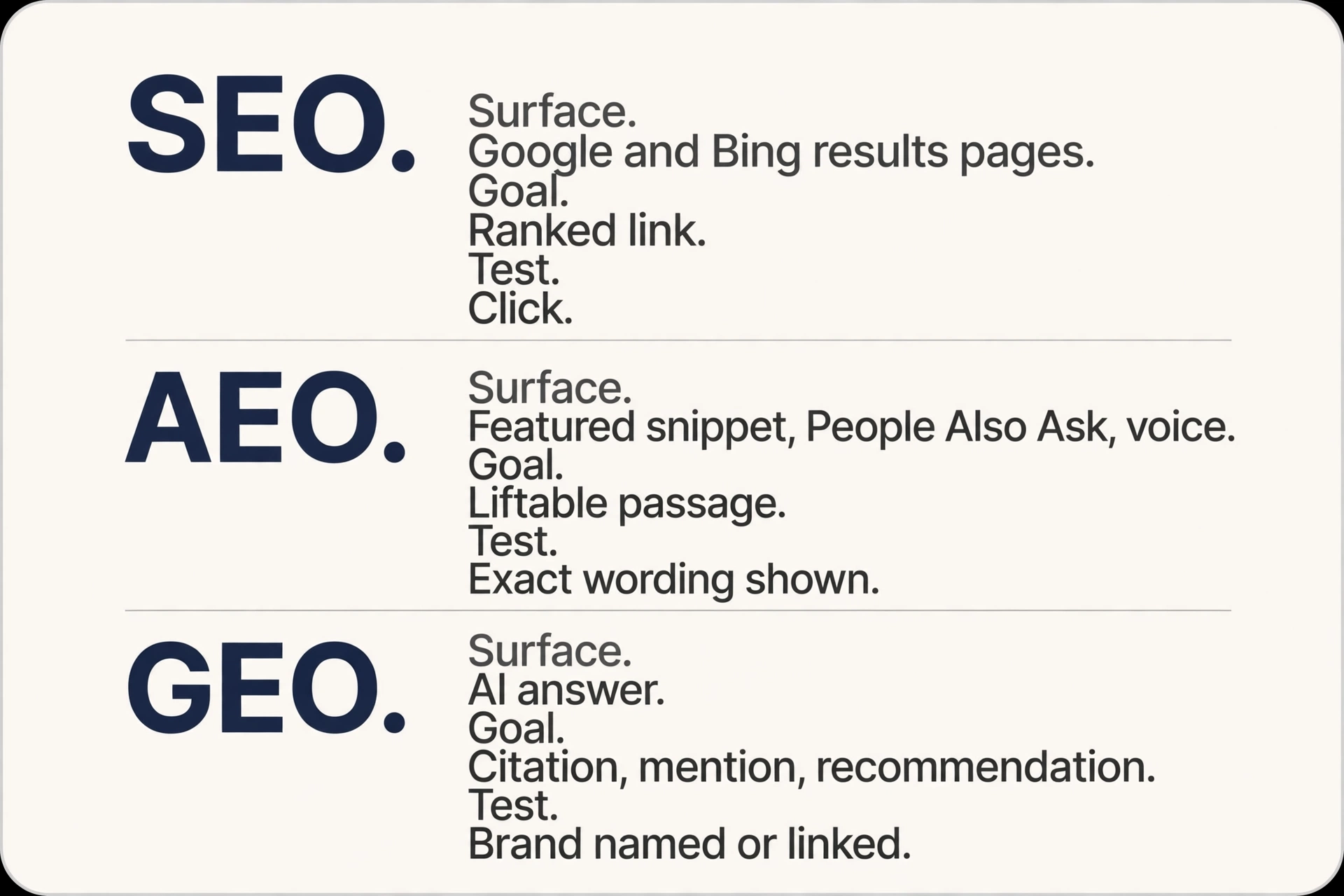
GEO vs SEO vs AEO at a glance
| Point | SEO | AEO | GEO |
|---|---|---|---|
| Main goal | Ranked link | Liftable passage | Citation, mention, recommendation |
| Where it shows | Google, Bing results | Snippets, People Also Ask, voice | AI answers, AI Overviews |
| Unit of work | One page for one intent | One passage for one question | One passage plus facts a system can check |
| Query shape | Short phrases | One direct question | Long prompts: budget, limits, comparisons |
| Content unit | A full page | A self-contained passage | Passages, facts, mentions |
| Main authority source | Links, site trust | Clear passage, page quality | Mentions, reviews, lists, consistent facts |
| How success is measured | Position, impressions, clicks, click rate | Passage shown | Mention rate, citation rate, share of voice |
| Main payoff | Visit to an owned page | The answer, source named | Brand notice, with or without a click |
Read the table as layers, not rivals. Each row names one job, and the jobs overlap.
SEO, AEO, and GEO share foundations. They differ in surface, unit, and measure.
What stays the same
Five points stay the same.
- Crawlable and indexable pages. Pages must be found and stored before any surface can show them.
- Relevance to the question. Each page must match the question the searcher asked.
- Trust and reputation signals. Signals from links, mentions, and reviews help a system trust a page.
- Helpful original content. Content must add value that a reader cannot find elsewhere.
- Site quality basics. Speed, clean structure, internal links, and structured data used accurately all matter.
Google states a page must be indexed and eligible to be shown in Google Search with a snippet. It must fulfill the Search technical requirements. That makes it eligible to be shown as a supporting link in AI Overviews or AI Mode, with no additional technical requirements.
In 2026, the site must also be included in the Search generative AI features control in Search Console. Eligibility does not guarantee display. Weak SEO foundations limit both surfaces.
What is actually different
1. The unit of success changes
SEO counts a rank and a click. GEO counts a citation, mention, or recommendation inside an answer. Zero click means the answer satisfies the searcher with no visit.
Brand recall can still matter, but recall is not the same as a lead.
2. Queries look different, and fan-out
SEO queries are short phrases. GEO prompts are long, with budget, place, limits, and comparisons. Query fan-out breaks one complex prompt into related sub searches.
Google defines fan-out as a set of concurrent, related queries generated by the model. They request more information and fetch additional relevant search results to address the user query.
That means covering the full topic and follow-up questions, not one head phrase alone. See query fan-out SEO.
3. Authority comes from more places
Links still matter for SEO, and they still signal trust for a page. For GEO, third-party mentions, reviews, lists, forums, and consistent facts across the web carry more weight.
Ahrefs studied 75,000 brands in a study published on 26 May 2025 and updated on 27 April 2026. Mentions correlated most strongly with AI Overview visibility, at 0.664, against 0.527 for anchors, 0.392 for search volume, and 0.218 for backlinks. The result is a Spearman correlation only.
The sample was limited to domains with Domain Rating above 40 and their highest-volume keyword of at least 800 searches a month. About 26 percent of the domains with zero mentions were excluded.
This covers AI Overviews only. Correlation is not proof of cause.
4. Content format changes in emphasis
An AI system reads one section at a time, not a whole page at once. When the direct answer opens a section, the system can use that section without hunting through the rest of the page.
Still, short content does not always win, and a thin page with no proof can lose to a full page with proof.
5. Measurement changes completely
SEO counts position, impressions, clicks, click rate. GEO counts mention rate, citation rate, share of voice as rates across repeats. One screenshot proves nothing.
6. Crawler and access controls change
Blocking the wrong user agent has a clear cost. OpenAI settings are independent.
For OpenAI search, changes can take about 24 hours to take effect. For Perplexity, changes may take up to 24 hours to take effect.
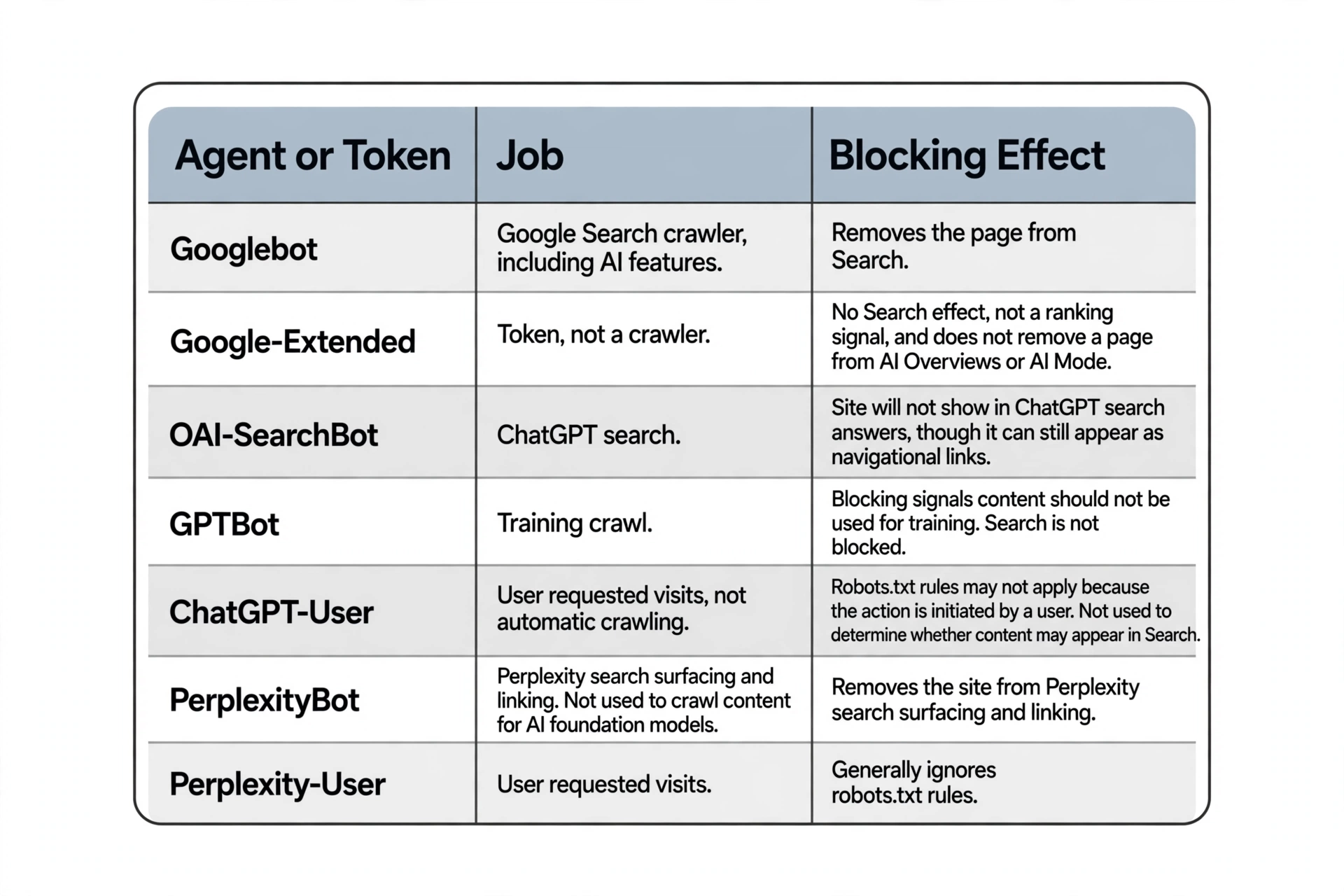
| User agent or token | Job | What blocking does |
|---|---|---|
| Googlebot | Google Search crawler, including AI features | Removes the page from Search |
| Google-Extended | Token, not a crawler | No Search effect, not a ranking signal, and does not remove a page from AI Overviews or AI Mode |
| OAI-SearchBot | ChatGPT search | The site will not show in ChatGPT search answers, though it can still appear as navigational links |
| GPTBot | Training crawl | Blocking signals content should not be used for training. Search is not blocked. |
| ChatGPT-User | User-requested visits, not automatic crawling | Robots.txt rules may not apply because the action is initiated by a user. It is not used to determine whether content may appear in Search. |
| PerplexityBot | Perplexity search surfacing and linking. It is not used to crawl content for AI foundation models. | Removes the site from Perplexity search surfacing and linking. |
| Perplexity-User | User-requested visits | Generally ignores robots.txt |
Put main content in the HTML the server sends, since content that appears only after scripts run can be missing. A Vercel and MERJ observation was published on 17 December 2024. It was a dated third-party measurement on the sites in a one-month window, not vendor policy.
It found no JavaScript rendering by the major AI crawlers observed. ChatGPT and Claude crawlers fetched JavaScript files in 11.50 percent and 23.84 percent of requests respectively, without executing them. They cannot read client-side rendered content.
Googlebot is different. Google states it is able to process content within JavaScript as long as the JavaScript is not blocked.
How a search and an AI answer each work, step by step
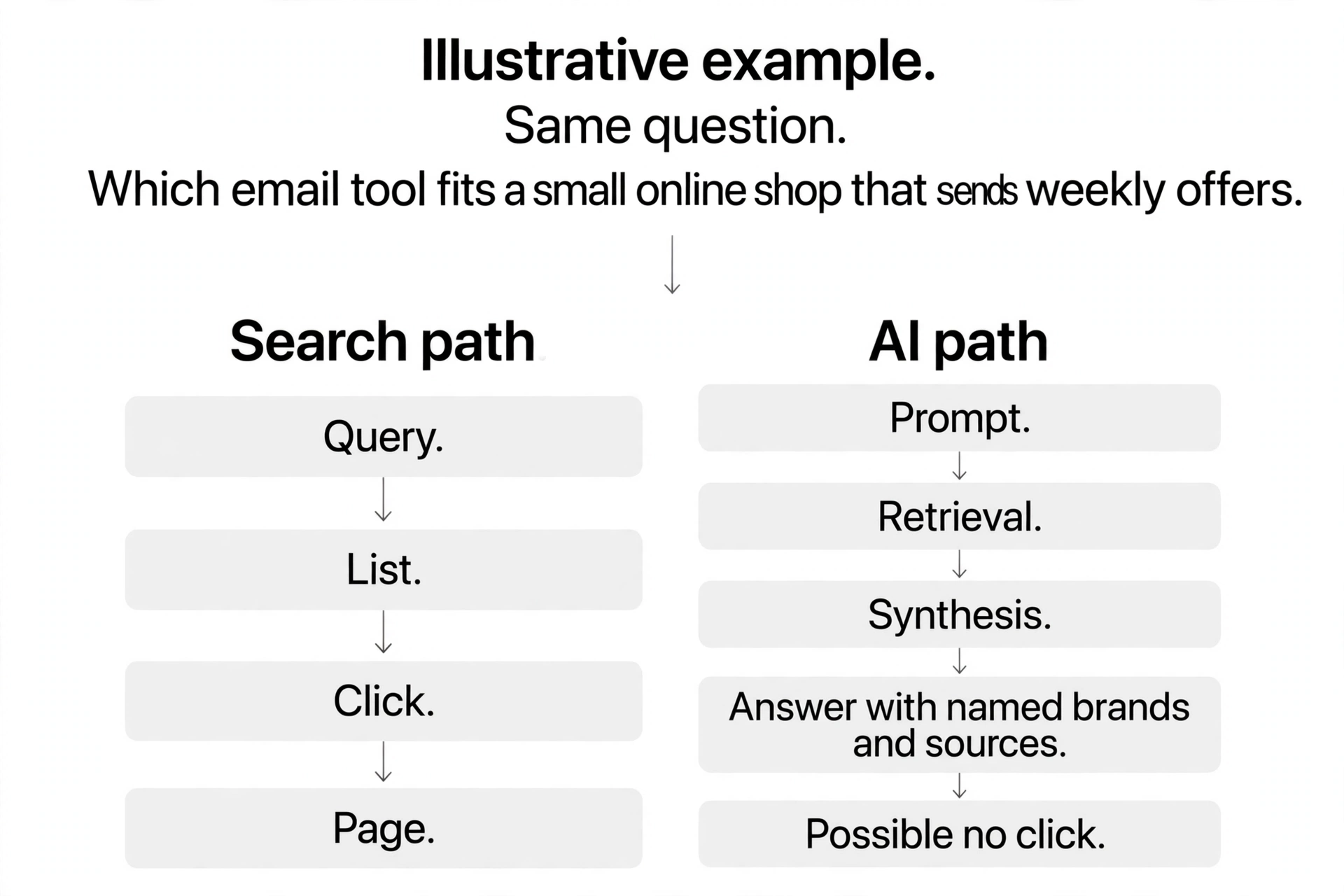
Take this illustrative question: Which email tool fits a small online shop? No real brand is named.
The Google path is type, list, click, page. The AI path is prompt, retrieval, synthesis, and an answer with named brands and sources, which may end with no click.
Fan-out adds sub questions on price, size, ease of use, and rivals. The intent is the same. The surfaces and the scoreboards differ.
Is GEO replacing SEO?
No. Clicks fall with an AI summary.
In the Seer analysis below, cited brands kept more clicks than uncited brands on informational queries. SEO foundations still decide eligibility, not citations on their own.
Pew studied 900 US adults in the KnowledgePanel Digital panel and 68,879 unique Google searches in March 2025. Of those searches, 12,593 produced an AI summary. The study was published on 22 July 2025.
With a summary, clicks on a traditional search result link were 8 percent of all visits, against 15 percent without one. Clicks to the first 3 links cited in a summary occurred in just 1 percent of all visits. That figure covers visits to pages with such a summary.
Browsing sessions ended on 26 percent of pages with an AI summary, against 16 percent with only traditional results.
This is observational, Google-only data, with no proof of cause. The summary for a given search may change over time.
Seer studied 53 brands, 5.47 million queries, and 2.43 billion impressions from January 2025 to February 2026. The study was published in April 2026.
The analysis covers informational queries in the full year 2025. Being cited in an AI Overview delivered about 120 percent more organic clicks per impression versus when not cited.
It still underperformed the no-AI-Overview case by about 38 percent. Per 1 million organic impressions on informational queries, about 33,500 clicks came with no AI Overview. On the same basis, about 20,743 clicks came when cited, and about 9,445 when not cited.
This is agency client data, not a random sample; Seer warns against extrapolating 2025 into 2026 planning. AIO status is a static label from the most recent SERP snapshot, applied back across all months. March 2026 figures are projections from an OLS model with no seasonality adjustment.
Ahrefs checked 15,000 long-tail queries in early July 2025, published on 11 August 2025. On average, only 12 percent of links cited by the assistants appeared in the Google top 10 for the original prompt. That 12 percent is 11.9 percent, the average of five sets.
Perplexity scored 28.6 percent, Gemini 8.6 percent, Copilot 8.2 percent, ChatGPT in-text citations 8.0 percent, and ChatGPT references 6.1 percent. This covers the original prompt only, not related fan-out queries.
Data may have changed since early July 2025.
Fix SEO foundations first, then add GEO measurement where AI answers already shape the buying questions.
What to do in practice: one page that serves both
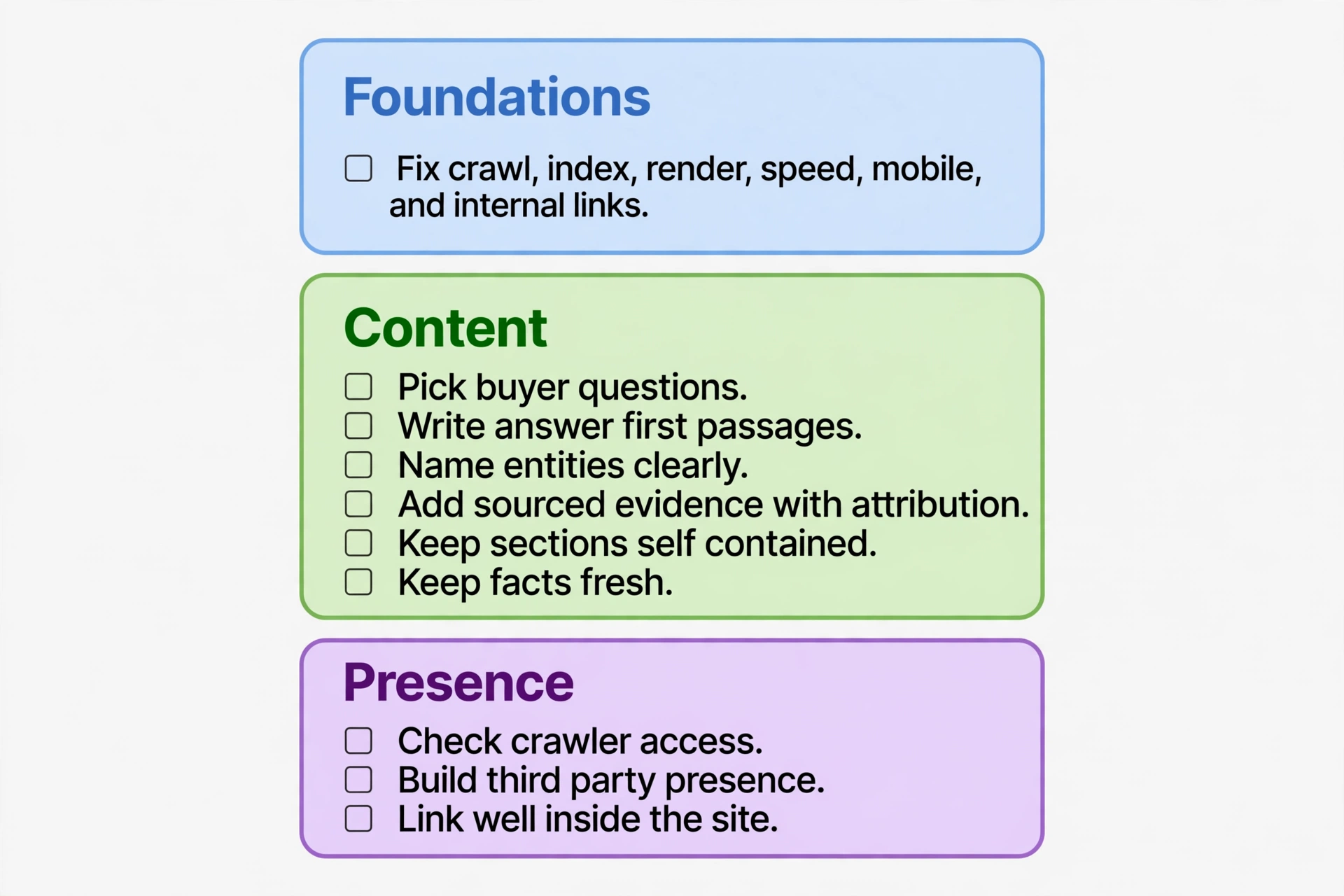
- Fix foundations first. Check crawl, index, render, speed, mobile, and internal links.
- Pick buyer questions first. Use real buyer language from sales calls, support questions, and demo forms, not only keyword tool phrases.
- Write answer-first passages. Put the direct answer first under each heading.
- Name entities clearly. Write business and product facts the same way everywhere.
- Add evidence a system can check. Use sourced statistics with a named source and date, and quotations with attribution. Add original data or firsthand testing where it exists, and cut claims with no source.
- Keep sections self-contained. Each section must make sense alone, with the brand and product named in the text, not only as ‘we’ or ‘our tool’.
- Keep facts fresh. Update statistics when facts change. A new date alone is not freshness.
- Check crawler access. Run the crawler check before blocking any agent.
- Build third-party presence steadily. Earn reviews, lists, comparisons, and consistent profiles. No single mention promises a citation.
- Link well inside the site. Use clear headings, descriptive links, and coverage of follow-up questions.
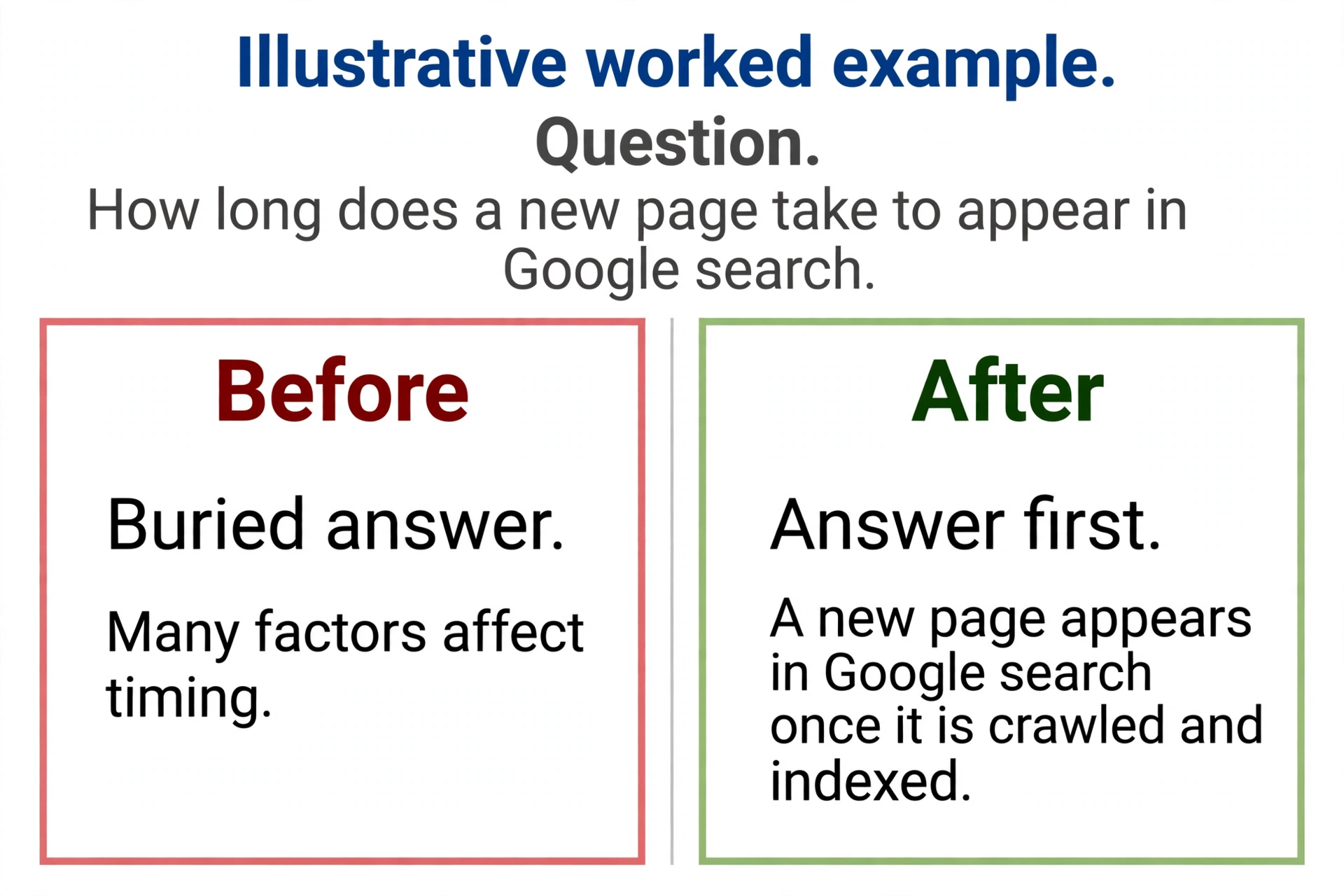
This worked example is illustrative only. Question: How long does a new page take to appear in Google search?
Buried: “Many factors affect timing.” Answer-first: “A new page appears in Google search once it is crawled and indexed.”
The second form serves all three uses at once. It gives a ranking page a clear answer at the top of a section. It gives a direct answer system one passage to lift, and an AI system one clear fact to cite.
See how to get cited in ChatGPT, Services, and Process.
How to measure each one without mixing them up
SEO measures
SEO measures: rankings, impressions, clicks, click rate, leads, revenue in Search Console and GA4.
Rankings and impressions show visibility, not value on their own. Clicks show visits, not leads or revenue. Leads and revenue show business value, but they do not prove which single change caused them.
GEO measures, read as rates
GEO measures: mention rate, citation rate, share of voice, recommendation rate, accuracy, AI referrals in GA4. Each figure is counted inside the chosen question set.
A weekly manual routine without a paid tracker
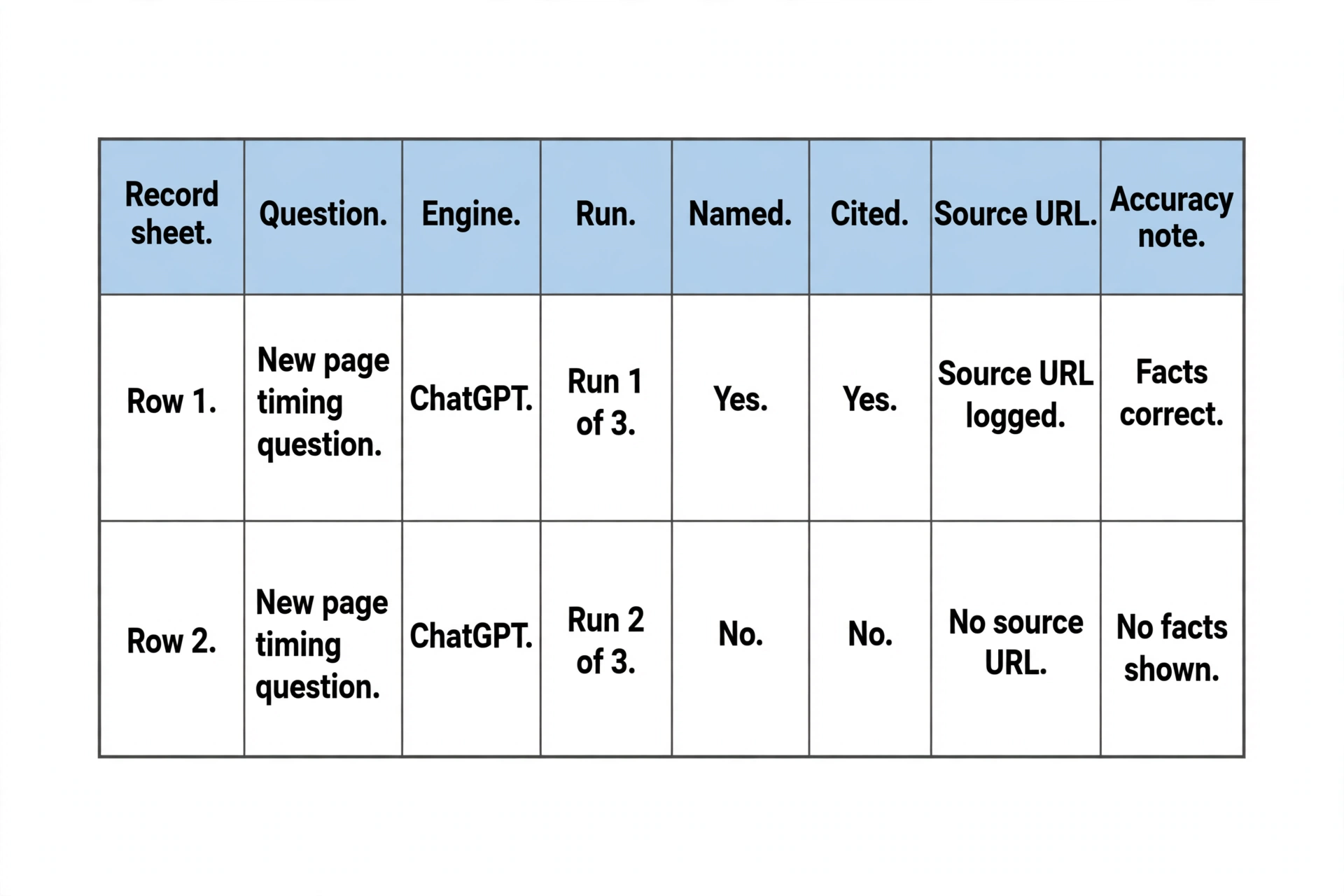
Build 10 to 15 buyer questions, split by stage. Run each question in each chosen engine on the same day each week. Repeat each question more than once, and record the rate across repeats, never from one run.
Record whether each run was named, cited, recommended, absent, or wrong. Log the source URLs cited for each run. Check accuracy of brand facts in each answer.
Compare week to week on the same question set. Record a baseline before changes. Read change over several weeks, not after one run.
| Question | Engine | Run | Named | Cited | Source URL | Accuracy note |
|---|---|---|---|---|---|---|
| New page timing question | ChatGPT | Run 1 of 3 | Yes | Yes | Source URL logged | Facts correct |
| New page timing question | ChatGPT | Run 2 of 3 | No | No | No source URL | No facts shown |
See how to measure AI search visibility.
Connect both to pipeline
The same measures apply to both: leads, pipeline, revenue. Use GA4 channel grouping for AI referrals, a ‘how did you find us’ field, and CRM first touch. Part of AI value arrives as branded search or direct visits, not as a clean AI referral.
Common mistakes and myths
Myth 1: GEO is just SEO with a new name. GEO shares foundations with SEO, but adds a different scoreboard.
Myth 2: GEO means geographic SEO. GEO here means Generative Engine Optimization, for AI answers.
Myth 3: A high ranking guarantees an AI citation. Ahrefs found, on average, only 12 percent overlap with the Google top 10 for the original prompt. Perplexity was the outlier at 28.6 percent.
Myth 4: Schema markup alone earns AI citations. For Google Search, Google states no special schema is needed. An Ahrefs test covered 1,885 pages that added JSON-LD between August 2025 and March 2026.
It was matched against 4,000 control pages and was measured 30 days before and 30 days after. It found no major uplift in citations for pages already cited. Every page in the cohort already had 100 or more AI Overview citations in February 2025.
So it cannot speak to pages not yet cited.
Myth 5: An llms.txt file guarantees citations. Google Search does not use llms.txt files. The idea is a Jeremy Howard proposal, dated 3 September 2024.
Myth 6: Blocking GPTBot also blocks ChatGPT search. OpenAI settings are independent. GPTBot controls training use only.
Myth 7: One AI run that names the brand proves GEO works. Answers vary from run to run. Read GEO as a rate across repeats.
Myth 8: GEO replaces SEO, so SEO work can stop. Google states this work is still SEO. A page must be indexed and eligible to be shown in Google Search with a snippet.
The site must be included in the Search generative AI features control in Search Console. That supports an AI Overview or AI Mode link.
Which one first: a decision guide by situation
| Situation | Start with | Add next | Watch out for |
|---|---|---|---|
| New site, thin pages | SEO foundations, core pages | Answer-first passages | Thin pages answering nothing fully |
| Crawl or index problems | Crawl, index, render fixes | GEO measurement after pages can be read | Blocking a needed crawler |
| Ranks well, absent from AI answers | Answer-first passages, checked facts | Third-party mentions, lists | Judging GEO from one run |
| Named in AI answers, few clicks | Titles, snippets, page value | Citation and click checks | Counting mentions as leads |
| Online shop, category and product pages | Category intent, speed, links | Comparison passages, product facts | Facts differing across pages |
| SaaS, comparison and pricing pages | Comparison intent, clear facts | Third-party lists, reviews | Pricing facts going stale |
| Service business, place-based demand | SEO foundations, local SEO separately | Answer-first passages | Treating this as a local SEO guide |
A new site needs core pages first, each answering one buyer question fully. A site with crawl or index problems needs access fixes first, so pages can be read at all.
A site that ranks well but is absent from AI answers needs answer-first passages and checked facts. A site named in AI answers but short on clicks needs stronger titles, snippets, and page value.
An online shop needs category intent and product facts kept the same everywhere. A SaaS business needs comparison facts kept fresh, so pricing facts stay correct.
A service business with place-based demand needs local SEO as a separate job, alongside this guide.
Fix foundations first, then add GEO measurement, then act on citation gaps. No site needs two separate content libraries. One useful page, shaped for both surfaces, beats a second library labeled AI content.
FAQ
What is the difference between GEO, SEO, and AEO?
SEO earns a ranked link a searcher can click. AEO supplies one passage a system can lift as a direct answer. GEO earns a citation, mention, or recommendation inside an AI answer.
Does GEO mean geographic SEO?
No. GEO here means Generative Engine Optimization, for AI answers. Geographic and local SEO serve place-based searches, as a separate job.
Can GEO replace SEO, and what should a small business do first?
No, GEO cannot replace SEO, and Google states this work is still SEO. Pew found traditional link clicks at 8 percent of visits with a summary, against 15 percent without one. First 3 cited clicks were 1 percent, and sessions ended on 26 percent of summary pages, against 16 percent without one. Seer put the cited gain at about 120 percent more clicks per impression, yet about 38 percent below no AI Overview. Fix crawl, index, speed, and relevance first, then add answer-first passages and a weekly rate check, with limits in the evidence section.
Want help applying this to your site? Contact Imran Ali to book a free 30-minute meeting.