

AI Search Traffic Is Small but Converts: What the GA4 Data Really Says

The AI search traffic conversion rate is the share of AI visits that complete a chosen action. That action can be a lead form, a signup, or a purchase. The share is often higher per visit than for Google organic search, while total AI visits stay small.
Total AI conversions stay small, even when the rate looks high. This article puts the studies side by side and shows a GA4 check you can run.
What the GA4 data says in one table
No single headline multiple tells the full story. Each study used a different sample, action, and comparison channel.
The Haynes figures below are as reported in the Search Engine Journal reproduction dated 21 October 2026. The primary Haynes page was not directly verified in this check. The window, industry mix, conversion definition, and pooled or median basis are not stated.
The studies side by side
| Study | Sample and dates | Result |
|---|---|---|
| Semrush | 500+ topics, 2025 | 4.4x vs traditional organic |
| Ahrefs | One site, June 2025 | 23x, 0.5% traffic, 12.1% signups |
| Seer | One client, Oct 2024 to Apr 2025 | ChatGPT 15.9% vs Google 1.76% |
| Clarity | 1,277 domains, Nov 2025 | Sign-up 1.66% vs 0.15%, Subscription 1.34% vs 0.55% |
| Adobe | US retail, July 2026 | 60% higher vs non-AI |
| Kaiser, Schulze | 973 sites, Aug 2024 to July 2025 | Below traditional, except paid social |
| Orbit | 97 sites, July 2025 to June 2026 | Pooled 3x, median 7x |
| Siege | 78 sites, Jan to May 2026 | Median 1.26x |
| Haynes | 100 sites, 12 months, conversion on 55 sites | ChatGPT 13.8% vs Google 3.02% |
| SEO Works | 95 sites, Sep 2025 to Aug 2026 | Pooled 1.18x, median 1.21x |
| Amsive | 54 sites, six months | 4.87% vs 4.60%, not significant |
| Visibility Labs | 94 stores, Jan to Dec 2025 | ChatGPT 1.81% vs non-branded 1.39% |
| Study | Definition vs channel | Limit |
|---|---|---|
| Semrush | Rate-based, vs traditional organic | Method unpublished |
| Ahrefs | Signups vs traditional organic | One site only |
| Seer | Key events vs Google organic | One anonymous client |
| Clarity | Smart Events vs Search | Publisher only, one month |
| Adobe | Retail conversion vs non-AI | US retail only, no base rates |
| Kaiser, Schulze | Transactions vs traditional channels | Ecommerce only, ends July 2025 |
| Orbit | Tiered events vs other organic | B2B lead sites only |
| Siege | KeyEventRate vs traditional | Revenue numbers unpublished |
| Haynes | Conversions vs Google organic | Window, industry not stated, conversion subset 55 sites |
| SEO Works | Key events, upper bound, vs organic | Rates 63 sites, totals 95 sites |
| Amsive | Session-based macro conversions vs organic | Mean gap +0.27pp, median gap +0.09pp, p = 0.794, not significant; most recent six months per site |
| Visibility Labs | Purchases vs non-branded organic | No date, early months thin |
Caption: Two tables show 12 studies with sample, result, definition, and limit kept together.
How to read the table without being misled
Rule 1, read the sample. Always read the sample and the comparison with the multiple. A 23x result from one site does not carry the weight of a median from 78 sites.
Rule 2, one site is not a market. A single-site result shows what is possible on that site. It does not show what is typical across many sites.
Rule 3, an estimate is not a measure. The Semrush 4.4x figure is a 2025 published estimate, and its method is unpublished. It must never be read as a measured benchmark.
Small volume, higher rate, and why both facts matter
Volume and rate answer different questions. Volume asks how many visits arrive, and rate asks how often those visits act.
Volume first, how small is small
Samples and dates for every share below are in the tables above. Orbit reports 0.5 percent of all traffic, and Siege reports 0.2 percent to 3 percent of total sessions. Haynes reports ChatGPT at 0.62 percent of Google organic sessions, and all LLMs at 0.73 percent.
The SEO Works reports 2.6 percent of organic sessions overall, and 3.86 percent in August 2026. Clarity reports under 1 percent of overall traffic, and Seer reports 0.07 percent of organic traffic.
Semrush reports 0.14 percent of visits, and Amsive reports 0.24 percent of sessions. Never mix these denominators into one share figure, as each share has its own base.
Rate second, what higher per-visit conversion means
Conversion rate means conversions per 100 sessions. A rate of 7 percent means about 7 conversions for every 100 sessions.
A higher rate means the small group that arrives converts more often per visit. It does not mean more conversions in total.
Total conversions, the number that decides budget
Total conversions equal sessions multiplied by rate, for the same sites and dates. A high rate on a tiny base is still a small total. That total decides whether a channel can justify a budget shift.
Haynes reports 964 Google organic conversions against 36 from all LLMs, on 55 sites. In the SEO Works panel, 5,001 conversions came from AI. Organic search accounted for 155,605 conversions.

Why the headlines disagree
Headlines disagree because honest studies measure different things. The range is expected once the sample, definition, baseline, and industry are kept in view.
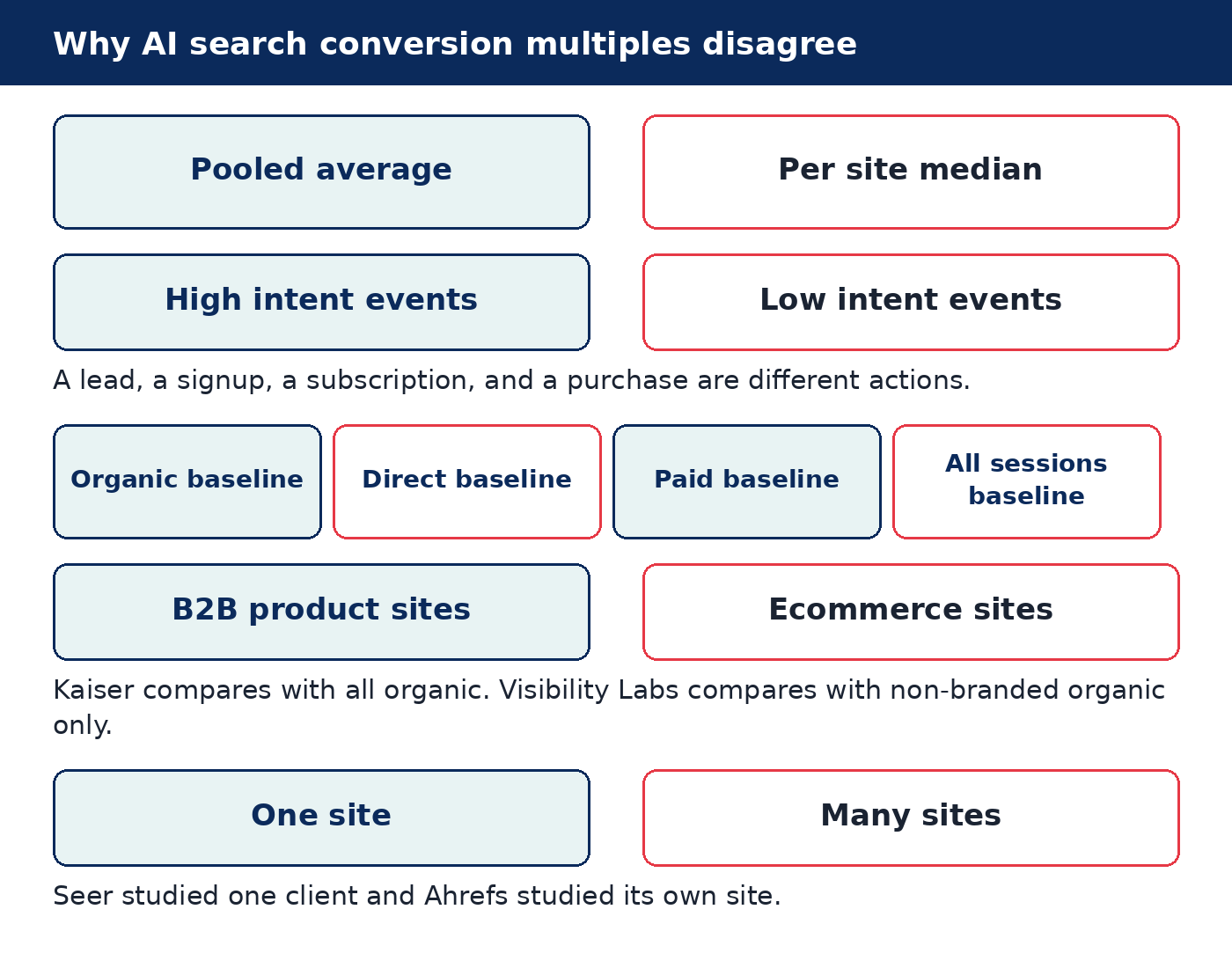
Pooled average versus per-site median
A pooled average adds all sessions together, so large sites dominate the result. A per-site median ranks each site equally, so small sites count as much as large sites.
Orbit shows the contrast in one dataset. The pooled result is 3x, and the per-site median is 7x, for the same B2B panel.
The SEO Works shows a closer pair, with pooled 1.18x and median 1.21x.
Different conversion definitions
Each site marks its own actions as key events, so one rate can hide different actions. A lead, a signup, a subscription, and a purchase are different actions. A study that counts signups will show a higher rate than one that counts only purchases.
Before Orbit compared rates, it placed each event in an intent group. A phone call click, a demo request, and a contact form all sat in the high-intent group.
The low-intent group held a webinar signup, a newsletter signup, and a report download. For low-intent actions, the AI rate ran at double the rate for other sources.
Different comparison channels
Swap the comparison channel, and the multiple from that panel moves. Against direct traffic the ratio was 2.48x, and against paid search it was 0.67x. Against organic search it was 1.18x, and against all sessions combined it was 1.37x.
The traffic stayed the same. Only the comparison changed. Always ask: higher than what?
Different industries and different sites
Industry changes the answer. Siege reports 1.67x for financial services, 1.29x for consumer and local services, and 1.27x for travel and real estate.
Siege also reports 1.05x for B2B SaaS, and 1.01x for ecommerce.
The SEO Works reports B2B product sites at a pooled 0.62x, across 10 sites, with AI worse on 6 of 10. Kaiser and Schulze found ChatGPT below organic search for ecommerce.
Visibility Labs found ChatGPT above non-branded organic for ecommerce. Keep both ecommerce findings with their different baselines.
One site is not a market
Seer studied one anonymous client, and Ahrefs studied its own site. Single-site results show what is possible on one site, not what is typical.
In Siege’s panel, the AI rate was no lower than the traditional rate on 72 percent of sites. Of the 63 sites in the SEO Works panel, 23 showed AI below organic. Amsive found no significant difference across 54 sites (paired t-test, p = 0.794).
What GA4 counts and what GA4 misses
GA4 reports only visits it can classify from a referrer or a channel rule. AI influence reaches further than the AI referral row. GA4 shows only the visits it can place, so the full AI total runs higher.
The AI Assistant channel and its start date
GA4 added a built-in AI Assistant channel on 13 May 2026. The channel sits in the Default Channel Group, with medium ai-assistant and campaign (ai-assistant).
Google names examples only, and does not publish the full list of recognized referrers. Examples are ChatGPT, Gemini, DeepSeek, Copilot, and Grok; Claude appears in the release note. Check Session source values in your own property to see which assistants send visits.
View the channel at Reports, then Acquisition, then Traffic acquisition, with Session default channel group as the primary dimension. Check the first date the AI Assistant row has data in your own property.
AI Overview clicks inside organic search
Clicks from Google AI Overviews and AI Mode arrive as ordinary organic search sessions. They are real AI-influenced visits, but they sit inside the organic baseline. That makes organic look stronger, and AI share look smaller.
Do not add an estimate for this share unless a primary source verifies it. For click loss, see what happens to clicks when an AI Overview is present.
App visits with no referrer inside Direct
Visits from AI apps often carry no referrer, so GA4 files them as Direct. The tracked AI referral number therefore understates total AI influence. No verified percentage for the missing share exists, so this article states none.
Buyers who arrive later through branded search
A buyer may read an AI answer, then search the brand name, then convert. GA4 credits branded organic search, not AI, for that visit. Branded search trend and citation checks are supporting signals, not additions to the AI total.
Never add branded conversions to the AI total. Doing so would double-count the same buyer under two labels. For visibility checks, see how to track citation and mention signals.

How to measure your own AI search conversion rate in GA4
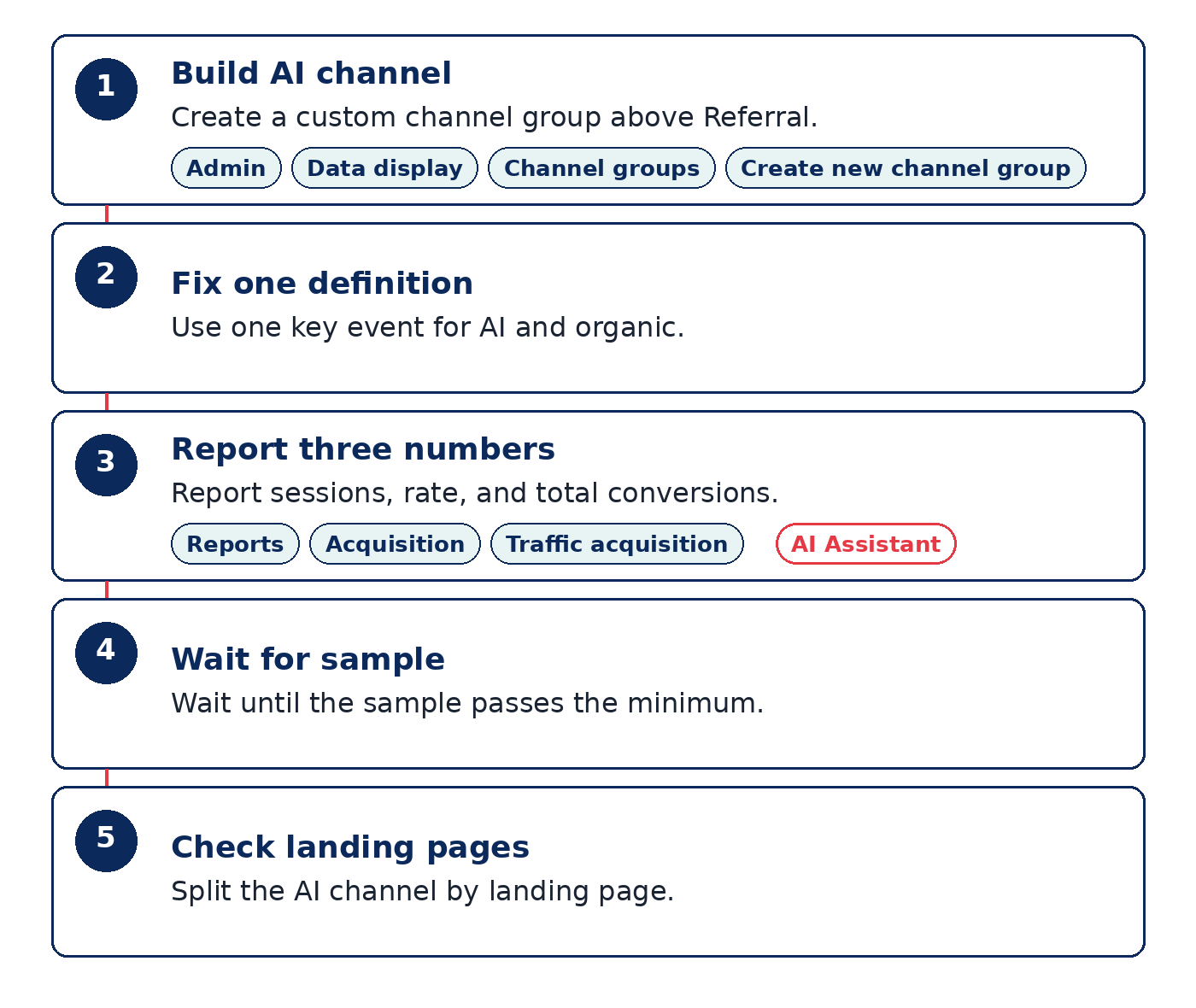
Use one channel, one definition, and the same dates on both sides. Report sessions, rate, and total conversions together, every time.
Step 1, build one AI channel that catches every referrer
Create a custom channel group in GA4, and add one AI channel inside it. Go to Admin, then Data display, then Channel groups, then Create new channel group. Reorder the new channel above Referral, so GA4 matches it first.
Google gives an example pattern for such a channel, with the condition set to “matches regex”. The pattern below is shown as Google presents the example.
It is broad and illustrative, and it matches any source containing ai or gpt. It is not the native channel classifier list.
^.*ai|.*.openai.*|.*chatgpt.*|.*gemini.*|.*gpt.*|.*copilot.*|.*perplexity.*|.*google.*bard.*|.*bard.*google.*|.*bard.*|.*.*gemini.*google.*$Label it as a Google example pattern. Domains to check include chatgpt.com, chat.openai.com, perplexity.ai, claude.ai, gemini.google.com, and copilot.microsoft.com.
Those domains appear in primary study methods, and they are not a Google list.
Step 2, fix one conversion definition for both channels
Pick one key event, or one tier of key events, and use it for AI and for Google organic alike. Separate high-intent events from low-intent events, and report them separately.
High intent includes a contact form, a demo request, a quote request, and a purchase. Low intent includes a newsletter signup, a guide download, and a webinar registration. Never compare an AI lead rate with an organic signup rate.
Step 3, report sessions, rate, and total conversions together
Every rate must travel with its session count and total conversions, for the same dates, on both channels. Use the shape below, and fill it with your own numbers only.
| Channel | Sessions | Conversions | Rate |
|---|---|---|---|
| AI Assistant | Your count | Your count | Your rate |
| Google organic | Your count | Your count | Your rate |
Step 4, set a minimum sample before you judge the rate
Do not judge a rate on a handful of sessions. A rate from a very small sample can swing wildly with one extra conversion. Below the threshold, report the count and wait, and do not report a multiple.
Siege used at least 250 AI sessions and 1,000 organic sessions. The SEO Works used at least 100 AI sessions and 1,000 organic sessions. Orbit required at least 100 AI sessions per site.
Step 5, check the landing pages behind the rate
Split the AI channel by landing page, and read the rate page by page. Homepage, service pages, articles, and contact pages convert at different rates, because intent differs by page. A blended rate hides which pages carry the result.
In Orbit’s page split, stated in order only, case-study pages led on rate while blog pages drew the most AI visits. Check which pages AI visitors already reach on your site.
The worked example, rate, volume, and total conversions together
This section uses SEO Works totals and rates as two separate facts. The totals and the rates cover different site subsets, so they must never be divided by each other.
The published totals, worked through
The SEO Works reports two separate facts. Across 95 sites, AI sent 72,095 sessions, and organic sent 2,825,594 sessions.
The AI total was 5,001 conversions. The organic total was 155,605 conversions. The SEO Works states that result as 3.2 AI conversions per 100 organic conversions.
The 63-site panel put the AI figure at 7.18 percent. The organic figure sat at 6.08 percent. The pooled ratio is 1.18x, and the median ratio is 1.21x.
The rates come from the 63-site subset. Do not divide the 95-site totals to get the rates.
| Measure | AI result | Organic result | Coverage |
|---|---|---|---|
| Sessions | 72,095 | 2,825,594 | 95 sites |
| Conversions | 5,001 | 155,605 | 95 sites |
| Conversion rate | 7.18 percent | 6.08 percent | 63 sites |
Caption: SEO Works totals and rates, with sample and dates. Totals cover 95 sites, and rates cover 63 sites.

Your own numbers, in the same shape
Use the template below with your own numbers only, from the same dates and the same key event definition.
| Channel | Sessions | Conversions | Rate |
|---|---|---|---|
| AI Assistant | Your count | Your count | Your rate |
| Google organic | Your count | Your count | Your rate |
First, fill sessions and conversions for both channels. Second, divide conversions by sessions for each rate. Third, divide AI conversions by organic conversions, and multiply by 100, for the per 100 figure.
Why AI visitors convert at a higher rate when they do
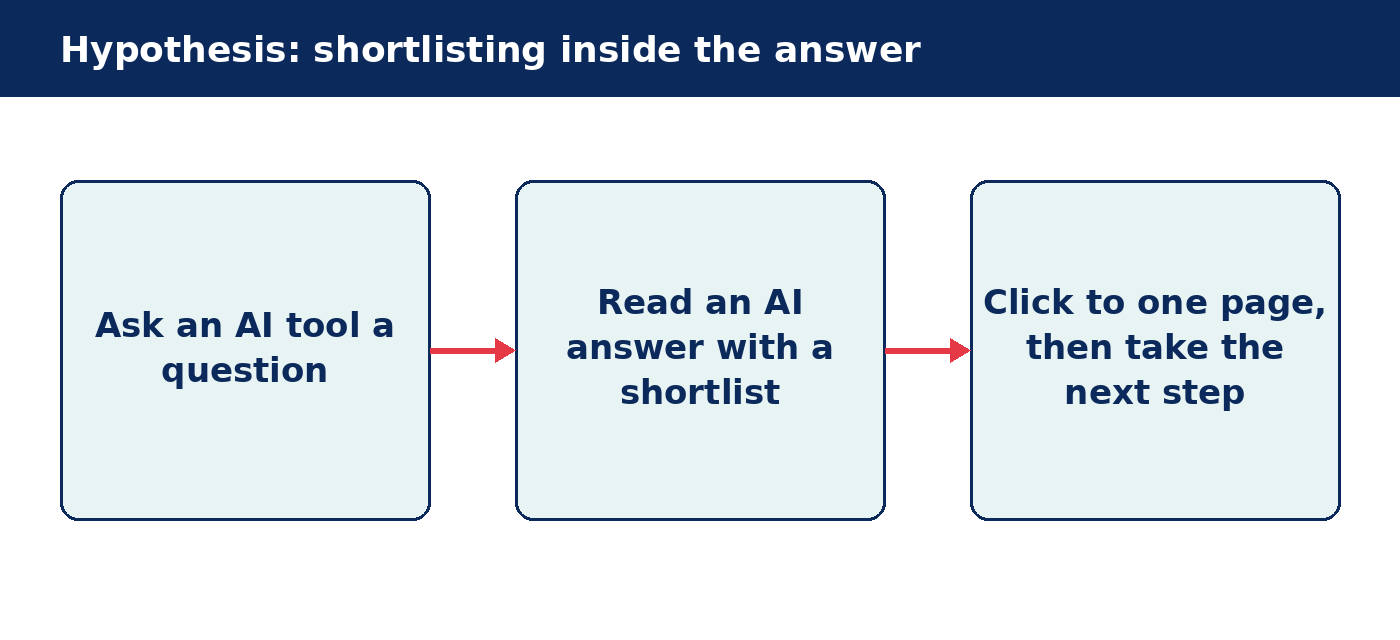
No study in the table proves that AI causes higher conversion. The explanations below are hypotheses offered by the studies, not measured causal findings. Treat them as possible reasons to test on your own pages.
Prequalification inside the answer
The leading hypothesis is shortlisting inside the answer. The visitor may reach the click only after the answer has weighed the options and picked a name. The comparison work may already sit behind the visitor when the page loads.
Seer and Semrush offer similar hypotheses, and none proves causation.
Later-stage arrival and fewer wasted clicks
Visitors who click a small source link, or who arrive after a conversation, have already filtered themselves. Less-qualified visitors never click, which raises the rate and lowers the volume at the same time. It is the same mechanism seen from two sides.
Orbit also names brand-aware visitors, answers that read as guidance, and task-led visitors.
When the explanation does not hold
The explanation does not hold everywhere. Kaiser and Schulze found ChatGPT below organic search for ecommerce.
Organic search showed about 13 percent higher odds of converting than ChatGPT in the regression model. That gap stopped being significant in 5 of 12 alternative checks, including checks for the most recent 3 months.
Visibility Labs found the opposite direction for ecommerce, with ChatGPT at 1.81 percent versus non-branded organic at 1.39 percent. The baselines differ, as Kaiser and Schulze compare against all organic, while Visibility Labs compares against non-branded organic only.
The SEO Works B2B product result also cuts against the headline, at a pooled 0.62x.
The reason for the split is not settled, so do not invent one.
What to do with a high rate and a small channel
Fix pages first, protect presence second, and move budget only when your own totals justify it. That order keeps effort tied to evidence, and it avoids chasing a headline multiple.
Fix the landing pages AI visitors already reach
Check the top AI landing pages from Step 5 in the GA4 method above. Each page needs a direct answer first, proof the reader can check, and one clear next step near the top. A page that answers the buyer question in full serves both AI and organic visitors.
Protect citation presence without moving the whole budget
Keep citation work as a small, steady share of effort. Build answer-first pages, comparison pages for buying questions, and pages with clear facts that an AI tool can quote. For method detail, see how to make pages quotable in AI answers.
Citation presence today decides who is on the shortlist when volume grows. Panels disagree about growth, because they cover different sites and windows.
When to leave the budget where it is
If AI totals are a small share of organic totals, do not move budget to AI-only work. Ordinary organic search still produces most of the volume here.
Haynes found Google organic drove 27 times more conversions than all LLMs combined, on the 55 sites that tracked conversions. That finding belongs to that panel, and your own panel may differ. Revisit the decision when share, rate, and total move together over one full quarter.
| Your numbers show | Do this | Check again when |
|---|---|---|
| High rate, tiny total | Fix top landing pages first | Sample passes the minimum threshold |
| Rising rate and rising total | Protect citation presence steadily | Share, rate, and total move together for one full quarter |
| Small total, flat share | Leave budget with ordinary organic search | The next full quarter of own data is complete |
Caption: Decision table with 3 rows. High rate with a tiny total, rising rate with a rising total, and small total with a flat share. Fix pages first, and move budget only when your own totals justify it.
FAQ
Does AI search traffic really convert better than Google organic search?
The AI search traffic conversion rate is sometimes higher per visit than for Google organic search. The answer is a range, not one multiple, and ecommerce results split by baseline. Check your own GA4 numbers on the same definition and the same dates.
How small is AI search traffic in GA4?
AI search traffic is small in every verified panel, and each share needs its denominator. Orbit reports 0.5 percent of all traffic, and Haynes reports ChatGPT at 0.62 percent of Google organic sessions.
The SEO Works reports AI at 2.6 percent of organic sessions overall. The GA4 row shows only part of the AI total.
How do I measure my own AI search conversion rate without guessing?
Build one AI channel, fix one conversion definition, and use the same dates for both channels. Report sessions plus rate plus total conversions together, and wait for a minimum sample. See the 5 steps in the GA4 method section above for the full check.
Start with your own GA4 check, fix the pages AI visitors already reach, and judge the channel on total conversions. For help with that work, see the SEO services page.
Want help applying this to your site? Contact Imran Ali to book a free 30-minute meeting.