

Topical Authority for SaaS: Mapping Content to the Buyer Journey
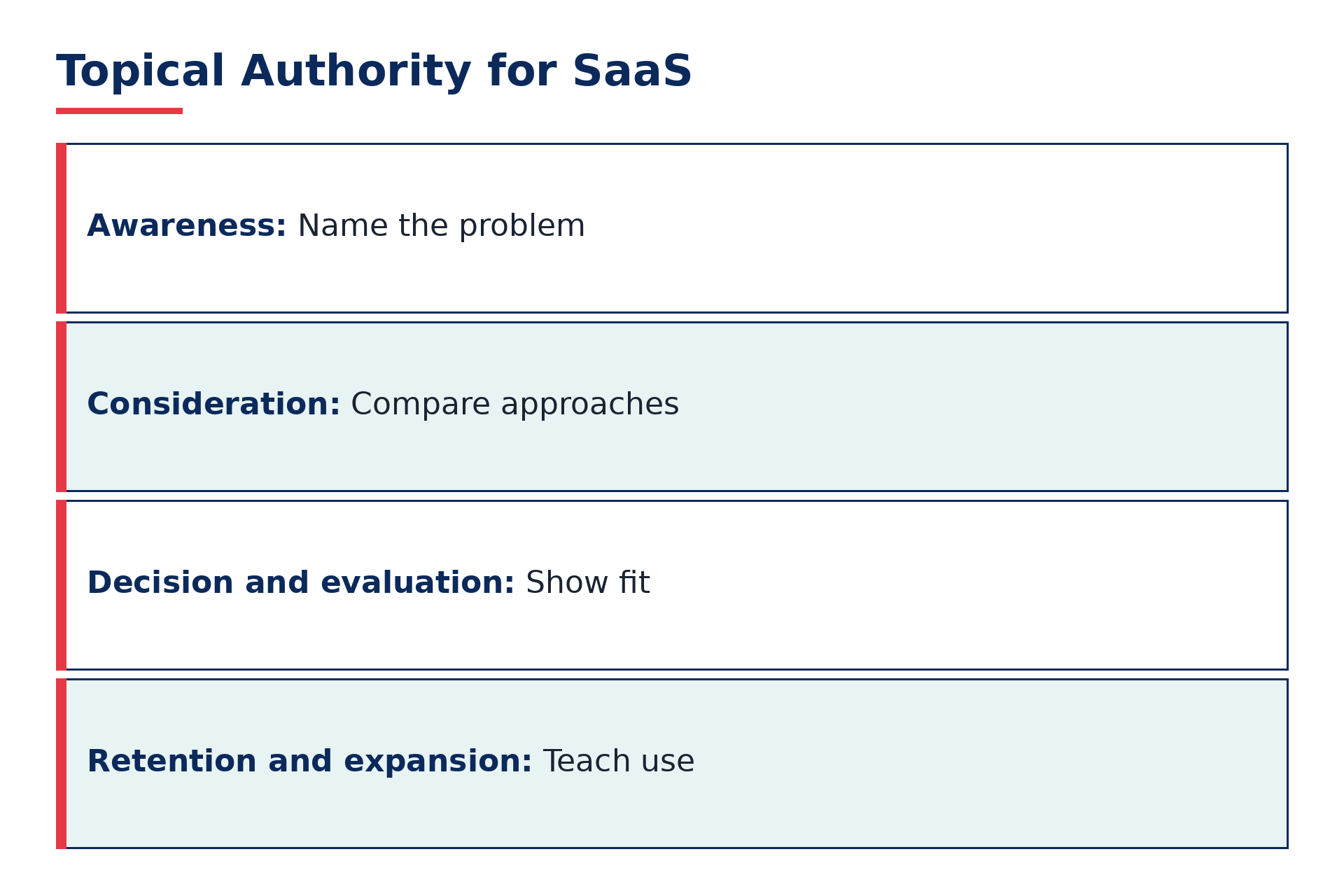
Topical authority SaaS is the judgment that a site answers every buyer question for one software subject in one clear place. The four stages are awareness, consideration, decision and evaluation, and retention and expansion. Each buyer question gets one stage, one intent, one page type, and one next page.
Buyers research a problem, compare tools, test fit, then use the product daily. This article shows the stage map, page types, and checks that keep it honest.
The direct answer: SaaS journey map
Topical authority grows when a site covers a subject fully, from problem to daily use. A SaaS map shows that coverage in journey order, one row per question.
Awareness names the problem, consideration compares approaches, and the decision and evaluation stage tests fit. The retention and expansion stage extends use, with one stage, one intent, one page type, and one next page per question.
Google publishes no authority score for a business website and no required page count for a cluster. TripleDart, in its FAQ, tells readers to track cluster metrics instead, because tools offer no score to read. A map proves coverage only, with no ranking or sale promised.
| Stage | Buyer question | Page job |
|---|---|---|
| Awareness | What is wrong? | Name the problem. |
| Consideration | Which tool fits us? | Compare approaches. |
| Decision and evaluation | Can we trust it? | Show fit. |
| Retention and expansion | How do we use it well? | Teach use. |

What topical authority means for SaaS specifically
A buyer must choose, set up, and use a tool daily, not only read about it. Coverage must follow the product in use, not the category name alone.
Google, in a post dated 23 May 2023, describes topic authority for newsy queries. The system helps determine which expert sources are helpful for queries in certain specialized topic areas, such as health, politics, or finance.
FinancesOnline, updated 16 June 2025, says topical authority measures how well a website covers a certain topic with its content. It is a strategy that focuses on becoming the go-to resource for a specific subject area.
AAMAX, published 27 August 2026, counts documentation and community content as coverage. AtOnce, in snippet wording, adds product inputs, use cases, integrations, and setup needs as coverage. Support questions, sales questions, and product use together set the coverage list, while a keyword list alone leaves gaps.
Many posts on one keyword do not show authority, and copied feature lists do not. Google warns against bulk publishing across unrelated subjects to chase a ranking.
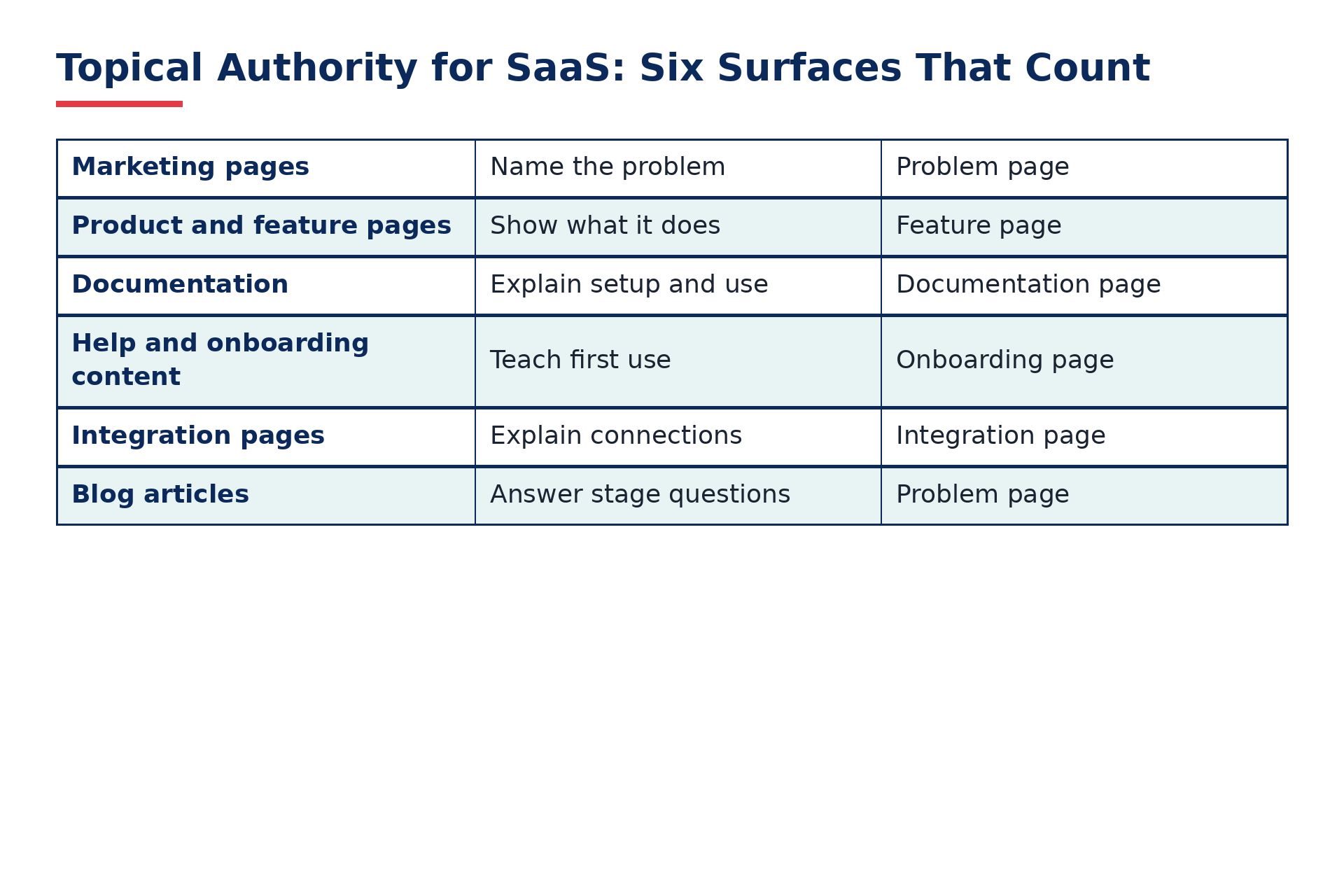
| Surface | Job in the journey | Example page type |
|---|---|---|
| Marketing pages | Name the problem | Problem page |
| Product and feature pages | Show what it does | Feature page |
| Documentation | Explain setup and use | Documentation page |
| Help and onboarding content | Teach first use | Onboarding page |
| Integration pages | Explain connections | Integration page |
| Blog articles | Answer stage questions | Problem page |
The four buyer journey stages
Each stage uses the same four fields, so stages compare without relabeling. Stage order is reader order, and decision pages may come before awareness pages.
At awareness, with learn intent, the buyer names a problem, not a category. The buyer must learn the cause and how others solve it, or it feels like a pitch.
At consideration, with compare intent, the buyer compares approaches and tools. The buyer must learn trade-offs, fit, and limits, or the page reads as one-sided praise.
At decision and evaluation, with check intent, the buyer tests fit, cost, and setup. Security and proof must be clear, or the page reads as a claim.
At retention and expansion, with use intent, the user learns setup and daily workflows. Without clear steps, the user stalls and the product sits unused.
| Stage | Buyer question | Intent | Must learn before moving on |
|---|---|---|---|
| Awareness | What is wrong? | Learn | Cause and solutions |
| Consideration | Which approach fits us? | Compare | Trade-offs, fit |
| Decision and evaluation | Can we trust this tool? | Check | Fit and proof |
| Retention and expansion | How do we use it well? | Use | Setup, workflows |

How to map content to the buyer journey, step by step
Use the method on paper or in a sheet for one product area. Work in journey order and record the map before writing, so gaps show early.
- Name the area. Write the product area and buyer in one line.
- List questions. List buyer questions in journey order from sales questions, support questions, search results, People Also Ask, related searches, and documentation questions.
- Tag stage. Each row carries one intent label first, then one stage label.
- Group intent. Group questions by distinct intent, not by wording.
- Cut sections. Remove groups that fit inside other pages.
- Assign type. Assign one page type per group, from the H2 5 table.
- Count groups. Count groups left, with the pillar counted separately.
- Link and record. Link each page to the next page and record one row.
Count only groups left after grouping by distinct intent and removing section groups. Count pillar and hub pages separately from the supporting pages in the map. Count commercial pages only where the H2 5 table places them in the counted map.
The total that follows covers one worked map only, not a rule, a minimum, or a target. WebCodeTeam, published 13 November 2026, records intent first and stage second for each question row, under one owning page. GrowthX, published 10 July 2026 and updated 13 November 2026, assigns each spoke one query and a hub link.
| Stage | Buyer question and intent | Page type | Next page |
|---|---|---|---|
| Stage name | Question (Learn) | Page type | Next page |
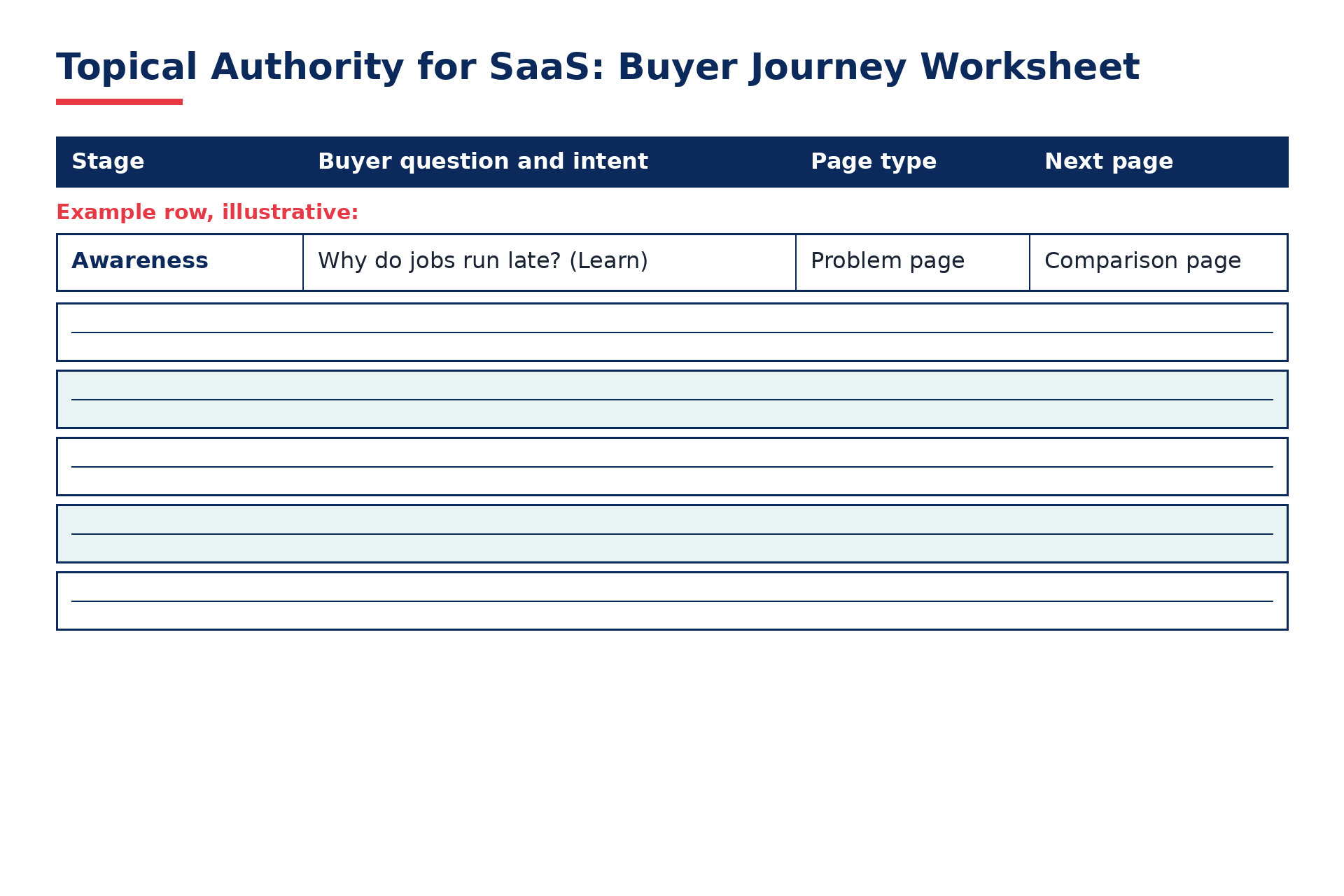
The full question list step lives in the topical map guide. This article assigns stages and page types to each row in that list.
SaaS page types, matched to stages
Each page type answers one question shape, at its own stage. Use the table below for mapping, and do not copy a rival stage label.
AAMAX, published 27 August 2026, places six page types at the bottom stage. The six are alternatives pages, competitor comparisons, use case pages, integration pages, pricing explainers, and feature landing pages.
In the labels here, alternatives and comparison pages sit at consideration. Pricing pages sit at decision and evaluation, with use case and integration pages at consideration and retention and expansion. Feature landing pages have no row below, because no stage question needs that page type.
| Page type | Stage | Question shape | Next page |
|---|---|---|---|
| Problem page | Awareness | What is wrong? | Comparison page |
| Comparison page | Consideration | Which tool fits us? | Pricing page |
| Alternatives page | Consideration | Replace our tool? | Demo page |
| Pricing page | Decision and evaluation | What do plans include? | Demo page |
| Demo page | Decision and evaluation | What will the demo show? | Onboarding page |
| ROI page | Decision and evaluation; Retention and expansion | What can we check? | Onboarding page |
| Onboarding page | Retention and expansion | How do we set up? | Integration page |
| Integration page | Consideration; Retention and expansion | What connects and breaks? | Use case page |
| Use case page | Consideration; Retention and expansion | How does a team use it? | Demo page |
Pricing detail stays in the SaaS pricing guide for plan tiers and quotes. An ROI page states checkable cost, time, and outcome, with no return figure. Use case and comparison pages stay separate where intent differs.

Worked example: one SaaS product area (Illustrative)
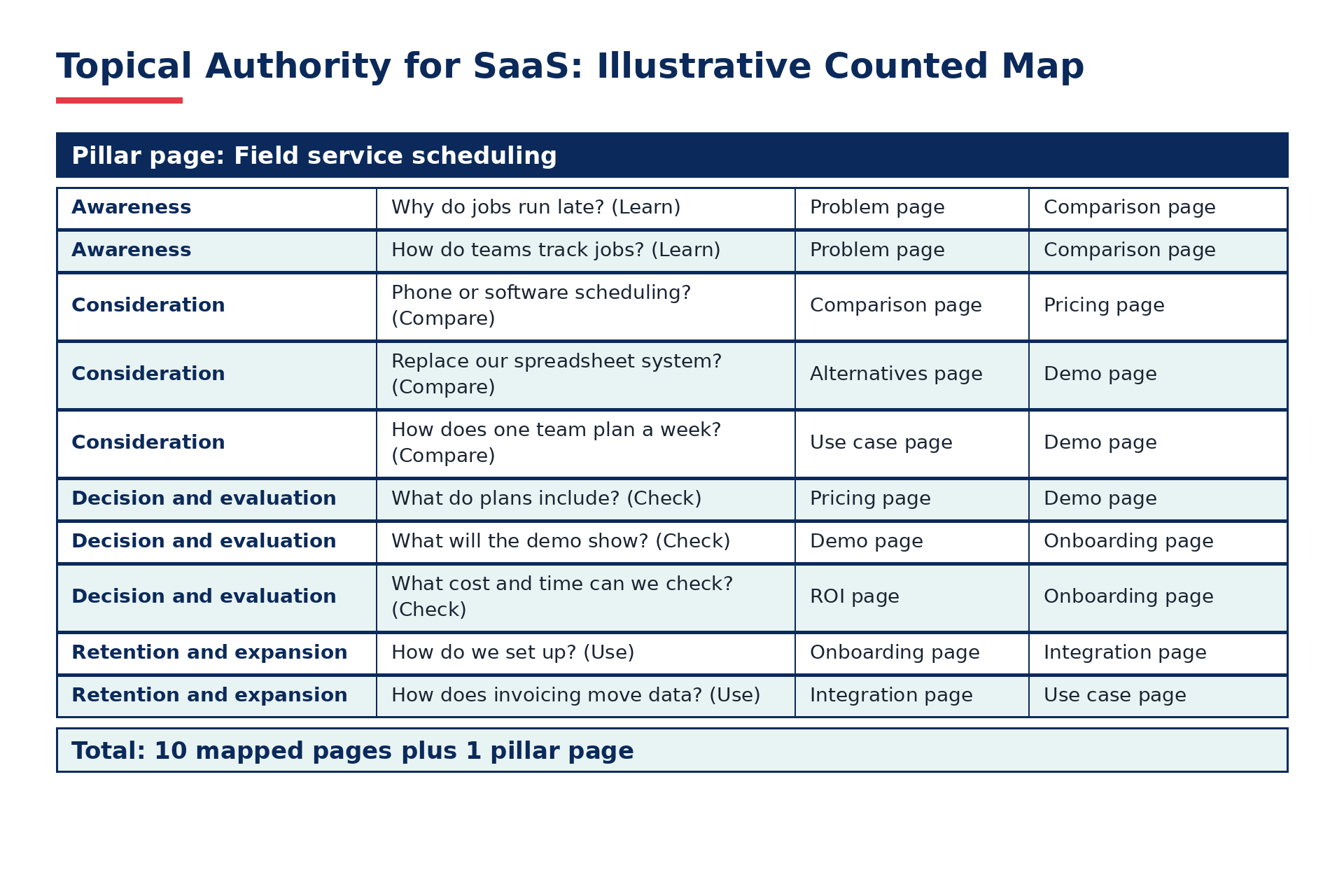
This illustrative example maps one hypothetical tool for small field service teams. The tool only helps teams schedule jobs, assign technicians, and send reminders. Ten mapped pages plus one pillar page make eleven pages here.
The illustrative pillar covers field service scheduling and routes readers onward. Awareness rows name late jobs and job tracking, before any tool is named.
Consideration rows compare phone scheduling, spreadsheet replacement, and one week plan. Decision rows test plans, the demo, and checkable cost and time. Retention rows cover setup and how invoicing moves data after signup.
| Stage | Buyer question and intent | Page type | Next page |
|---|---|---|---|
| Awareness | Why do jobs run late? (Learn) | Problem page | Comparison page |
| Awareness | How do teams track jobs? (Learn) | Problem page | Comparison page |
| Consideration | Phone or software scheduling? (Compare) | Comparison page | Pricing page |
| Consideration | Replace our spreadsheet system? (Compare) | Alternatives page | Demo page |
| Consideration | How does one team plan a week? (Compare) | Use case page | Demo page |
| Decision and evaluation | What do plans include? (Check) | Pricing page | Demo page |
| Decision and evaluation | What will the demo show? (Check) | Demo page | Onboarding page |
| Decision and evaluation | What cost and time can we check? (Check) | ROI page | Onboarding page |
| Retention and expansion | How do we set up? (Use) | Onboarding page | Integration page |
| Retention and expansion | How does invoicing move data? (Use) | Integration page | Use case page |
A second product area, a second role cluster, and repeat intent stay out by choice. The pillar counts separately, so ten rows are the mapped pages only.
Gaps and overlaps: check the map first
Run four checks on the map record before writing, and fix every fail there. A missing page for a question no buyer asks is not a real gap.
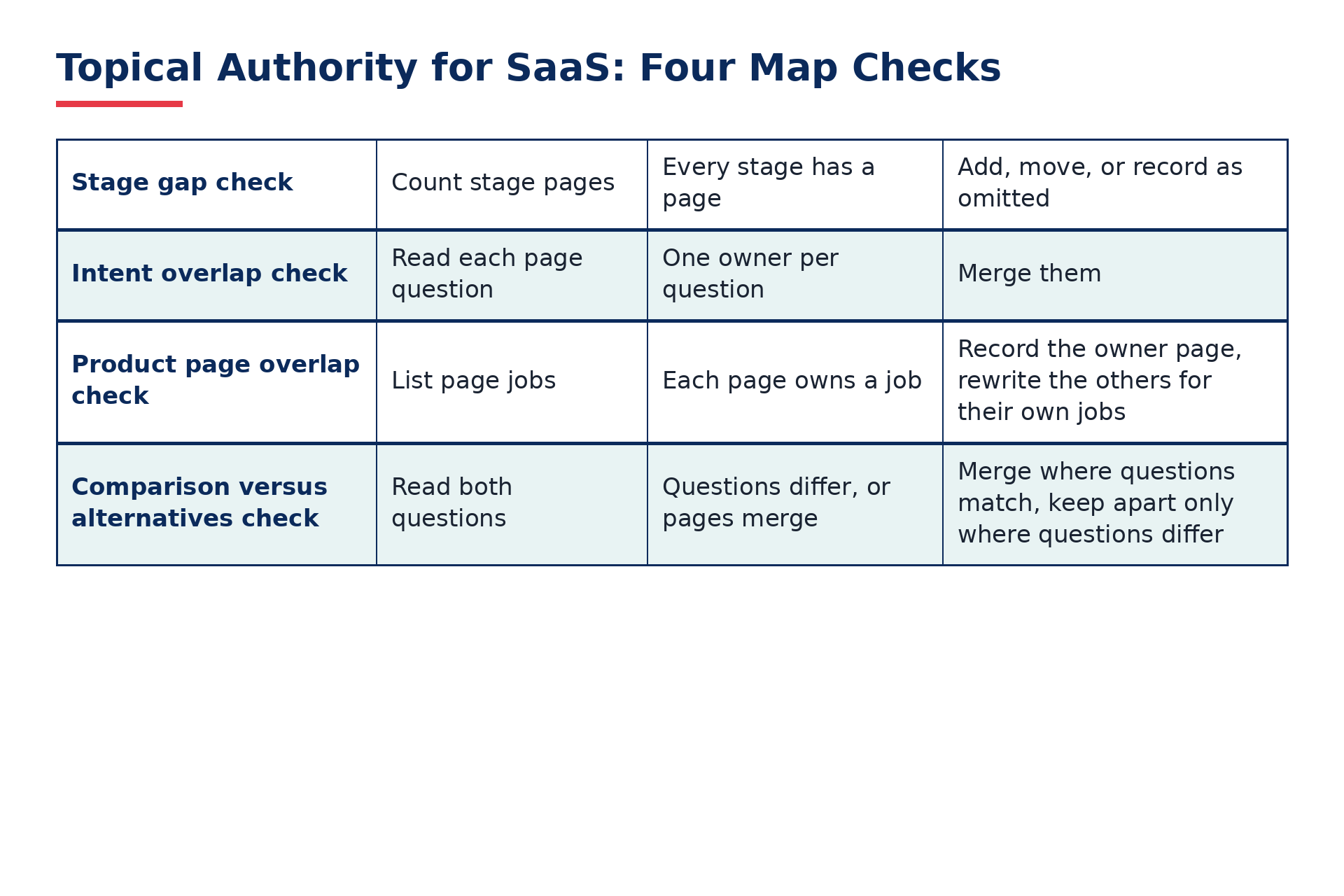
The stage gap check fails where a stage has no page, so add, move, or record a page for the stage. The intent overlap check fails where two pages answer one question alike, so merge them.
AAMAX, published 27 August 2026, describes two pages that give one buyer the same answer twice. WebCodeTeam, published 13 November 2026, asks first whether the buyer or the intent has changed. When neither has changed, the related questions share a single page.
The product page check asks whether blog, feature, and documentation pages own distinct jobs. Fail means record the owner page and rewrite the others for their own jobs.
The comparison check asks whether comparison and alternatives pages answer different shortlist questions. Fail means merge them where questions match, and keep them apart where they differ.
| Check | How to run it | Pass looks like |
|---|---|---|
| Stage gap check | Count stage pages | Every stage has a page |
| Intent overlap check | Read each page question | One owner per question |
| Product page overlap check | List page jobs | Each page owns a job |
| Comparison versus alternatives check | Read both questions | Questions differ, or pages merge |
How to measure a SaaS map, by stage
Measure by stage from Search Console and GA4 only, with no score and no ranking promise. Stage tagging is a reader sheet method, not a report feature.
Coverage counts live pages against planned rows, and impressions for each planned question. Search Console Help lists clicks, impressions, CTR, and average position. CTR means the click count divided by the impression count in the report.
The queries per stage check reads the Queries tab for questions the map does not answer. Record each new question for one page, with one page per query. GrowthX, published 10 July 2026 and updated 13 November 2026, calls impression queries with no page confirmed demand.
Movement compares two periods with Compare and reads the Difference column. GA4 Landing page report shows the first page in a session, with sessions and key events. Group landing rows by stage, and read marked trial and demo events.
Citation presence is a manual repeat check on AI answer queries, with no promise. Google names the Generative AI performance report, with fan-out detail in the query fan-out guide. AAMAX, published 27 August 2026, reviews cluster work quarterly and reallocates effort.
Measurement does not prove a map caused a sale, or one stage caused a trial. Google states ranking works at the page level, with site-wide signals also used.
| Stage | What to check | Where to check it | Weak result means |
|---|---|---|---|
| Awareness | Live pages, impressions | Search Console | No live page |
| Consideration | Comparison queries | Search Console | Shared owner question |
| Decision and evaluation | Landing rows, key events | GA4 Landing page report | No key event |
| Retention and expansion | Onboarding landing rows | GA4 Landing page report | No onward use |

Common SaaS mapping mistakes
Each mistake is a mapping mistake, and each fix is a map decision.
- Feature-first mapping misses problem questions when the map mirrors the product menu [H2 4].
- Decision-only map leaves no entry point for new buyers [H2 3].
- Awareness-only map never reaches a demo, a price, or a trial [H2 3].
- Competing shortlist pages answer one question with two owner pages [H2 7].
- Hidden decision content stays hard to find, check, and link [H2 5].
- Thin split pages leave each page too weak for one question [H2 4].
- Count-only judgment calls a large map complete while core questions stay unanswered [H2 8].
- Signup stop map leaves onboarding and expansion pages outside the cluster [H2 3].
- No next page strands the reader at a stage end [H2 4].
Fix each mistake in the map record first, then write. A fixed map shows one owner page per question, in stage order.
How this map ties to wider guides
Use this map for SaaS stages, and the linked guides for the wider method.
| Article | What this article takes | What this article does not do |
|---|---|---|
| Topical Authority Guide | Wider case | Restate the case |
| Topical Map Guide | Question list | Reteach map steps |
| Pillar Pages Guide | Architecture | Restate page types |
| Query Fan Out Guide | Citation pointer | Reteach fan-out evidence |
| Internal Linking Guide | One next page | Expand linking strategy |
| Cluster Size Guide | Split pointer | Answer count in general |
When a stage grows, split the map and record the decision. The split method lives in the cluster size guide above.
FAQ: Frequently asked questions
Does every SaaS feature need its own cluster page?
No, give a feature its own page only when it answers a distinct buyer question at a distinct stage. Use the intent test in H2 4, not a fixed rule, to decide.
How do onboarding and integration pages fit into topical authority after a buyer signs up?
Onboarding pages, integration pages, workflow pages, and use case pages belong in the same retention and expansion stage. They answer the next questions a signed-up user asks while learning the product. Judge them by the same retention stage checks, not by a separate help standard.
How do you keep comparison, alternatives, and category pages from competing with each other?
Keep comparison, alternatives, and category pages apart only where buyer questions differ. Merge them at once where they answer the same question, and record one owner per question before writing.
Want help applying this to your site? Contact Imran Ali to book a free 30-minute meeting.