

Brand Mentions vs Backlinks: What AI Answers Actually Reward

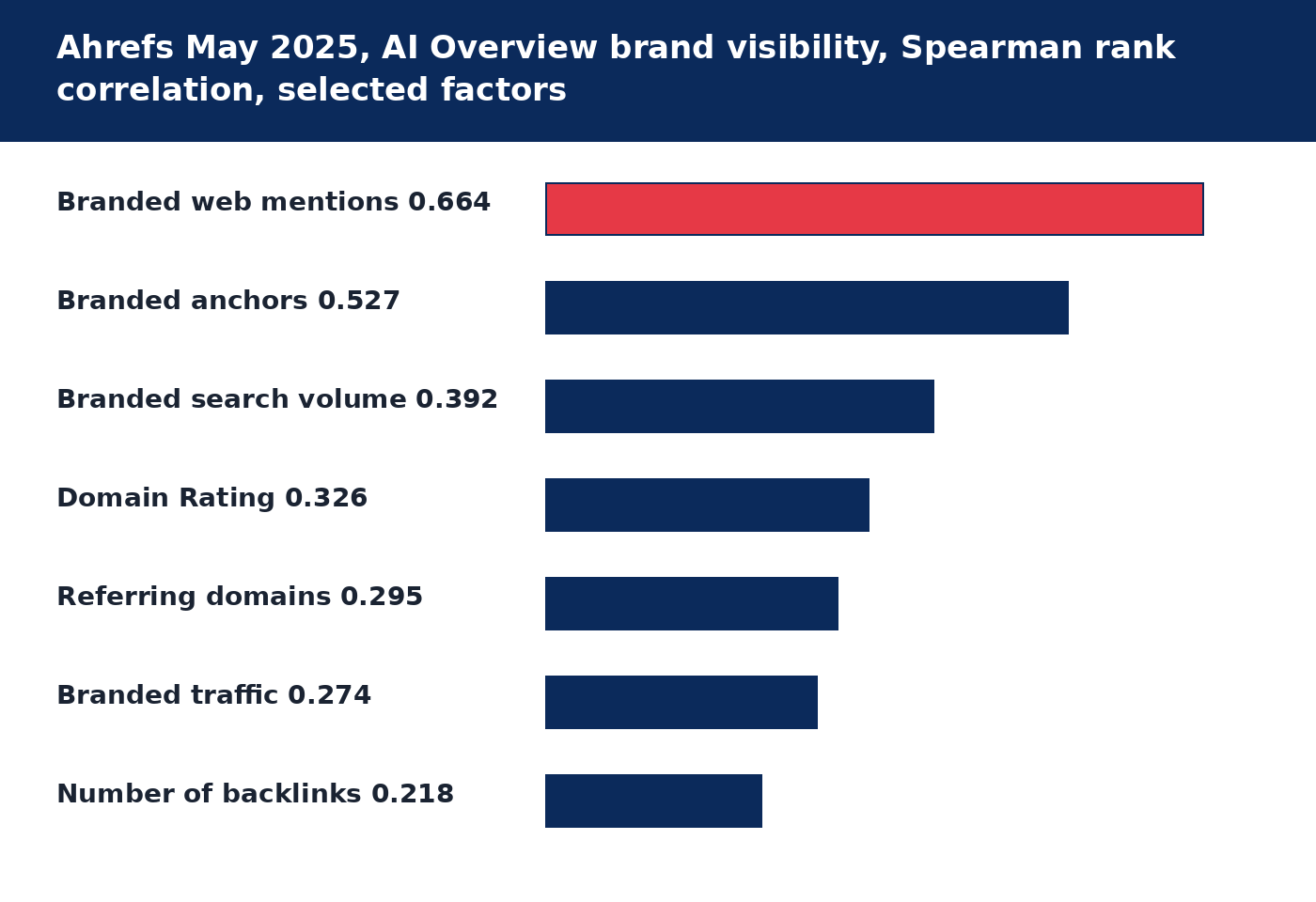
The search phrase “brand mentions ai search” asks whether mentions track AI visibility more closely than backlink counts. The Ahrefs study of 75,000 brands, published 26 May 2025, found web mentions correlated 0.664 and backlink counts correlated 0.218. Correlation is not causation, so these figures show only that the measures go together for AI Overview visibility in this sample.
The slogan that mentions are the new backlinks hides the difference, because a mention, a link, and a citation differ.
What a brand mention is, and how it differs from a backlink and a citation
A mention is the brand name in text, on a web page or in an AI answer. A backlink is a link on another site that points to a page on the brand site. A citation is the source link an AI answer shows beside its text.
The six terms, kept apart
| Term | What it is | Fictional example | Role in AI search |
|---|---|---|---|
| Brand mention | Brand name in text | Blue Fern Desks in a list | Shows the brand is known in text |
| Backlink | Link to a brand page | A list page links to its home page | Helps readers and crawlers find the brand page |
| Linked mention | Mention with a link | Name links to its site | Names the brand and points to its page |
| Unlinked mention | Mention with no link | Name, no link to its site | Names the brand, but gives no path to its page |
| Citation | Source link in an answer | Answer links to its guide page | Shows which page informed the answer |
| Ghost citation | Citation with no naming | Answer links to its page, name absent | Uses the page, but the brand name may be missed |
Why the confusion matters
A page can be cited without the brand being named, as a ghost citation shows. A brand can be named in an answer with no source link to its own pages.
A backlink is often also a mention, when the link text or the nearby text names the brand. A mention is not always a backlink, because an unlinked mention names the brand with no hyperlink. An answer mention is what the AI says, and a page mention is text it may have read.
A note on implied mentions and entity names
A brand can be described without being named, for example when a report is quoted but its publisher is not named. This article counts a mention only when the brand name appears in text, so implied mentions are not counted here.
What the Ahrefs evidence actually shows
The first study, AI Overviews only
Ahrefs studied 75,000 brands in a study published 26 May 2025 and updated 27 April 2026. The sample kept only domains with a Domain Rating above 40. Each brand was found through its highest-volume keyword, with at least 800 searches per month.
Ahrefs checked millions of AI Overview responses with Brand Radar, and compared rank orders with Spearman rank correlation. That method compares two rank orders.
About 26 percent of brands had zero AI Overview mentions, so the correlations cover the remaining 74 percent. Ahrefs sells Brand Radar, the tool used to collect the AI Overview data in this study.
| Factor | Correlation | What was counted |
|---|---|---|
| Branded web mentions | 0.664 | Brand name in text anywhere on the web |
| Branded anchors | 0.527 | Brand name in a link |
| Branded search volume | 0.392 | Search volume for the brand name |
| Domain Rating | 0.326 | Domain Rating value |
| Referring domains | 0.295 | Linking domains |
| Branded traffic | 0.274 | Traffic from brand name searches |
| Number of backlinks | 0.218 | Number of links to the brand site |
The follow-up across three engines
Ahrefs repeated the study across ChatGPT, AI Mode, and AI Overviews, published 12 December 2025, with the same 75,000-brand scale. The AI Overview part reused data from the earlier study.
Branded web mentions correlated 0.709 in AI Mode, 0.664 in AI Overviews, and 0.656 in ChatGPT. Branded anchors correlated 0.628 in AI Mode, 0.527 in AI Overviews, and 0.511 in ChatGPT. Correlation is not causation.
YouTube mentions correlated about 0.737 across the three platforms, the strongest figure in the study, but correlation is not causation. Ahrefs looked for the brand name in three places on YouTube: the title, the transcript, and the description. Ahrefs described link metrics as very weak across all AI systems in the December 2025 study.
The November 2026 study, and a different way to count
Ahrefs studied 10,000 US brands in a study published 3 November 2026, with 260 million non-branded AI prompts. Prompts that named a brand were left out, so the study tested unprompted brand naming in answers.
Ahrefs counted web mentions by exact phrase in this study. It left out brand names under five characters, and it excluded common words and personal names. It also excluded the brand’s own website, and it left out pages with no estimated organic traffic.
Reddit mentions in ranking threads correlated about 0.75, and news article mentions correlated 0.67. YouTube mentions correlated 0.64, and TikTok mentions correlated 0.60 in the same sample. Correlation is not causation.
A second study points the same way, with a different count. Semrush counted mentions and citations separately in a study published 9 June 2026, with 3,981 observed domain appearances.
In that sample, 61.7 percent of appearances were ghost citations, where a source was linked but the brand was not named. Semrush sells the AI Visibility Toolkit used to collect that data.
What the evidence does not prove
Correlation is not causation
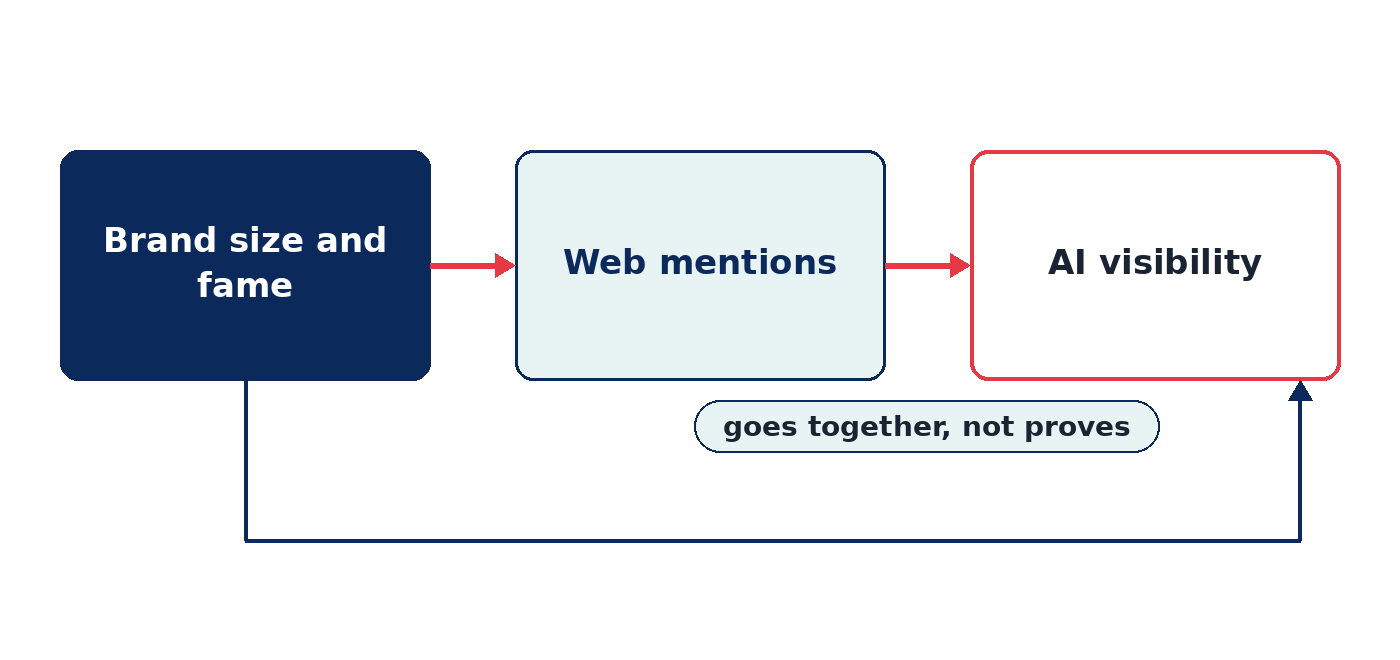
Big brands collect more mentions, links, searches, and AI visibility at the same time. A new mention does not prove a lift in AI visibility by itself, because brand size can feed both measures. Ahrefs stated in May 2025 that correlation does not equal causation for every factor it studied.
One engine, one sample, one date
The first Ahrefs study covers Google AI Overviews only, and it does not measure ChatGPT, Perplexity, Gemini, or AI Mode. The sample kept only domains with Domain Rating above 40, so it says little about a new site or a small brand. The study does not say whether a mention was positive, negative, or neutral.
The three-times shorthand, and why it misleads
Dividing 0.664 by 0.218 gives about 3.05, but correlation coefficients cannot be divided to give strength ratios. A brand with three times the mentions does not get three times the visibility from that arithmetic alone.
What would prove causation, and why it does not exist yet
Proof would need a controlled test that adds mentions to matched brands and measures AI visibility over time. Engine, prompt set, and baseline would stay fixed, so only the added mentions could explain a change. No study cited here does that test, so no causal claim is made from the correlations in this article.
Where backlinks still matter
Links feed the rankings that feed retrieval
Google states that links or references from prominent sites are one quality factor for Search. That statement covers Google Search ranking in general. It does not mention AI Overviews, brand mentions, or citations.
Google also states that a page must be indexed to be shown as a supporting link in AI Overviews or AI Mode. The page must also be eligible to be shown in Google Search with a snippet, fulfilling the Search technical requirements. Google’s wording is “There are no additional technical requirements.”
Links and internal findability
Google lists making content easily findable through internal links as one SEO fundamental for AI features. A mention with no link names the brand, but it gives no link to the brand page.
Lifewood reads the studies as a gate and a dial
Lifewood reads the Ahrefs and Semrush studies as a gate and a dial, authority as the gate and mentions as the dial. That is a reading of the studies, not a verified finding. The studies show correlations and counts, not a gate test for one brand.
A linked mention beats an unlinked mention where it counts
Ask for a link, but do not refuse a good placement with no link. The Semrush study of 9 June 2026 shows why the link still matters even when the brand is named. ChatGPT cited a source in 87 percent of appearances, but it named the brand in only 20.7 percent.
Gemini named brands in 83.7 percent of appearances, but it cited a source in only 21.4 percent. A named brand with no cited source gives the reader no page to check.
Links are how mentions are earned
The same outreach that earns a mention on a trusted publication usually earns a link at the same time. Original research, guest placements, and list inclusion produce both signals from one piece of work. The budget debate is mostly a false choice, because the work that earns mentions is the work that earns links.
| Job | What a link does | What a mention does | If the job is missing |
|---|---|---|---|
| Rank and retrieval | May help ranking and retrieval (interpretation) | Names the brand in text | Pages rank lower, so answers fetch and quote them less |
| Discovery | Makes content findable through internal links | Gives no path to a page | Pages are harder to find |
| Authority gate (reading) | May build entry authority (reading) | Tracks naming once the brand is inside (reading) | Brand may stay outside the answer pool |
| Naming in answers | Points to a page, but the name may be absent | Names the brand in the answer text | A link with no name, or a name with no link |
How AI answers use mentions
Training text plus live retrieval
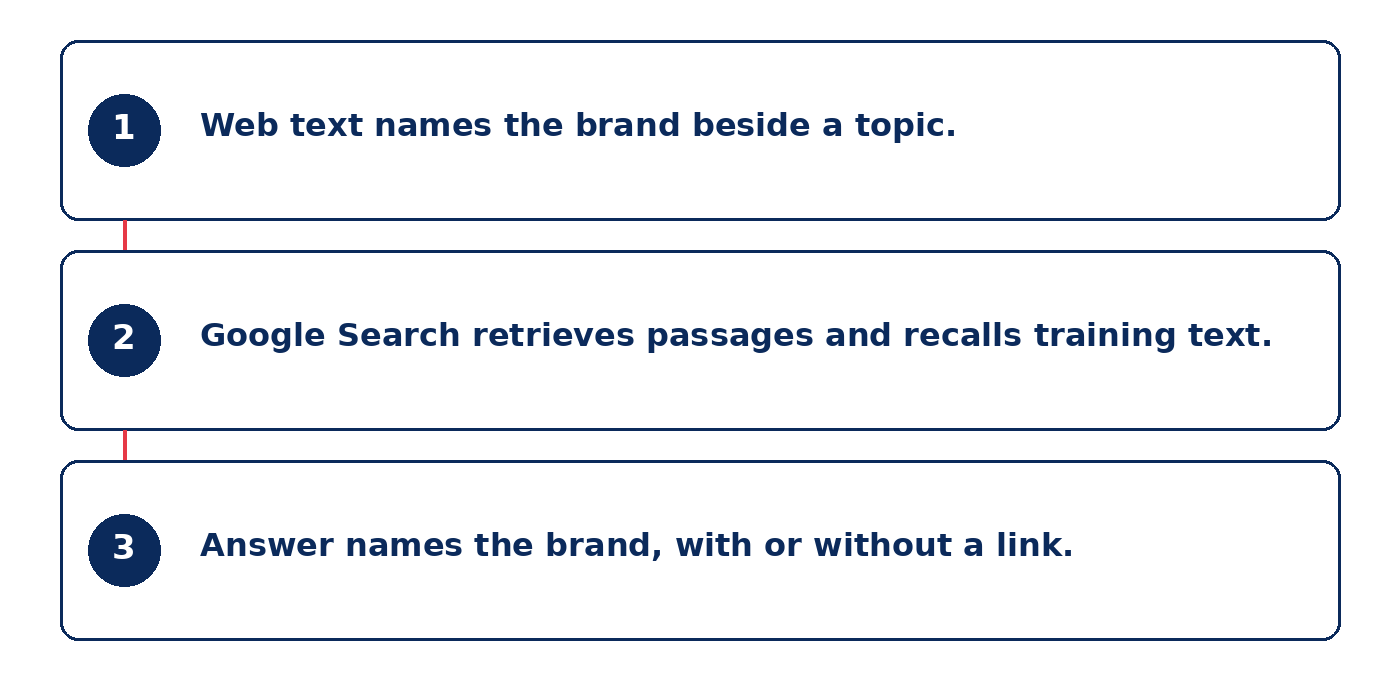
For Google Search generative features, Google describes answers built from its Search index by retrieval augmented generation. Training text is a large body of web text, in which a brand appears beside a topic many times. Training text does not update at once.
Why context matters more than count
Ryan Law, Director of Content Marketing at Ahrefs, described the idea in general terms. How often a name shows up, and the words that sit near it, tell a model what the name means. That is his reported view, not a measured finding in the study.
How engines differ
Engines name the same brands often, with high overlap in the brands named across engines. Semrush found the different rates in its 9 June 2026 study. Check the engine your buyers use, and do not average engines into one score, because habits differ by engine.
In the Ahrefs December 2025 study of 75,000 brands, output overlap was 0.779, and correlation is not causation. The figures were 0.821 for AI Overviews and AI Mode, and 0.769 for AI Mode and ChatGPT. The figure was 0.749 for AI Overviews and ChatGPT.
Where AI finds mentions
Listicles, comparisons, and reviews
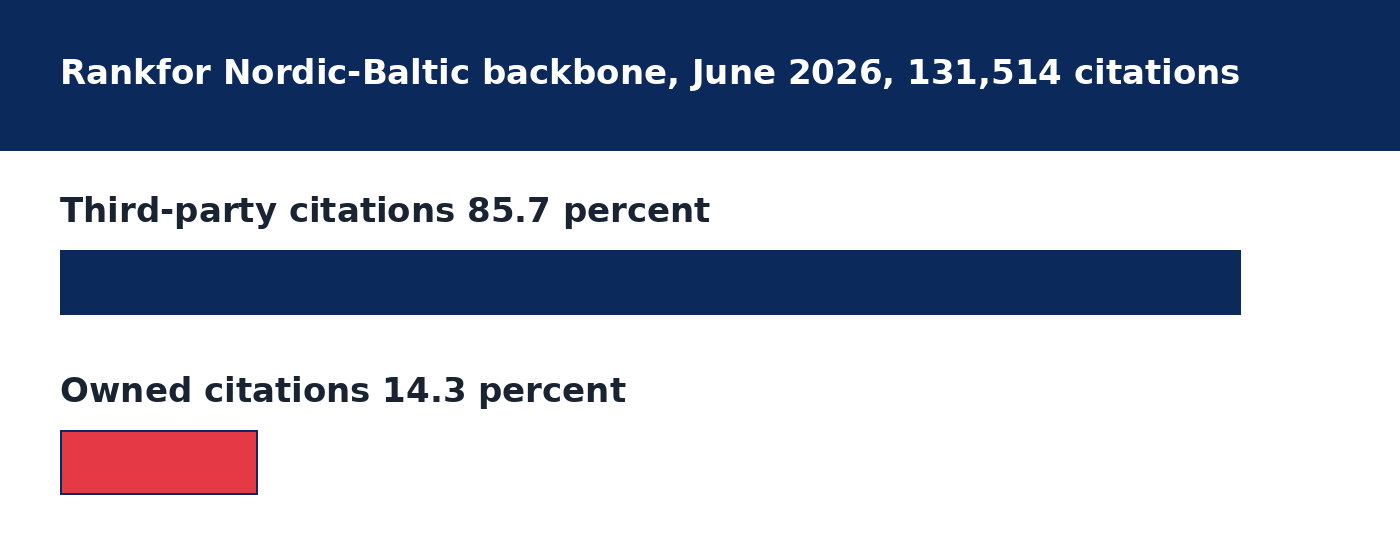
Rankfor studied a full merged corpus of 167,551 URL-grounded citations across 128 brands. On the Nordic-Baltic backbone of 131,514 citations, 85.7 percent of citations pointed to sites the brand does not own. The remaining 14.3 percent pointed to owned domains.
The paper is a June 2026 preprint built on Rankfor.AI data, and the author discloses an affiliation with Rankfor.AI. Rankfor.AI develops AI brand intelligence tools.
Review sites and directories
A complete review profile must carry the exact brand name, category, service description, and website address. Keep that name and description identical across profiles, so AI systems can match the entity more reliably.
Reddit, forums, and community discussion
Reddit threads that rank in Google are the mentions that counted in the November 2026 study, not all Reddit posts in general. Earn those mentions by answering real questions in ranking threads.
YouTube and earned media
YouTube mentions were the strongest figure in the December 2025 study, as stated in the evidence section. Correlation is not causation. Earn those mentions through honest creator reviews, as Step 5 shows.
Muck Rack reported more than 84 percent of cited links came from earned and third-party sources. That figure comes from a press release dated 28 October 2026. The release covers more than 40 million AI responses and 207 million citations in 2026.
Muck Rack sells Generative Pulse, the product behind the research. Earned and third-party coverage is a broad vendor category, not press coverage alone. It covers journalism, Wikipedia and encyclopedic sites, government and NGO sources, academic research, and third-party corporate content.
How to earn accurate mentions
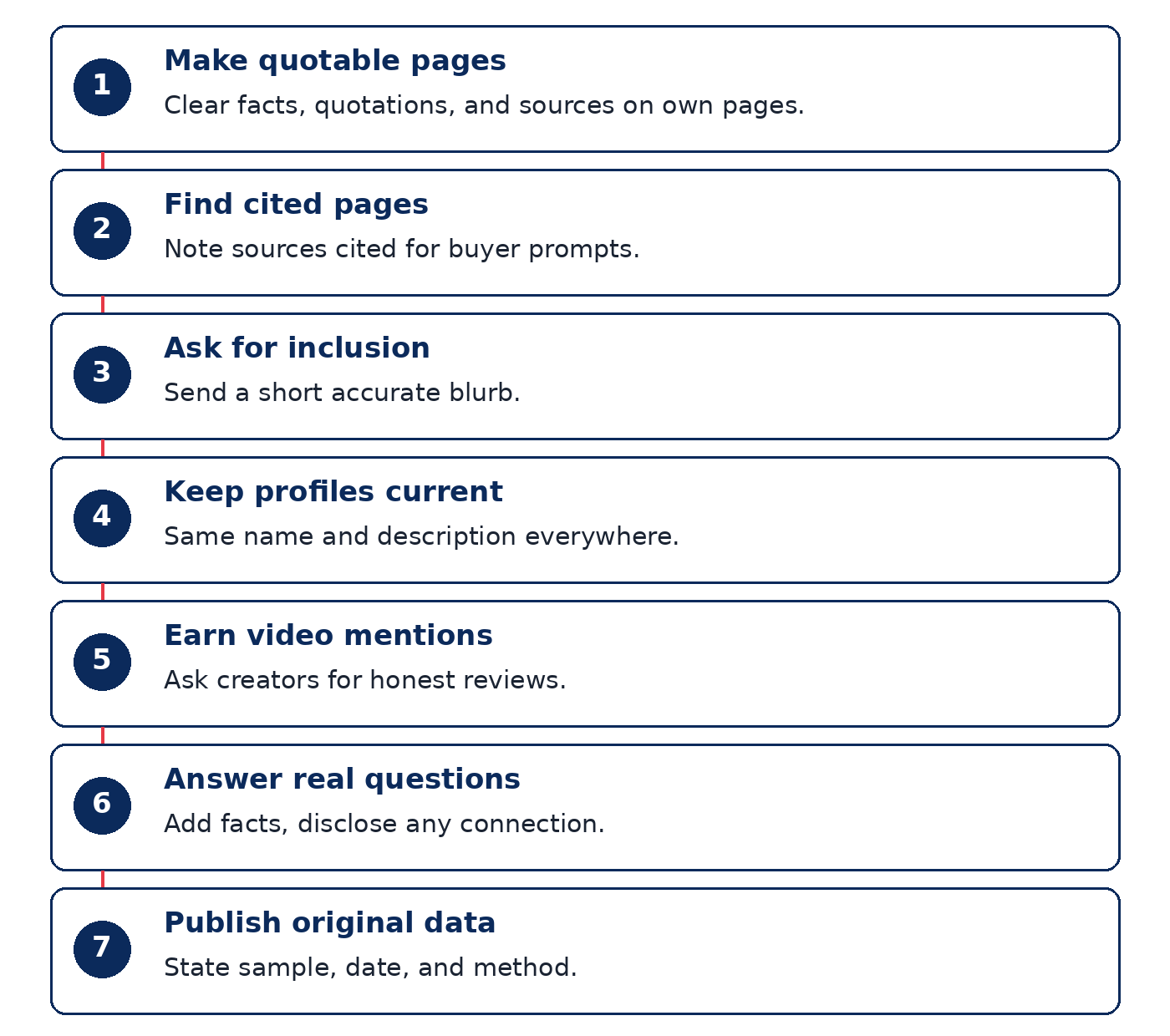
Step 1, make your own pages worth quoting
Build answer-first pages with clear facts, direct quotations, and sources the reader can check. State what the brand does and who it serves.
Step 2, find the pages AI already cites for your buyer prompts
Ask ChatGPT, Perplexity, and Google the questions buyers ask, and note the sources cited in each answer.
- Prompt: the exact buyer question, in the same words each time.
- Cited page: the page title and address cited in the answer.
- Brands named: every brand named in the answer, in order.
- Reader’s own brand named: yes or no, and whether a link is present.
For the full AI Overviews citation method, read the guide on how to appear in AI Overviews.
For the full ChatGPT citation method, read the guide on getting cited in ChatGPT.
Step 3, ask for inclusion with a short accurate blurb
Contact the author or editor of each list or comparison, and send a short blurb they can paste. Use the exact brand name, one sentence on what the brand does, one sentence on who it serves, and one checkable fact.
In this fictional example, Blue Fern Desks sends this blurb to a list author.
“Blue Fern Desks makes standing desks for home offices. The desks serve people who work from home in small rooms. The desk height adjusts by hand crank, as shown in the brand’s own guide.”
Step 4, keep review profiles current and consistent
Complete every field on each review profile, with the identical name and description. Do not buy reviews, write fake reviews, or offer a reward for a positive review.
Step 5, earn YouTube mentions from other creators
Send the product or service to small and mid-sized creators in the niche, and ask for an honest review. Appear as a guest on shows that publish to YouTube. Make sure the brand name is spoken clearly and spelled in the title or description.
Step 6, be present where buyers discuss the category
Answer real questions on forums and in community threads, and add facts the thread lacks. Disclose any connection to the brand plainly in the answer. Do not post the brand name in every thread.
Step 7, publish original data others can quote
Publish one small original study, survey, price check, or worked example, with sample, date, and method stated. Every number in it must be real, or the study must not be published.
How to measure mentions and citations
Count three numbers separately, never one blended number
Count three numbers separately, and never blend them into one number. Number one is AI answer mentions: how often the brand name appears in AI answers to a fixed prompt set. Number two is citations: how often a source page is linked in AI answers, whether or not the brand is named.
Number three is owned citations: how often the reader’s own pages are linked in AI answers. Take three answers to the same buyer prompt.
One answer names the fictional brand Blue Fern Desks with no link. A second answer cites a fictional Blue Fern Desks page without naming it, and a third answer does both. The three counts record three different facts from those three answers.
Use a fixed prompt set and repeat the check
Use a small fixed set of buyer prompts, with discovery, comparison, and decision prompts in the same words. Ask the same prompts on the same engines weekly, and record each run.
For the full prompt set and tracker method, read the guide on measuring AI search visibility.
Repeat runs changed the cited domains, even on the same day. Muck Rack reported a September collection of 1,020 prompts, run twice in one day, in a press release dated 28 October 2026. The repeat run kept 41 percent of cited domains for ChatGPT, 45 percent for Gemini, and 94 percent for Perplexity.
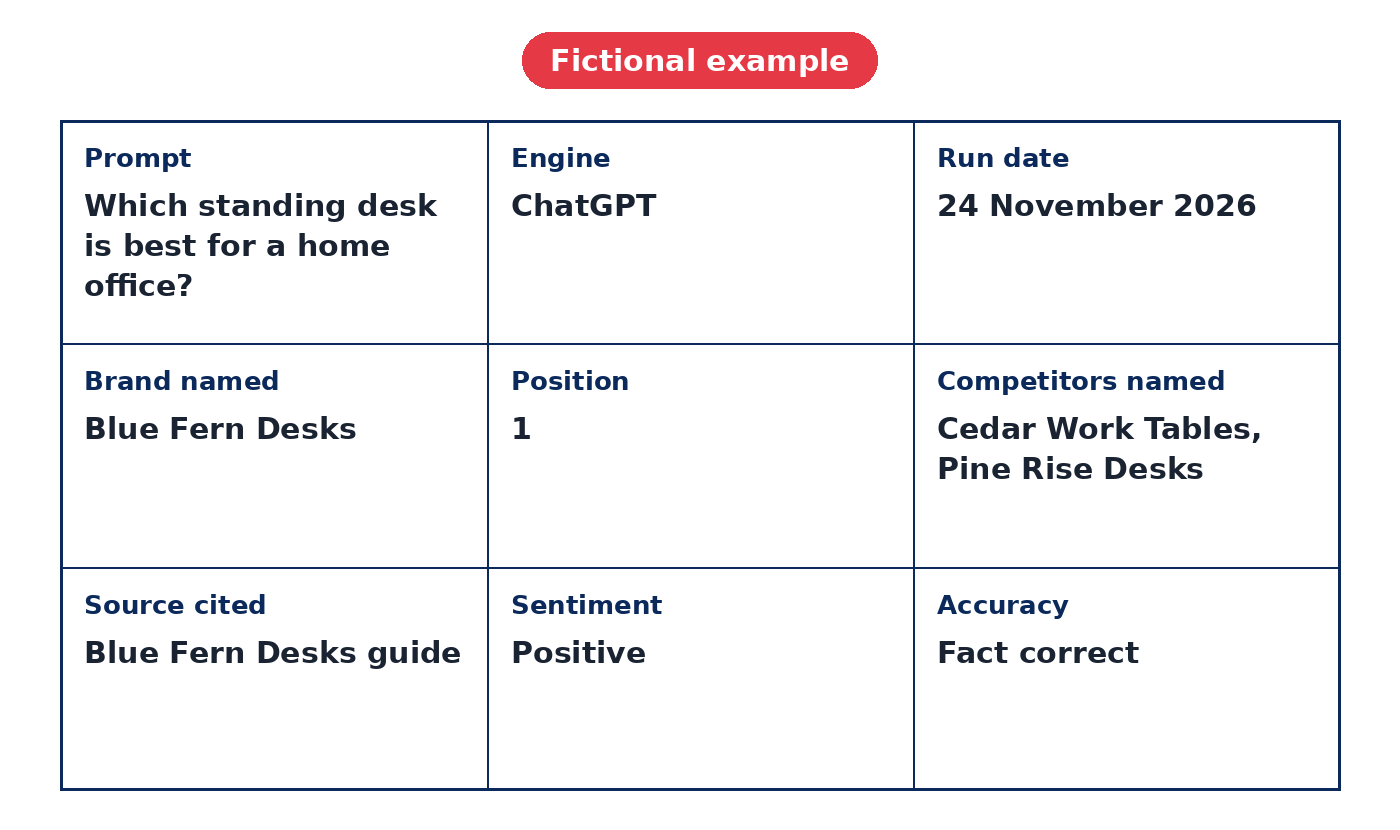
Record position, sentiment, and accuracy, not only presence
A mention first in a shortlist is not the same as a mention last in a long list. A positive mention is not the same as a negative mention, and a mention with a wrong fact is not a win.
Tie visibility to outcomes, and report the gap honestly
Mention share and citation share are leading signals. Sessions, leads, and conversions must be measured separately, and a mention is not proof of a click or a sale. A rise in mentions with no rise in sessions is a signal to check the landing page and the offer.
| Prompt | Engine and run date | Brand named, position, competitors named | Source cited, sentiment, accuracy |
|---|---|---|---|
| Your buyer prompt | Engine name and run date | Yes or no, position, and competitors named | Source page, sentiment, and accuracy note |
Mistakes and limits
Mistake 1, chasing mention volume
Google warns that manufactured mentions offer little help, because its systems favor high-quality content and block spam. That warning is in a guide last updated 10 July 2026 for Google Search only.
Mistake 2, stopping links to fund mentions
Cutting all link work removes discovery, ranking, retrieval, and the outreach that creates mentions. It also removes the authority gate idea, which is a reading of the studies, not a verified finding. Reweight the work instead, and keep quality placements with real traffic.
Mistake 3, counting every mention as a win
Fix the facts on the reader’s own pages first. Then contact the source page author with the correct facts and a source they can check. Record the correction in the measurement template.
A mention that gives the fictional brand Blue Fern Desks a wrong fact harms the brand until it is fixed. Do not demand removal of an honest negative review.
Mistake 4, trusting one run, one engine, or one tool score
Answers vary by run, engine, prompt wording, and region, so one run proves nothing. One tool score blends engines, prompts, and methods the reader cannot see, so treat any single score as directional, not precise.
Mistake 5, expecting mentions to fix a weak offer or weak pages
A mention puts the brand on a shortlist, and the landing page, the offer, and the follow-up decide what happens next. If cited pages send visitors to a thin page, the mention work is wasted.
Limits that apply even when the work is done well
In the Ahrefs samples, brands in the lower half for web mentions averaged 0 to 3 AI Overview mentions. That describes those samples only, and no study in this article tracked a new brand from zero mentions to visibility. Muck Rack notes citation behavior may shift as models are updated or retrained, so recheck the method after each release.
Own-funded sites taught the same lesson. Test with your own capital first, then apply what works. No promise, timeline, or number of mentions guarantees visibility, even when the work is done well.
| Mistake | Why it hurts | Do this instead |
|---|---|---|
| Chasing mention volume | Seeking inauthentic mentions helps little | Judge by venue, fit, and discussion |
| Stopping all link work | Removes discovery, ranking, and retrieval | Reweight, keep quality placements |
| Counting every mention as a win | Wrong facts mislead | Check facts, sentiment, and category |
| Trusting one run | Answers vary by run and engine | Report trends, split by engine |
| Expecting mentions to fix weak pages | Shortlist visits leave thin pages | Fix the landing page first |
FAQ
Are brand mentions more important than backlinks for AI search?
In the Ahrefs evidence on “brand mentions ai search”, brand mentions track AI Overview visibility more closely than backlink counts. The figures are 0.664 compared with 0.218, in a study of 75,000 brands published 26 May 2025. The finding is correlation, not causation, and, as an interpretation, backlinks may help indirectly through Search ranking and cited pages.
Do unlinked brand mentions help AI visibility?
Ahrefs counted mentions linked or unlinked in its May 2025 study of 75,000 brands. Mentions tracked visibility more closely than backlink counts in that study. Ask for a link as well, since it may help indirectly through Search ranking, as an interpretation, not a measured finding.
How do I earn brand mentions that AI answers actually use?
Make your own pages quotable, find the pages AI cites for buyer prompts, and ask for inclusion with a short accurate blurb. Keep review profiles current and consistent, and measure mentions and citations separately over repeated runs. The section on how to earn accurate mentions gives the full sequence in order.
Want help applying this to your site? Contact Imran Ali to book a free 30-minute meeting.